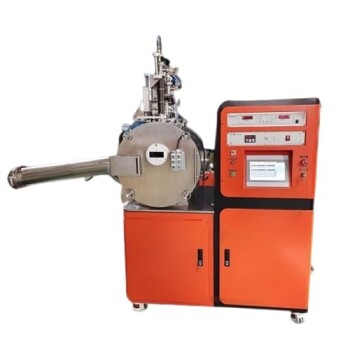
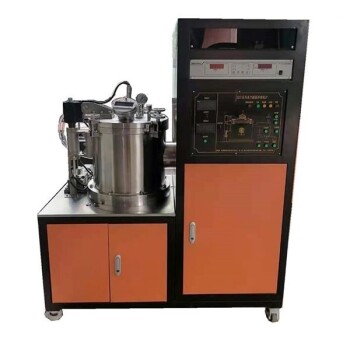
Vacuum induction melting (VIM) facilitates the production of high-entropy alloys (HEAs) by creating a controlled environment that solves the two biggest challenges in multi-component alloying: chemical oxidation and elemental segregation. By melting in a vacuum or inert gas, it prevents the loss of reactive elements like aluminum and titanium, while the inherent electromagnetic stirring ensures the distinct elements mix thoroughly into a uniform solid solution.
Core Takeaway The success of a high-entropy alloy depends on maintaining precise stoichiometric ratios across multiple elements. VIM achieves this by shielding reactive metals from oxygen and using magnetic fields to actively stir the melt, ensuring the final material yields the predicted single-phase or multi-phase microstructure without impurities.
The Critical Role of Atmosphere Control
High-entropy alloys often rely on a precise "cocktail" of elements. If the composition shifts even slightly due to oxidation, the desired entropy-stabilized phase may fail to form.
Preventing Oxidative Loss
Many HEAs incorporate active metals such as aluminum (Al) and titanium (Ti) to reduce density or improve oxidation resistance.
In standard atmospheric melting, these elements react rapidly with oxygen, turning into slag (oxides) rather than dissolving into the alloy. VIM operates under high vacuum or inert gas, effectively eliminating oxygen from the chamber. This ensures that virtually 100% of the active metals added to the crucible remain in the final alloy.
Removing Harmful Gases and Impurities
Beyond protecting the base elements, the vacuum environment actively cleans the material.
Under vacuum pressure, dissolved interstitial gases—specifically oxygen (O2), nitrogen (N2), and hydrogen (H2)—are drawn out of the molten metal. Furthermore, harmful trace elements with low melting points (such as lead, bismuth, and tin) evaporate from the melt. This purification is essential for stabilizing high-performance properties, such as creep resistance at temperatures exceeding 980 °C.
Achieving Homogeneity via Electromagnetic Stirring
The "entropy" in HEAs comes from the random but uniform distribution of many different atoms. However, melting five or more metals with different densities often leads to segregation (separation).
The Mechanism of Induction Stirring
Unlike arc melting, which relies on thermal convection or mechanical flipping, VIM utilizes an induction coil.
As the alternating current passes through the coil, it generates an electromagnetic field that induces currents within the molten metal. These currents create a vigorous, continuous stirring action throughout the melt.
Ensuring Microstructural Consistency
This stirring is critical for HEAs, which may combine heavy refractory metals with lighter elements.
Without this agitation, heavy elements would sink and light elements would float. The electromagnetic stirring forces them to mix at the atomic level, guaranteeing the formation of the predicted single-phase solid solution or specific multi-phase microstructures required for the application.
Understanding the Trade-offs
While VIM is a powerful tool for HEA production, it requires careful management to avoid specific pitfalls.
Crucible Reactivity
VIM requires the metal to be melted inside a ceramic crucible.
Because HEAs often require high melting temperatures, there is a risk of the molten alloy reacting with the crucible lining (refractory erosion). This can introduce new oxide inclusions into the melt, counteracting the purity benefits of the vacuum.
Evaporation of Volatile Elements
The vacuum environment is excellent for removing impurities, but it does not discriminate.
If the HEA formulation includes beneficial elements with high vapor pressures (like manganese), the vacuum can cause these elements to evaporate preferentially. Operators must precisely control the pressure (often backfilling with inert gas like argon) to balance purification with composition retention.
Making the Right Choice for Your Goal
The decision to use VIM depends on the specific chemical makeup of your high-entropy alloy.
- If your primary focus is Compositional Precision: Use VIM for alloys containing reactive elements (Al, Ti, Cr), as the vacuum prevents their loss to oxidation.
- If your primary focus is Microstructural Uniformity: Use VIM for alloys with significant density differences between elements, as electromagnetic stirring prevents segregation.
- If your primary focus is High-Temperature Performance: Use VIM to eliminate interstitial gases and low-melting impurities that degrade creep, fatigue, and rupture life.
VIM transforms the theoretical promise of high-entropy alloys into practical reality by ensuring the metal you pour is chemically identical to the formula you calculated.
Summary Table:
| Feature | Benefit for HEA Production | Why it Matters |
|---|---|---|
| Vacuum Environment | Prevents Oxidation of Al, Ti, Cr | Maintains precise stoichiometric ratios |
| Degassing Action | Removes O2, N2, H2 & Impurities | Enhances creep and fatigue resistance |
| Induction Stirring | Prevents Elemental Segregation | Ensures uniform solid solution distribution |
| Pressure Control | Manages Volatile Element Loss | Prevents evaporation of elements like Manganese |
Elevate Your Material Research with KINTEK
Are you struggling with oxidation or elemental segregation in your high-entropy alloy development? KINTEK specializes in advanced laboratory equipment, including high-performance vacuum induction melting (VIM) furnaces, rotary furnaces, and induction melting systems designed to handle the most demanding metallurgical requirements.
Our comprehensive range also includes crushing and milling systems, hydraulic presses, and high-temperature reactors, providing a complete ecosystem for battery research and advanced materials science. Let us help you transform theoretical formulas into high-performance realities with precision and consistency.
Ready to optimize your alloying process? Contact our experts today to find the perfect solution for your lab.
References
- Jiaxuan Ma, Sheng Sun. MLMD: a programming-free AI platform to predict and design materials. DOI: 10.1038/s41524-024-01243-4
This article is also based on technical information from Kintek Solution Knowledge Base .
Related Products
- Lab-Scale Vacuum Induction Melting Furnace
- Vacuum Induction Melting Spinning System Arc Melting Furnace
- Vacuum Heat Treat Furnace and Levitation Induction Melting Furnace
- Vacuum Arc Induction Melting Furnace
- Non Consumable Vacuum Arc Induction Melting Furnace
People Also Ask
- How do vacuum induction or arc melting furnaces facilitate the synthesis of U-Al-C MAX phases? Precision Heat & Purity
- What types of metals are typically processed in a vacuum induction melting furnace? High-Purity Alloys for Critical Applications
- Why use VIM for rare earth steel? Essential Precision for Melting Reactive Lanthanum and Cerium
- What is the primary function of a vacuum induction melting furnace in Ni-Mo-Cr-Fe master alloy prep? Ensure High Purity
- What is the function of a vacuum induction melting furnace? Essential Guide for High-Purity FeCrAl Alloy Production