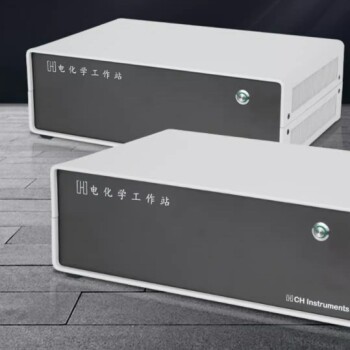
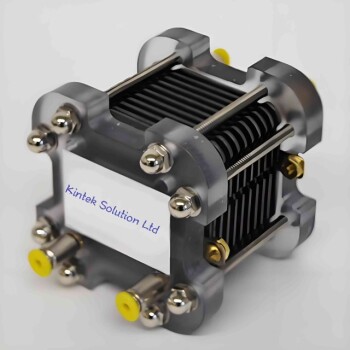
An electrochemical synthesis system facilitates MOF thin film preparation by utilizing an electrolytic cell to drive the nucleation and growth of materials directly onto conductive substrates. Instead of relying on passive chemical precipitation and expensive salts, this method uses a power supply to dissolve a sacrificial metal anode, releasing metal ions into the solution to react with organic linkers in a controlled manner.
By shifting from chemical mixing to electrochemical control, this system allows for real-time adjustments to film thickness and morphology. The result is the production of high-quality, crack-free thin films that are functionally superior for applications like electrochemical sensors.
The Mechanics of Electrochemical Growth
The Role of the Sacrificial Anode
In traditional synthesis, you often rely on expensive metal salt precursors. An electrochemical system replaces these with a sacrificial metal anode.
When a voltage is applied, the anode oxidizes, continuously releasing metal ions into the electrolyte. This not only lowers material costs but also allows you to regulate the concentration of metal ions by simply adjusting the current or voltage.
Direct Nucleation on Substrates
The electrolytic cell enables the MOF to nucleate and grow directly onto the conductive substrate (the working electrode).
This is distinct from methods where crystals form in the bulk solution and must be adhered later. Direct growth ensures better adhesion and electrical contact between the MOF film and the substrate, which is critical for sensor performance.
The Function of the Electrolytic Environment
Ensuring Reaction Stability
The electrolytic cell serves as the stable vessel for this three-electrode environment.
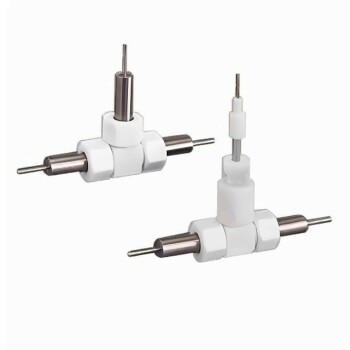
To ensure data accuracy and repeatability, the cell must support high-purity consumables, such as platinum counter electrodes and reference electrodes. This precise configuration is necessary to maintain the specific potential required for uniform film growth.
Managing Byproducts and Interference
For complex reactions, or those involving gas evolution (such as hydrogen or oxygen), standard single-chamber cells may be insufficient.
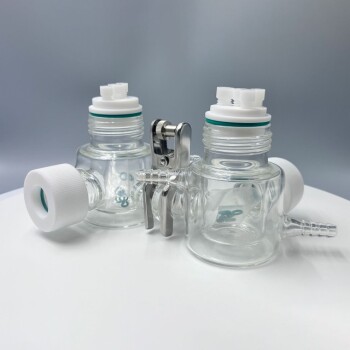
In these cases, specialized designs like the H-type electrolytic cell are employed. These cells physically separate the cathode and anode chambers to prevent product cross-interference, ensuring that the local environment at the substrate remains pure for MOF formation.
Advantages in Control and Quality
Real-Time Monitoring and Tuning
The primary advantage of this system is the ability to monitor the synthesis as it happens.
Because the growth is driven by electricity, you can control the coating thickness, porosity, and morphology in real time. This allows you to tailor the film's properties to the specific requirements of the target application.
Structural Integrity
Electrochemical synthesis addresses a common failure point in thin films: cracking.
By controlling the rate of growth, this method produces crack-free functionalized thin films. This structural continuity is essential for the reliability and longevity of electrochemical sensors.
Understanding the Trade-offs
Substrate Limitations
This method relies heavily on the substrate being conductive.
If your application requires MOF growth on a non-conductive material (like certain plastics or ceramics), you cannot use direct electrochemical synthesis without pre-coating the substrate with a conductive layer.
Cell Visibility vs. Chemical Resistance
Selecting the right cell material involves a balance.
High-transparency glass is preferred for observing the reaction and checking for electrode alignment. However, if your synthesis requires highly aggressive electrolytes (such as strong fluorides), you may need to sacrifice visibility for corrosion-resistant plastics.
Making the Right Choice for Your Project
The electrochemical route offers precision, but it requires specific hardware and conditions. Use the following guide to determine if this approach aligns with your goals:
- If your primary focus is High-Performance Sensors: Prioritize this method for its ability to create crack-free, adherent films with tunable porosity.
- If your primary focus is Cost Reduction: Leverage the sacrificial anode technique to eliminate the need for expensive precursor metal salts.
- If your primary focus is Reaction Purity: Implement an H-type electrolytic cell to physically separate reaction chambers and prevent cross-contamination from gas evolution.
By mastering the electrolytic environment, you turn the synthesis process from a variable chemical reaction into a precise engineering tool.
Summary Table:
| Feature | Electrochemical Synthesis Advantage |
|---|---|
| Metal Source | Sacrificial metal anode (replaces expensive metal salts) |
| Growth Method | Direct nucleation on conductive substrates for superior adhesion |
| Thickness Control | Real-time tuning via voltage and current adjustments |
| Film Quality | Produces uniform, crack-free functionalized coatings |
| Purity Management | H-type cells prevent cross-interference and gas byproduct contamination |
Elevate Your Material Research with KINTEK Precision
Unlock the full potential of your MOF synthesis and electrochemical research with high-performance laboratory solutions from KINTEK. Whether you are developing next-generation sensors or advanced energy storage, our specialized electrolytic cells, high-purity electrodes (platinum, reference), and H-type cell configurations provide the stability and control your experiments demand.
Beyond electrochemistry, KINTEK offers a comprehensive range of high-temperature furnaces (CVD, vacuum, muffle), high-pressure reactors, and homogenizers to support every stage of material engineering. Partner with us for reliable consumables and cutting-edge equipment tailored for researchers and industrial labs.
Ready to optimize your synthesis process? Contact KINTEK experts today and let us deliver the precision tools your innovation deserves!
References
- Ricky Lalawmpuia, Diwakar Tiwari. Metal organic framework (MOF): Synthesis and fabrication for the application of electrochemical sensing. DOI: 10.4491/eer.2023.636
This article is also based on technical information from Kintek Solution Knowledge Base .
Related Products
- Lab Electrochemical Workstation Potentiostat for Laboratory Use
- FS Electrochemical Hydrogen Fuel Cells for Diverse Applications
- Multifunctional Electrolytic Electrochemical Cell Water Bath Single Layer Double Layer
- Electrolytic Electrochemical Cell with Five-Port
- Customizable PEM Electrolysis Cells for Diverse Research Applications
People Also Ask
- How does an electrochemical workstation assist in assessing corrosion resistance? Quantify Laser-Remelted Steel Performance
- How does an electrochemical testing system evaluate mesoporous oxide electrodes? Precision Analysis for Battery Research
- What are the primary functions of an electrochemical workstation (Potentiostat)? Expert Titanium Alloy Corrosion Analysis
- What is the primary function of a high-precision electrochemical workstation? Optimize Your Reactor Performance
- What role do electrochemical workstations play in researching the corrosion resistance of carbon coatings? Expert Guide