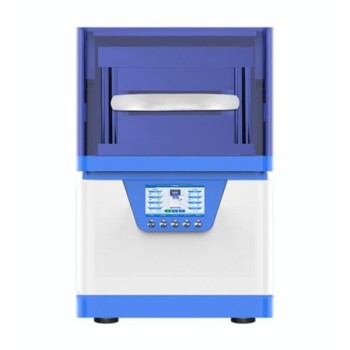
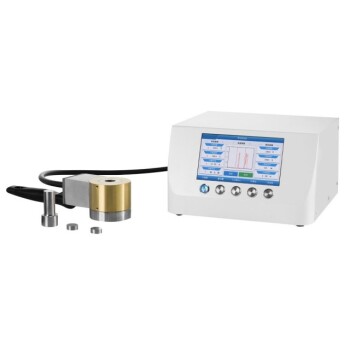
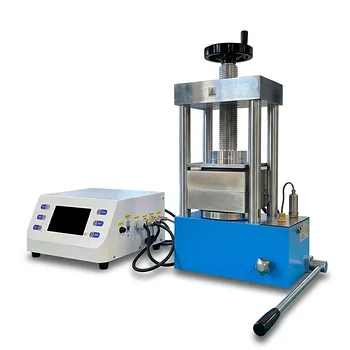
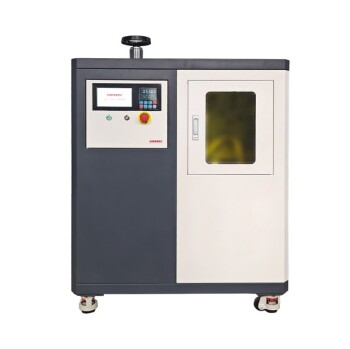
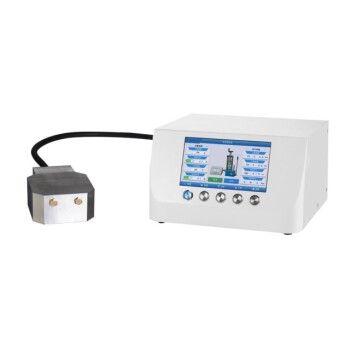
An experimental hot press facilitates TlBr fabrication by applying a highly specific combination of thermal and mechanical force to purified raw materials. Specifically, the device maintains a temperature range between 455°C and 465°C while exerting a continuous pressure of approximately 30 kN, transforming the material into a fully densified, high-performance crystal.
The hot press utilizes the synergistic effect of heat and pressure to eliminate microscopic defects and ensure uniform crystal orientation. This process is essential for converting purified Thallium Bromide into detectors with the high energy resolution and geometric accuracy required for radiation sensing.
The Mechanics of Densification
High-Precision Environmental Control
The core function of the experimental hot press is the simultaneous application of extreme pressure and specific heat.
By maintaining the temperature strictly between 455°C and 465°C, the equipment ensures the material remains in an optimal state for molding without degrading.
Simultaneously, a constant pressure of roughly 30 kN is applied, which is critical for achieving the necessary structural integrity of the crystal.
Achieving Full Densification
The primary goal of this technique is full densification of the raw material within a mold.
Unlike loose powder or sintered materials, the hot-pressed TlBr achieves a solid, high-density bulk state.
This density is a fundamental requirement for the efficient detection of photons in X-ray and gamma-ray applications.
Enhancing Crystal Quality and Performance
Elimination of Internal Defects
The combination of heat and pressure does more than just shape the material; it actively heals internal flaws.
The process helps eliminate internal microscopic defects that typically plague crystal growth.
By reducing these voids and imperfections, the hot press ensures a continuous, high-quality medium for charge transport.
Controlling Orientation and Stress
Hot pressing offers superior control over crystal orientation compared to traditional crystal growth methods.
The technique significantly reduces thermal stress during fabrication, resulting in a more uniform internal strain distribution.
This uniformity is directly responsible for improving the energy resolution and detection efficiency of the final semiconductor device.
Geometric Precision and Consistency
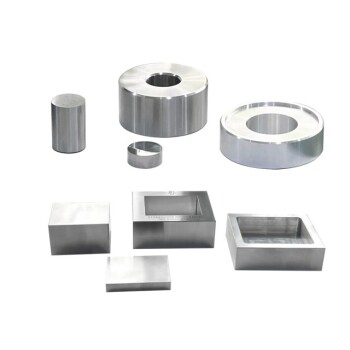
The use of precision molds allows for quasi-in-situ molding, which minimizes damage associated with post-processing cutting or shaping.
This ensures high geometric accuracy for specific sample sizes, such as 2 mm x 2 mm x 2.5 mm specimens.
Consequently, the process guarantees consistency in photoelectric performance across different batches of detectors.
Understanding the Process Requirements
The Purification Prerequisite
It is critical to note that the hot press acts on materials that have already been purified.
Deep purification is typically achieved beforehand using a multi-stage zone refining furnace, which removes impurities via heating and cooling cycles.
The hot press cannot fix chemical impurity issues; it can only optimize the physical structure of chemically pure material.
Quasi-In-Situ Advantages
A key advantage of this specific hot pressing setup is the reduction of processing damage.
By molding the crystal into its near-final shape (quasi-in-situ), manufacturers avoid the mechanical stress introduced by sawing or heavy grinding.
This preservation of integrity is vital for maintaining the sensitive electronic properties of TlBr.
Making the Right Choice for Your Goal
When evaluating the role of a hot press in your fabrication line, consider your specific performance targets:
- If your primary focus is Energy Resolution: Rely on the hot press to minimize thermal stress and optimize crystal orientation, as these factors directly dictate the spectral quality of the detector.
- If your primary focus is Production Consistency: Leverage the high-precision pressure control (30 kN) and mold accuracy to ensure every sample meets identical geometric and photoelectric standards.
- If your primary focus is Material Density: Ensure your temperature parameters remain strictly within the 455°C–465°C window to achieve full compaction without material degradation.
By synergizing high pressure with precise thermal control, the hot press transforms raw TlBr into a robust, high-fidelity semiconductor material.
Summary Table:
| Parameter | Specification/Requirement | Impact on TlBr Fabrication |
|---|---|---|
| Temperature Range | 455°C - 465°C | Ensures optimal molding state without material degradation. |
| Applied Pressure | Approx. 30 kN | Achieves full densification and structural integrity. |
| Material State | Pre-purified bulk/powder | Foundation for high energy resolution sensing. |
| Key Outcome | Quasi-in-situ molding | Minimizes post-processing damage and thermal stress. |
| Sample Accuracy | High Geometric Precision | Ensures consistent photoelectric performance across batches. |
Elevate Your Semiconductor Research with KINTEK Precision
Unlock the full potential of your material science projects with KINTEK’s advanced laboratory solutions. Whether you are fabricating high-performance Thallium Bromide (TlBr) detectors or researching next-generation electronics, our high-precision hydraulic hot presses, vacuum furnaces, and crushing and milling systems provide the exact thermal and mechanical control your materials demand.
From high-temperature reactors to specialized PTFE and ceramic consumables, KINTEK empowers researchers and manufacturers to achieve superior crystal orientation and full material densification. Contact us today to discuss your specific lab equipment needs and see how our comprehensive portfolio—including centrifuges, ULT freezers, and dental furnaces—can streamline your path to discovery.
References
- Aleksandra Paveleva, D. N. Trunov. Research station for tomographic and radiographic studies of large objects and the possibilities of its application. DOI: 10.21175/rad.abstr.book.2023.27.3
This article is also based on technical information from Kintek Solution Knowledge Base .
Related Products
- 30T 40T Split Automatic Heated Hydraulic Press Machine with Heated Plates for Laboratory Hot Press
- Automatic Heated Hydraulic Press Machine with Heated Plates for Laboratory Hot Press
- Heated Hydraulic Press Machine with Heated Plates Split Manual Laboratory Hot Press
- 24T 30T 60T Heated Hydraulic Press Machine with Heated Plates for Laboratory Hot Press
- Manual Heated Hydraulic Press Machine with Heated Plates for Laboratory Hot Press
People Also Ask
- What are the advantages of using a laboratory hydraulic press for hot pressing? Achieve Peak Nano-Composite Density
- What are the core advantages of using a laboratory hot press to produce Bi2Se3? Achieve 93% Density & High Conductivity
- Why is a laboratory hydraulic hot press essential for high-density, additive-free Silicon Carbide? Unlock Pure SiC.
- How does a laboratory hydraulic hot press ensure the quality of PHBV/natural fiber composites? Expert Guide
- What is the function of a laboratory hydraulic hot press in the assembly of solid-state photoelectrochemical cells?