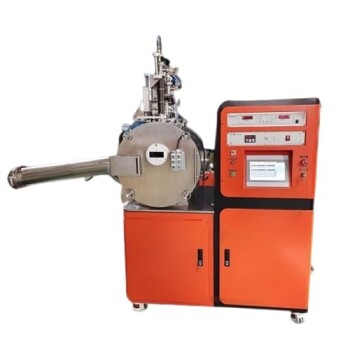
Ultrafast High-temperature Sintering (UHS) achieves its extreme speed by utilizing high-power radiation heating within a controlled inert atmosphere. Unlike traditional methods that rely on slow convective heat transfer, UHS employs radiative heat conduction to generate massive heating rates ranging from 10³ to 10⁴ °C/s.
The core innovation of UHS is the shift from convection or contact-based heating to high-power radiation. This allows ceramic materials to reach sintering temperatures exceeding 3000 °C in as little as 10 to 30 seconds, significantly compressing production cycles while maintaining high material density.
The Physics of Radiative Heating
Bypassing Thermal Lag
Standard furnaces heat the air or elements around a sample, which then heats the sample. UHS utilizes high-power radiation to transfer energy directly to the ceramic material.
Instantaneous Energy Transfer
This radiative heat conduction mechanism allows for immediate energy absorption. Consequently, the system avoids the thermal lag associated with traditional heating elements.
Extreme Temperature Capabilities
The system is capable of reaching temperatures exceeding 3000 °C. This is achieved not over hours, but within a window of 10 to 30 seconds.
Environmental Control
To prevent oxidation or degradation at these extreme temperatures, the process occurs in an inert atmosphere. This protects the material chemistry while permitting rapid thermal ramp-ups.
Impact on Material Quality
Balancing Time and Density
The primary goal of any sintering process is to eliminate residual pores and achieve high density. UHS accomplishes this through its rapid heat treatment cycle.
Suppressing Grain Coarsening
Prolonged exposure to high heat typically causes grains to grow, which weakens the material. By reducing the heating time to seconds, UHS densifies the material before grain coarsening can occur.
Comparison to Joule Heating Methods
It is important to distinguish UHS from other rapid techniques like Spark Plasma Sintering (SPS) or Pulse Current Assisted Sintering (PCAS).
Radiation vs. Current
While PCAS and SPS rely on DC current pulses and Joule heating passing through the tool or powder to generate heat, UHS relies strictly on radiation. While SPS reduces cycles to minutes, UHS reduces them to seconds.
Understanding the Trade-offs
Process Stability
Achieving heating rates of 10⁴ °C/s requires precise control. If the radiative delivery is not uniform, it could lead to thermal shock in materials with low thermal conductivity.
Atmospheric Requirements
The reliance on an inert atmosphere adds complexity to the system design. It requires robust sealing and gas management systems to maintain the purity of the environment at 3000 °C.
Making the Right Choice for Your Goal
When selecting a sintering technology, align the method with your specific material constraints and throughput requirements.
- If your primary focus is maximum throughput: UHS is the superior choice, capable of completing sintering cycles in 10 to 30 seconds.
- If your primary focus is preventing grain growth: UHS offers distinct advantages by completing densification faster than the grains can coarsen.
- If your primary focus is mechanical pressure assistance: Consider Pulse Current Assisted Sintering (PCAS), which combines rapid heating with axial pressure to aid densification.
By leveraging high-power radiation, UHS transforms sintering from a bottleneck into a near-instantaneous step in ceramic manufacturing.
Summary Table:
| Feature | Ultrafast High-temperature Sintering (UHS) | Traditional Sintering Methods |
|---|---|---|
| Heating Mechanism | High-power Radiation | Convection / Contact |
| Heating Rate | 10³ to 10⁴ °C/s | 1 to 50 °C/min |
| Sintering Time | 10 to 30 Seconds | Hours to Days |
| Max Temperature | > 3000 °C | Varies (Typically lower) |
| Material Quality | Suppresses Grain Coarsening | Risk of Grain Growth |
| Atmosphere | Controlled Inert Atmosphere | Air or Vacuum |
Revolutionize Your Material Research with KINTEK
Unlock the power of instantaneous densification and superior grain control. KINTEK specializes in advanced laboratory solutions, offering a comprehensive range of high-temperature furnaces (muffle, tube, vacuum, and atmosphere) and precision crushing and milling systems to prepare your ceramic precursors.
Whether you need high-temperature high-pressure reactors, isostatic hydraulic presses for pre-forming, or specialized ceramics and crucibles that withstand extreme thermal shocks, our expert team provides the tools necessary to compress your production cycles from hours to seconds.
Ready to accelerate your throughput? Contact KINTEK today to find the perfect sintering and material processing solution for your lab!
References
- Xinghong Zhang, PingAn Hu. Research Progress on Ultra-high Temperature Ceramic Composites. DOI: 10.15541/jim20230609
This article is also based on technical information from Kintek Solution Knowledge Base .
Related Products
- Ultra-High Temperature Graphite Vacuum Graphitization Furnace
- Vacuum Heat Treat and Pressure Sintering Furnace for High Temperature Applications
- Spark Plasma Sintering Furnace SPS Furnace
- High Temperature Muffle Oven Furnace for Laboratory Debinding and Pre Sintering
- Vacuum Heat Treat and Sintering Furnace with 9MPa Air Pressure
People Also Ask
- What is the disadvantage of graphite furnace? Managing Reactivity and Contamination Risks
- Is a graphite melting point high or low? Discover Its Extreme Thermal Resilience
- What are the advantages and disadvantages of graphite furnace? Unlock Extreme Heat Performance
- What is the temperature range of a graphite furnace? Unlock up to 3000°C for advanced materials processing.
- What is the temperature of a graphite furnace? Achieve Extreme Heat Up to 3000°C