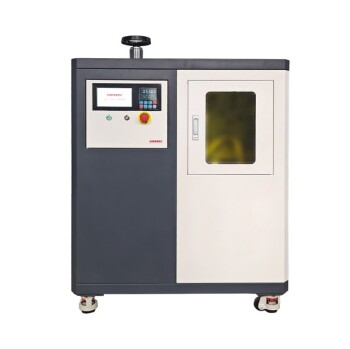
Post-treatment in a Hot Isostatic Press (HIP) furnace elevates the optical quality of fluoride ceramics by eliminating microscopic defects that standard hot pressing cannot remove. By subjecting the material to high-pressure inert gas from every direction, the process compresses residual closed pores, resulting in higher density and significantly improved in-line transmittance.
Core Takeaway While standard hot pressing is effective for initial sintering, it often leaves behind tiny voids that scatter light. HIP post-treatment utilizes isotropic pressure to close these residual pores, pushing the material to near-theoretical density and maximizing optical clarity, especially in the short-wavelength spectrum.
The Mechanics of Optical Improvement
The Limitation of Standard Hot Pressing
Standard hot pressing typically applies mechanical pressure in a single direction (uniaxial).
While this achieves high density, it frequently creates a material structure containing tiny, residual closed pores.
These microscopic voids act as scattering centers for light, degrading the optical performance of the final ceramic.
The Power of Isotropic Pressure
The HIP process differs fundamentally by using an inert gas, such as argon, as the pressure medium.
At high temperatures, this gas applies isotropic pressure—meaning force is exerted equally from all sides—often reaching levels around 100 MPa.
This uniform compression provides a powerful driving force that uniaxial pressing cannot replicate.
Eliminating Light-Scattering Defects
The intense, multi-directional pressure of the HIP furnace effectively collapses and eliminates the residual closed pores left by the initial sintering.
By removing these voids, the material achieves a higher overall density.
The reduction in porosity directly translates to a reduction in light scattering, which significantly boosts in-line transmittance.
Enhancement in the Short-Wavelength Spectrum
The removal of micropores is particularly critical for performance in specific optical ranges.
The reference data indicates that HIP treatment specifically improves performance in the short-wavelength spectrum.
Since shorter wavelengths are more susceptible to scattering by small defects, the densification provided by HIP is essential for high-performance applications in this range.
Understanding the Trade-offs
The Requirement for Closed Porosity
It is critical to note that HIP is a post-treatment process that relies on the state of the material after the initial hot pressing.
The process is only effective on closed pores encapsulated within the ceramic.
If the ceramic contains open porosity (pores connected to the surface), the high-pressure gas will penetrate the material rather than compressing it, rendering the process ineffective.
Making the Right Choice for Your Goal
If your primary focus is Maximum Optical Clarity: Prioritize the HIP post-treatment to eliminate scattering centers and maximize transmission, particularly if your application uses short-wavelength light.
If your primary focus is Basic Sintering Efficiency: Standard hot pressing may suffice if the application tolerates minor residual porosity and does not require near-theoretical density.
If your primary focus is Defect Elimination: Ensure your initial sintering process achieves a state of closed porosity before moving to the HIP stage, or the pressure treatment will fail to densify the material.
By leveraging the isotropic power of HIP, you transform a standard sintered ceramic into a high-performance optical component.
Summary Table:
| Feature | Standard Hot Pressing | HIP Post-Treatment |
|---|---|---|
| Pressure Direction | Uniaxial (Single direction) | Isotropic (All directions via gas) |
| Pressure Medium | Mechanical Die | Inert Gas (e.g., Argon) |
| Porosity Impact | Leaves residual closed pores | Collapses and eliminates closed pores |
| Density Level | High density | Near-theoretical density |
| Optical Result | Moderate transmittance; scattering | Maximum in-line transmittance; low scattering |
| Best For | Initial sintering stages | High-performance short-wavelength optics |
Elevate Your Material Performance with KINTEK Precision
Maximize the optical clarity and density of your advanced ceramics with KINTEK’s industry-leading thermal processing solutions. Whether you require high-performance Hot Isostatic Presses (HIP) to eliminate scattering defects or specialized high-temperature vacuum furnaces for initial sintering, we provide the tools necessary to achieve near-theoretical density.
Our comprehensive laboratory portfolio includes:
- Advanced Furnaces: Muffle, Tube, Rotary, Vacuum, and High-Pressure HIP systems.
- Precision Pressing: Hydraulic pellet presses, hot presses, and isostatic systems.
- Research Essentials: Crushing/milling systems, high-pressure reactors, and high-purity ceramics/crucibles.
Ready to transform your research into high-performance components? Contact our technical experts today to find the perfect equipment for your lab's unique requirements!
Related Products
- 600T Vacuum Induction Hot Press Furnace for Heat Treat and Sintering
- Warm Isostatic Press for Solid State Battery Research
- Laboratory High Pressure Vacuum Tube Furnace
- Vacuum Hot Press Furnace Heated Vacuum Press Machine Tube Furnace
- Vacuum Hot Press Furnace Machine Heated Vacuum Press
People Also Ask
- What role does an induction vacuum hot pressing furnace play in sintering? Achieve 98% Density in Carbide Blocks
- What advantages does a vacuum hot press furnace provide for LSLBO ceramic electrolytes? Achieve 94% Relative Density
- What role does a Vacuum Hot Press (VHP) furnace play in the densification of austenitic stainless steel 316 composites?
- What are the advantages of a vacuum hot press furnace for W-50%Cu? Achieve 99.6% Density at Lower Temperatures
- What role does mechanical pressure play during the vacuum diffusion bonding of tungsten and copper? Keys to Solid Bonding