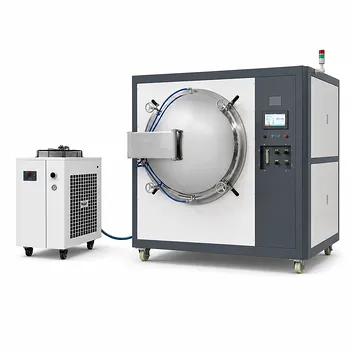
A high vacuum system is essential for sintering Ti-22Al-25Nb alloys primarily to create an environment with extremely low oxygen partial pressure. Because Titanium (Ti), Aluminum (Al), and Niobium (Nb) are highly chemically active at elevated temperatures, they will instantly react with oxygen or interstitial elements if exposed to air, leading to material degradation.
Core Takeaway The vacuum chamber acts as a critical isolation barrier during the high-temperature densification process. It prevents the formation of brittle oxide layers and element segregation, ensuring that the final alloy retains the purity and mechanical ductility necessary for high-performance applications.
The Chemical Vulnerability of Ti-22Al-25Nb
High Reactivity at Elevated Temperatures
The elemental components of this alloy—specifically Titanium and Aluminum—possess high melting points and strong chemical affinity for oxygen.
When heated to the temperatures required for sintering, these elements become highly aggressive in capturing oxygen atoms.
The Dangers of Interstitial Contamination
Without a vacuum, oxygen and other interstitial elements infiltrate the powder matrix.
This reaction leads to element segregation, where the alloy's composition becomes inconsistent across the microstructure.
More critically, it causes material embrittlement. The formation of oxides creates weak points within the material, drastically reducing its ductility and making it prone to fracture.
Mechanics of Vacuum Densification
Eliminating Oxide Scales
A high vacuum (often around $10^{-3}$ Pa) evacuates residual gases that would otherwise form oxide scales on the surface of the powder particles.
By preventing these scales, the system ensures that "clean" metal surfaces come into contact with one another.
Facilitating Plastic Flow
For successful hot pressing, the raw powders must undergo plastic flow to fill voids and bond together.
The vacuum environment facilitates this by removing trapped gases that would otherwise create pores or resist compression.
This allows the simultaneous application of heat and uniaxial pressure to achieve high density and a uniform microstructure.
Understanding the Trade-offs
Equipment Complexity and Cost
While a vacuum is non-negotiable for quality, it introduces significant complexity to the manufacturing process.
Vacuum hot pressing equipment is considerably more expensive to operate and maintain than non-vacuum counterparts due to the need for pumps, seals, and leak detection systems.
Sensitivity to Leak Rates
The process is intolerant of failure; even a minor vacuum leak during the heating cycle can ruin an entire batch.
You must maintain a rigorous maintenance schedule to ensure the vacuum integrity remains at the specific levels required (often better than $1.33 \times 10^{-1}$ Pa) to prevent micro-oxidation.
Making the Right Choice for Your Goal
To maximize the performance of your Ti-22Al-25Nb alloy, prioritize your processing parameters based on your specific engineering targets:
- If your primary focus is Mechanical Ductility: Ensure your vacuum system can maintain a deep vacuum throughout the entire heating cycle to absolutely minimize interstitial oxygen embrittlement.
- If your primary focus is Material Density: Prioritize the degassing phase within the vacuum cycle to fully evacuate trapped gases before applying peak pressure, preventing internal voids.
The vacuum system is not just an accessory; it is the primary safeguard ensuring your raw powder transforms into a high-performance structural component.
Summary Table:
| Feature | Impact on Ti-22Al-25Nb Alloy |
|---|---|
| Oxygen Partial Pressure | Extremely low to prevent brittle oxide layer formation |
| Chemical Stability | Protects active Ti, Al, and Nb from atmospheric reaction |
| Microstructure | Ensures uniform composition and prevents element segregation |
| Mechanical Properties | Maintains high ductility and prevents fracture-prone embrittlement |
| Densification | Facilitates plastic flow by removing trapped gases and pores |
Elevate Your Advanced Material Research with KINTEK
High-performance alloys like Ti-22Al-25Nb demand uncompromising processing environments. KINTEK specializes in precision laboratory equipment designed to meet the most rigorous vacuum and thermal requirements. Whether you are performing hot pressing sintering, high-pressure research, or material densification, our comprehensive range of vacuum hot presses, muffle furnaces, and high-temperature high-pressure reactors provides the reliability your data depends on.
From crushing and milling systems for powder preparation to isostatic presses and ULT freezers for sample integrity, KINTEK offers a complete ecosystem of tools and consumables (including PTFE and ceramics) tailored for battery research, metallurgy, and advanced ceramics.
Ready to achieve superior material purity and density? Contact our experts today to find the perfect vacuum system for your high-temperature applications!
Related Products
- Vacuum Heat Treat and Sintering Furnace with 9MPa Air Pressure
- 600T Vacuum Induction Hot Press Furnace for Heat Treat and Sintering
- Vacuum Heat Treat and Pressure Sintering Furnace for High Temperature Applications
- 2200 ℃ Tungsten Vacuum Heat Treat and Sintering Furnace
- 2200 ℃ Graphite Vacuum Heat Treat Furnace
People Also Ask
- What is the process of pressure sintering? Achieve Superior Density and Strength for High-Performance Parts
- What is the effect of pressure during sintering? Achieve Higher Density and Finer Microstructures Faster
- Why must green bodies produced via binder jetting undergo treatment in a vacuum sintering furnace?
- What is a vacuum sintering furnace? Unlock Purity and Performance in Advanced Materials
- How does the vacuum environment impact sintering of diamond-copper composites? Protect Against Thermal Damage