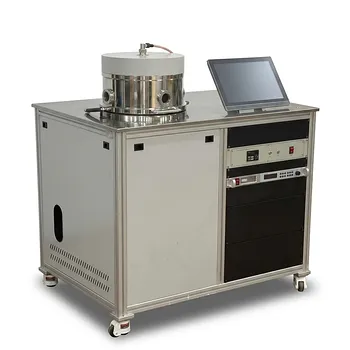
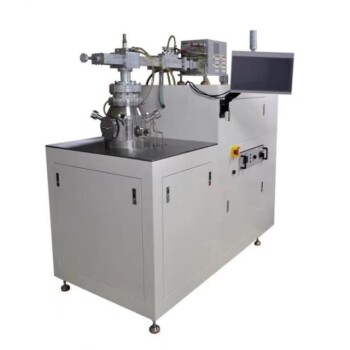
Radio Frequency Enhanced Plasma Chemical Vapour Deposition (RF-PECVD) functions by utilizing radio frequency energy to ignite a glow discharge plasma within a low-pressure vacuum chamber. Instead of relying solely on heat, this process uses the plasma's high-energy electrons to decompose precursor gases—such as silane, methane, or oxygen—into reactive ions and radicals. These activated species then bombard the target substrate, chemically reacting to form solid thin films like oxides, nitrides, or polycrystalline structures.
By decoupling chemical reactivity from thermal energy, RF-PECVD allows for the deposition of high-quality films on temperature-sensitive substrates, facilitating reactions that would otherwise require damaging levels of heat.
The Mechanics of Deposition
Creating the Plasma Environment
The process begins by introducing specific precursor gases into a reaction chamber maintained at low pressure.
Radio frequency (RF) energy is applied to the gas mixture, creating an electromagnetic field that strips electrons from the gas molecules.
This ionization creates a "glow discharge" plasma, a dynamic mixture of free electrons, ions, and excited neutral atoms.
The Kinetic Reaction
In traditional Chemical Vapor Deposition (CVD), high temperatures are required to break chemical bonds.
RF-PECVD bypasses this by using the kinetic energy of free electrons in the plasma to collide with and decompose the precursor gas molecules.
These collisions create highly reactive radicals that are capable of bonding to the substrate surface at significantly lower temperatures.
Film Formation
Once the gas is decomposed, the resulting ions and radicals diffuse toward the substrate.
They adsorb onto the surface, reacting chemically to build up a solid layer, such as vertical graphene or silicon dioxide.
Because the energy is supplied by the plasma, the substrate itself remains relatively cool, preventing thermal damage to the underlying material.
Coupling Methods: CCP vs. ICP
Capacitive Coupling (CCP)
This method generates the RF plasma using parallel plate electrodes.
According to standard industry observations, CCP typically results in a lower ionization rate.
While effective for many standard applications, it generally offers lower deposition efficiency compared to inductive methods.
Inductive Coupling (ICP)
This method utilizes coils to generate the electromagnetic field that drives the plasma.
ICP is capable of creating a much higher plasma density than capacitive coupling.
This high-density environment leads to greater efficiency and is often preferred when rapid or dense film growth is required.
Understanding the Trade-offs
Impact of Ion Bombardment
While the bombardment of high-energy ions ensures a dense, well-adhered film, it introduces a risk of surface damage.
If the plasma energy is too high, the impact can etch or degrade the very film you are trying to deposit.
Equipment Complexity
RF-PECVD systems are significantly more complex than thermal CVD systems due to the need for RF matching networks and vacuum controls.
The choice between CCP and ICP also dictates the cost and maintenance requirements of the system, with ICP generally representing a higher tier of complexity.
Making the Right Choice for Your Goal
To maximize the efficacy of your deposition process, align the coupling method with your specific substrate limitations and film requirements.
- If your primary focus is processing temperature-sensitive materials: Rely on RF-PECVD to deposit films on substrates like plastics or semiconductors that cannot withstand standard CVD temperatures.
- If your primary focus is deposition rate and efficiency: Prioritize Inductive Coupling (ICP) over Capacitive Coupling (CCP) to achieve higher plasma density.
- If your primary focus is cost-effective, standard coating: Utilize Capacitive Coupling (CCP), accepting lower ionization rates for a simpler equipment setup.
RF-PECVD remains the definitive solution for integrating advanced thin-film coatings into delicate, high-precision manufacturing environments.
Summary Table:
| Feature | Capacitive Coupling (CCP) | Inductive Coupling (ICP) |
|---|---|---|
| Plasma Source | Parallel plate electrodes | Electromagnetic coils |
| Plasma Density | Lower ionization rate | High-density plasma |
| Deposition Efficiency | Standard efficiency | High efficiency/Rapid growth |
| Complexity | Simpler equipment setup | Higher complexity and cost |
| Best Use Case | Cost-effective standard coating | Advanced high-rate deposition |
Elevate Your Material Research with KINTEK’s Precision RF-PECVD Solutions
Are you working with temperature-sensitive substrates or looking for superior thin-film quality? KINTEK specializes in advanced laboratory equipment, providing high-performance CVD, PECVD, and MPCVD systems designed for the most demanding research applications. Beyond our state-of-the-art furnaces, we offer a comprehensive portfolio including:
- Material Processing: Crushing, milling, and hydraulic presses (pellet, hot, isostatic).
- High-Pressure Solutions: High-temperature high-pressure reactors and autoclaves.
- Electrochemical Tools: Specialized electrolytic cells and electrodes.
- Battery & Thermal Management: Research consumables and cooling solutions like ULT freezers.
Whether you need robust CCP systems for standard coatings or high-density ICP technology for rapid film growth, our experts are here to help you select the perfect configuration. Contact KINTEK today to optimize your deposition process!
Related Products
- RF PECVD System Radio Frequency Plasma-Enhanced Chemical Vapor Deposition RF PECVD
- Inclined Rotary Plasma Enhanced Chemical Vapor Deposition PECVD Equipment Tube Furnace Machine
- Chemical Vapor Deposition CVD Equipment System Chamber Slide PECVD Tube Furnace with Liquid Gasifier PECVD Machine
- Inclined Rotary Plasma Enhanced Chemical Vapor Deposition PECVD Equipment Tube Furnace Machine
- 915MHz MPCVD Diamond Machine Microwave Plasma Chemical Vapor Deposition System Reactor
People Also Ask
- What is plasma enhanced chemical vapour deposition PECVD used for? Enable Low-Temp Thin Films for Electronics & Solar
- What is the role of RF-PECVD in VFG preparation? Mastering Vertical Growth and Surface Functionality
- What is an example of PECVD? RF-PECVD for High-Quality Thin Film Deposition
- What is plasma enhanced chemical Vapour deposition process used for fabrication of? A Guide to Low-Temperature Thin Films
- What is plasma chemical vapor deposition? A Low-Temperature Thin Film Coating Solution