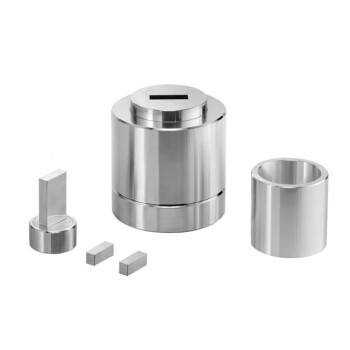
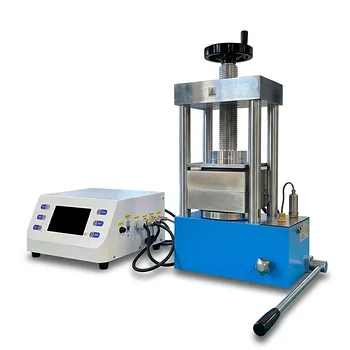
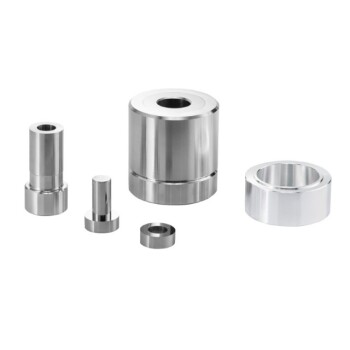
High-pressure application via a laboratory hydraulic press is the critical preparatory step that determines the ultimate electrochemical performance of LLZO ceramic pellets. By applying substantial force (such as 8 tons), the press compacts loose powder into a high-density "green body," significantly reducing inter-particle voids to ensure proper grain fusion during sintering.
Core Takeaway The quality of an LLZO pellet is defined by its ionic conductivity, which is directly dependent on density. The hydraulic press creates the necessary initial density (green body) to eliminate grain boundary impedance and prevent structural failure during high-temperature sintering.
The Mechanism of Densification
Reduction of Inter-Particle Voids
The primary function of the hydraulic press is to mechanically force loose LLZO powder particles together.
By applying high pressure, the press drastically reduces the empty spaces (voids) that naturally exist between powder particles. This creates a tightly packed structure, which is the prerequisite for a high-quality final product.
Formation of the High-Density Green Body
The immediate output of the hydraulic press is known as a green body.
This compacted form must possess high density and specific geometric strength before it ever enters a furnace. If the green body density is too low, the particles will be too far apart to fuse correctly during the heating process.
Impact on Electrochemical Performance
Enabling Effective Grain Fusion
The high density achieved by the press facilitates the sintering process, typically occurring around 1100°C.
Because the particles are already physically touching due to the hydraulic pressure, they fuse together more efficiently when heated. This fusion creates a continuous ceramic network rather than a collection of loosely connected grains.
Eliminating Grain Boundary Impedance
For LLZO pellets, the most critical quality metric is ionic conductivity.
If the pressing stage fails to remove voids, "grain boundary impedance" occurs—essentially, resistance that blocks the flow of ions. High-pressure compaction minimizes this resistance, ensuring the final pellet is highly conductive.
Structural Integrity and Uniformity
Preventing Cracking and Deformation
A laboratory hydraulic press utilizes precision molds to ensure the pressure is applied uniformly.
This uniformity minimizes internal stress and macro defects within the green body. Without this precise control, the pellet is liable to crack, warp, or suffer severe deformation during the thermal expansion and contraction of sintering.
Ensuring Mechanical Consistency
Beyond conductivity, the pellet must be mechanically strong enough to handle experimental testing.
Proper hydraulic pressing increases the green compact density, which directly translates to the final mechanical strength of the sintered ceramic. This ensures the geometric integrity of the pellet remains intact for accurate fracture toughness testing.
Understanding the Trade-offs
The Necessity of Uniform Pressure
While high pressure is required, it must be applied with axial precision.
Non-uniform pressure can create density gradients within the pellet (some parts denser than others). This leads to inconsistent microstructures, which can skew experimental data and cause the pellet to fail under stress.
Pressure vs. Sintering Reliance
It is a common misconception that sintering alone fixes density issues.
Sintering cannot compensate for a poorly pressed green body. If the hydraulic press does not achieve sufficient starting density, even high-temperature treatment will fail to produce a pellet with theoretical density or high conductivity.
Making the Right Choice for Your Goal
To optimize your LLZO fabrication process, align your pressing parameters with your specific performance targets:
- If your primary focus is High Ionic Conductivity: Maximize the pressure (e.g., 8 tons) to ensure the highest possible green density, which directly eliminates grain boundary impedance.
- If your primary focus is Mechanical Structural Integrity: Focus on the precision of the mold and the uniformity of the axial pressure to prevent internal stress and cracking during sintering.
The hydraulic press does not just shape the powder; it establishes the physical connectivity required for the material to function as a solid-state electrolyte.
Summary Table:
| Factor | Impact on LLZO Quality | Benefit to Final Ceramic |
|---|---|---|
| Inter-particle Voids | Significant reduction through high pressure | Eliminates grain boundary impedance |
| Green Body Density | Creates a tightly packed powder structure | Ensures efficient grain fusion at 1100°C |
| Pressure Uniformity | Prevents internal stress and macro defects | Minimizes cracking and warping during sintering |
| Mechanical Force | Compaction typically around 8 tons | Increases structural integrity and fracture toughness |
Elevate Your Solid-State Battery Research with KINTEK
Precision is the foundation of high-performance LLZO electrolytes. KINTEK specializes in advanced laboratory solutions, offering a robust range of manual and automatic hydraulic presses (pellet, hot, and isostatic) designed to achieve the precise green body density your research demands.
Beyond compaction, we provide the full ecosystem for ceramic synthesis, including high-temperature muffle and tube furnaces, precision crushing and milling systems, and high-quality crucibles. Partner with KINTEK to eliminate grain boundary impedance and ensure mechanical consistency in every pellet.
Contact our technical experts today to find the perfect pressing solution for your lab!
Related Products
- Automatic Laboratory Hydraulic Pellet Press Machine for Lab Use
- Laboratory Manual Hydraulic Pellet Press for Lab Use
- Laboratory Manual Hydraulic Pellet Press for Lab Use
- Laboratory Hydraulic Press Lab Pellet Press Machine for Glove Box
- Laboratory Hydraulic Press Split Electric Lab Pellet Press
People Also Ask
- What is the role of a laboratory hydraulic pellet press and stainless steel molds in the fabrication of RuO2/NbC anodes?
- What role does a laboratory pellet press play in the enhancement of biomass energy products? Optimize Fuel Efficiency
- What is the purpose of using a laboratory pellet press when evaluating the electronic conductivity of carbon powders? Guide
- How does a laboratory hydraulic pellet press contribute to SiCw/2024 aluminum composite preforms? Optimize Densification
- What is the significance of applying 200 MPa of pressure with a laboratory hydraulic pellet press for composite ceramics?