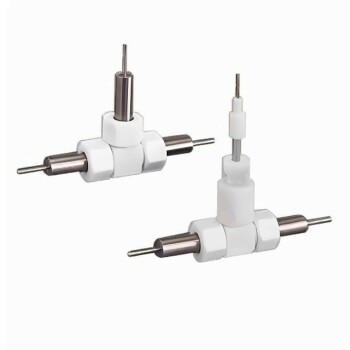
The design of an electrolytic cell serves as the primary control mechanism for the electrochemical synthesis of metal oxide nanotube arrays. Specific configuration details—such as electrode spacing, stirring efficiency, and temperature stability—directly determine how ions migrate and how fast electrochemical reactions occur, ultimately defining the structural integrity of the material.
Core Takeaway While the chemical composition is important, the physical architecture of the electrolytic cell governs the kinetics of the reaction. By strictly controlling the cell's environment and electrical inputs, you can precisely engineer the geometry of nanotubes, including their length, diameter, and wall thickness.
Mechanisms of Influence
The Role of Physical Configuration
The physical layout of the cell is not merely a container; it is an active variable in the synthesis process. Electrode spacing is a critical parameter that dictates the distance ions must travel.
This spacing directly influences ion migration rates between the anode and cathode. If the spacing is unregulated, the migration becomes inconsistent, leading to uneven growth across the array.
Impact of Environmental Controls
Beyond geometry, the dynamic environment within the cell drives the reaction quality. Stirring efficiency ensures that the electrolyte concentration remains uniform at the electrode interface.
Simultaneously, temperature control stability is essential for maintaining consistent reaction kinetics. Fluctuations in temperature can alter reaction speeds unpredictably, resulting in structural defects.
Regulating Nanotube Morphology
Controlling Diameter and Wall Thickness
The primary goal of optimizing cell design is to gain authority over the nanotubes' physical dimensions. For materials like titanium dioxide, the cell design enables precise adjustments to current density and voltage.
By manipulating these electrical variables within a stable cell environment, you can dictate the specific diameter and wall thickness of the nanotubes.
Determining Nanotube Length
The duration and intensity of the electrochemical process, supported by the cell's design, also define the length of the nanotube arrays.
A well-designed cell allows for sustained, stable reaction conditions. This stability is required to grow longer nanotubes without compromising their structural alignment or mechanical strength.
Common Pitfalls to Avoid
Inconsistent Kinetics
A major trade-off in cell design involves the balance between reaction speed and stability. If stirring efficiency is neglected to simplify the setup, ion depletion layers can form.
This leads to erratic electrochemical reaction kinetics. The result is often an array with varying wall thicknesses or incomplete nanotube formation.
The Cost of Instability
Similarly, failing to invest in rigorous temperature control creates a volatile reaction environment.
While a simpler cell is cheaper to build, thermal gradients causes uneven reaction rates. This lack of precision makes it impossible to reliably reproduce specific nanotube geometries.
Making the Right Choice for Your Goal
To optimize your electrochemical synthesis process, you must prioritize specific design parameters based on your desired outcome.
- If your primary focus is Geometric Precision: Prioritize stable voltage and current density controls to strictly regulate diameter and wall thickness.
- If your primary focus is Uniform Growth: Ensure your design features optimized electrode spacing and high-efficiency stirring to maintain consistent ion migration rates.
Mastering the physical design of your electrolytic cell is the first step toward achieving reproducible, high-quality metal oxide nanostructures.
Summary Table:
| Design Parameter | Impact on Synthesis | Outcome for Nanotubes |
|---|---|---|
| Electrode Spacing | Controls ion migration rates | Uniformity of the array growth |
| Stirring Efficiency | Maintains electrolyte concentration | Prevents ion depletion & erratic kinetics |
| Temperature Stability | Regulates reaction kinetics | Avoids structural defects & thermal gradients |
| Electrical Control | Directs voltage/current density | Defines diameter, wall thickness, and length |
Elevate Your Material Science with Precision-Engineered Solutions
Achieving the perfect nanotube morphology requires more than just chemistry—it demands a stable, high-performance environment. KINTEK specializes in advanced laboratory equipment designed to meet the rigorous demands of electrochemical synthesis and material research.
From our precision electrolytic cells and high-quality electrodes to our state-of-the-art high-temperature furnaces (CVD, PECVD, vacuum) and cooling solutions, we provide the tools you need for reproducible results. Whether you are engineering titanium dioxide arrays or developing next-gen battery tech, KINTEK offers the comprehensive range of consumables—including PTFE products, ceramics, and crucibles—to support your breakthroughs.
Ready to optimize your lab’s synthesis capabilities? Contact our experts today to find the ideal equipment for your specific research goals.
References
- Tetiana Dontsova, Ihor Astrelin. Metaloxide Nanomaterials and Nanocomposites of Ecological Purpose. DOI: 10.1155/2019/5942194
This article is also based on technical information from Kintek Solution Knowledge Base .
Related Products
- PTFE Electrolytic Cell Electrochemical Cell Corrosion-Resistant Sealed and Non-Sealed
- Super Sealed Electrolytic Electrochemical Cell
- Electrolytic Electrochemical Cell with Five-Port
- H Type Electrolytic Cell Triple Electrochemical Cell
- Electrolytic Electrochemical Cell Gas Diffusion Liquid Flow Reaction Cell
People Also Ask
- What is the necessity of selecting a PTFE electrolytic cell? Ensure Precise Graphene Corrosion Testing Accuracy
- What is the proper method for cleaning the surface of an all-PTFE electrolytic cell? Ensure Accurate Results with a Pristine Surface
- How should an all-PTFE electrolytic cell be stored after use? Expert Maintenance Tips for Long-Lasting Performance
- What is the proper cleaning method for an all-PTFE electrolytic cell? Essential Tips for Surface Integrity
- What are the standard opening specifications for all-PTFE electrolytic cells? A Guide to Sealed vs. Non-Sealed Ports