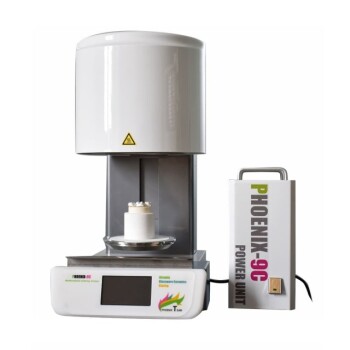
The maximum heating temperature of an atmosphere sintering furnace is the primary driver of dimensional accuracy in pyrolytic carbon (PyC) scaffolds, as it dictates the precise degree of material shrinkage. By modulating the temperature between 500°C and 900°C, the scaffold undergoes a predictable, isotropic volume shrinkage ranging from 50% to 73%. This allows for the fabrication of structural features as small as 4 micrometers, effectively surpassing the initial resolution limits of the 3D printing process.
The core relationship between temperature and dimensional accuracy is defined by a controlled reduction in volume. By leveraging high-temperature sintering to shrink a "green" structure, engineers can achieve microscopic geometric precision that is impossible to reach through direct printing alone.
The Mechanics of Thermal Shrinkage
Achieving Isotropic Volume Reduction
At temperatures between 500°C and 900°C, the precursor material undergoes a transformation into pyrolytic carbon. This process is characterized by an isotropic shrinkage, meaning the scaffold reduces in size uniformly across all axes.
The furnace temperature serves as the control dial for this reduction, consistently yielding a volume loss of 50% to 73%. This predictability is essential for calculating the "oversize" factor required during the initial printing phase to reach a specific final dimension.
Surpassing Printing Resolution Limits
Sintering acts as a secondary refinement process that enhances the effective resolution of the fabrication. While a 3D printer may have a minimum feature size, the subsequent thermal shrinkage can reduce those features to a thickness of approximately 4 micrometers.
This capability is critical for creating ultra-fine lattices. It allows for the production of complex geometries that provide the necessary surface area and structural cues for specialized applications, such as skeletal muscle cell growth.
The Impact on Scaffold Functionality
Optimizing for Biological Compatibility
The dimensional accuracy achieved through high-temperature sintering directly influences how biological cells interact with the scaffold. Precise control over the lattice thickness ensures the geometry is compatible with the specific growth requirements of skeletal muscle cells.
When the furnace temperature is precisely maintained, the resulting carbon structure provides a stable, biocompatible environment. The high degree of accuracy ensures that the micro-pores remain open and interconnected, which is vital for nutrient transport.
Enhancing Mechanical Integrity and Porosity
While the primary reference focuses on PyC, the broader principles of sintering indicate that temperature also influences particle diffusion and neck growth. In similar ceramic or carbon-based systems, precise thermal control is used to provide the material with its final mechanical strength.
Maintaining a balance between shrinkage and structural integrity allows the scaffold to preserve a specific connected porosity. This ensures that the final geometry is not only dimensionally accurate but also physically capable of supporting interpenetrating networks or secondary material infiltrations.
Understanding the Trade-offs and Pitfalls
The Risk of Excessive Shrinkage
While higher temperatures allow for finer features, exceeding the optimal thermal range for pyrolytic carbon can lead to structural failure. If the temperature is too high or the ramp-up too aggressive, the internal stresses caused by rapid shrinkage can result in warping or micro-cracks.
Calibration Complexity
Achieving high dimensional accuracy requires rigorous calibration between the printer's output and the furnace's thermal profile. Because the shrinkage is so significant (up to 73%), any minor fluctuation in furnace temperature can lead to a disproportionately large error in the final scaffold dimensions.
How to Apply This to Your Project
When utilizing an atmosphere sintering furnace for PyC scaffold fabrication, your temperature settings should be dictated by your specific geometric and biological requirements.
- If your primary focus is ultra-fine feature resolution: Maximize the sintering temperature within the 900°C range to achieve the highest percentage of isotropic shrinkage, enabling features down to 4 micrometers.
- If your primary focus is precise dimensional matching: Utilize a lower, more conservative temperature gradient to minimize the shrinkage percentage, making the final dimensions easier to predict and control.
- If your primary focus is mechanical and porous stability: Prioritize a steady temperature soak that promotes uniform neck growth and maintains a connected porosity of at least 32 vol percent.
Mastering the thermal profile of the sintering furnace transforms the material's inherent shrinkage from a manufacturing challenge into a powerful tool for microscopic precision.
Summary Table:
| Temperature Range | Isotropic Shrinkage | Min. Feature Size | Key Application Impact |
|---|---|---|---|
| 500°C - 900°C | 50% to 73% (Volume) | ~4 Micrometers | Surpasses 3D printing resolution limits |
| Low Range (500°C+) | Lower Shrinkage % | Larger Features | Easier dimensional matching/prediction |
| High Range (Up to 900°C) | Max Shrinkage % | Ultra-fine Lattices | Optimized for skeletal muscle cell growth |
Elevate Your Material Research with KINTEK Precision
Achieving microscopic geometric precision in pyrolytic carbon scaffolds requires more than just heat—it requires the absolute thermal stability of a KINTEK atmosphere sintering furnace. Whether you are developing ultra-fine lattices for skeletal muscle growth or high-strength ceramic structures, our advanced furnace technology ensures the uniform, isotropic shrinkage vital for dimensional accuracy.
Why choose KINTEK?
- Comprehensive Furnace Portfolio: From atmosphere and vacuum furnaces to CVD and PECVD systems, we provide the exact environment your materials demand.
- Precision Control: Master your thermal profiles to reduce feature sizes down to 4 micrometers without risking structural integrity.
- End-to-End Solutions: We offer everything from crushing and milling systems to hydraulic pellet presses and essential consumables like crucibles and high-purity ceramics.
Don't let thermal fluctuations compromise your resolution. Contact KINTEK today to find the perfect high-temperature solution for your laboratory’s next breakthrough!
References
- Mohammadreza Taale, Monsur Islam. Microarchitected Compliant Scaffolds of Pyrolytic Carbon for 3D Muscle Cell Growth. DOI: 10.1002/adhm.202303485
This article is also based on technical information from Kintek Solution Knowledge Base .
Related Products
- Mesh belt controlled atmosphere furnace
- Controlled Nitrogen Inert Hydrogen Atmosphere Furnace
- Vacuum Heat Treat and Sintering Furnace with 9MPa Air Pressure
- 1200℃ Controlled Atmosphere Furnace Nitrogen Inert Atmosphere Furnace
- Spark Plasma Sintering Furnace SPS Furnace
People Also Ask
- What are some of the reasons why a controlled atmosphere furnace is desirable in sintering? Achieve Superior Sintering Results
- What role does a controlled atmosphere furnace with argon gas flow play in the production of reduced graphene oxide (rGO)?
- Why is a furnace equipped with a controlled atmosphere necessary for the preparation of active metal catalysts?
- What is the process of a mesh belt furnace? Achieve Consistent, High-Volume Heat Treatment
- How does a mesh belt furnace work? Achieve High-Volume, Repeatable Heat Treatment