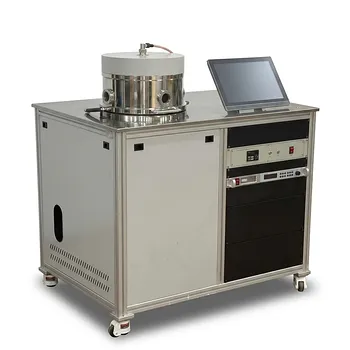
The operating frequency of the RF power supply is a critical variable in the Plasma-Enhanced Chemical Vapor Deposition (PECVD) process, directly dictating the structural integrity and quality of the deposited film. Typically ranging from 50kHz to 13.56MHz, the frequency level controls the intensity of ion bombardment within the plasma, which acts as the primary mechanism for modifying film properties.
Core Takeaway Increasing the RF operating frequency enhances ion bombardment, resulting in significantly denser films and superior spatial uniformity across the plate. However, this increased energy comes with a calculated risk: a higher potential for inflicting physical damage on the substrate.
The Physics of Frequency and Film Structure
Impact on Ion Bombardment
The choice of frequency fundamentally changes the behavior of the plasma. Higher operating frequencies facilitate stronger ion bombardment against the surface of the material.
This intense bombardment is not merely a side effect; it is a driving force that alters how coating materials settle and bond.
Resulting Film Density
Because high-frequency operation increases the energy of impact, the depositing material is packed more tightly.
This results in a film with higher density. If your application requires a robust, non-porous structure, higher frequency operation is generally the preferred approach.
Uniformity and Process Consistency
Stabilizing the Electric Field
One of the most significant advantages of high-frequency operation (approaching 13.56MHz) is the stabilization of the electric field.
At lower frequencies, the electric field can vary significantly across the plate. High-frequency inputs create a much more consistent field distribution.
Controlling Deposition Rates
This consistency directly impacts how evenly the film grows.
At high frequencies, the disparity in deposition speed between the center of the plate and the edges is minimized. This ensures that the film thickness remains uniform across the entire surface area.
Understanding the Trade-offs
The Risk of Substrate Damage
While "stronger bombardment" yields a denser film, it acts as a double-edged sword.
The same energetic impact that compacts the film can transfer excessive energy to the substrate. If the substrate is delicate or sensitive to lattice damage, the aggressive nature of high-frequency deposition may degrade the underlying material.
Making the Right Choice for Your Goal
To select the optimal frequency, you must weigh the need for film quality against the durability of your substrate.
- If your primary focus is Film Density and Uniformity: Utilize higher frequencies (near 13.56MHz) to ensure a compact structure and consistent thickness across the wafer.
- If your primary focus is Substrate Protection: You must carefully monitor the impact of bombardment, as high-frequency processing poses a greater risk of damaging sensitive underlying layers.
Balancing these factors allows you to achieve a dense, uniform coating without compromising the integrity of your device.
Summary Table:
| Frequency Range | Ion Bombardment | Film Density | Spatial Uniformity | Substrate Damage Risk |
|---|---|---|---|---|
| Low (50kHz - 400kHz) | Moderate | Lower/Porous | Lower Consistency | Low |
| High (up to 13.56MHz) | Strong/Intense | High/Dense | High/Consistent | Higher |
Elevate Your Thin-Film Research with KINTEK Precision
Achieving the perfect balance between film density and substrate integrity requires advanced PECVD control. KINTEK specializes in high-performance laboratory equipment, providing researchers with the tools needed for precise material deposition. Whether you are optimizing semiconductor layers with our PECVD and CVD systems, processing advanced ceramics in high-temperature furnaces, or preparing samples with our hydraulic presses and milling systems, our experts are here to support your mission.
Ready to enhance your lab's deposition capabilities? Contact us today to discover how our tailored cooling solutions, battery research tools, and high-frequency RF power configurations can deliver superior results for your specific applications.
Related Products
- RF PECVD System Radio Frequency Plasma-Enhanced Chemical Vapor Deposition RF PECVD
- Chemical Vapor Deposition CVD Equipment System Chamber Slide PECVD Tube Furnace with Liquid Gasifier PECVD Machine
- Inclined Rotary Plasma Enhanced Chemical Vapor Deposition PECVD Equipment Tube Furnace Machine
- Inclined Rotary Plasma Enhanced Chemical Vapor Deposition PECVD Equipment Tube Furnace Machine
People Also Ask
- What is plasma enhanced chemical vapour deposition PECVD used for? Enable Low-Temp Thin Films for Electronics & Solar
- What is the role of RF-PECVD in VFG preparation? Mastering Vertical Growth and Surface Functionality
- What is an example of PECVD? RF-PECVD for High-Quality Thin Film Deposition
- What is plasma enhanced chemical Vapour deposition process used for fabrication of? A Guide to Low-Temperature Thin Films
- What is plasma CVD? Unlock Low-Temperature Thin Film Deposition for Sensitive Materials