The precision of a laboratory hydraulic press is the primary factor in determining the mechanical and electrochemical integrity of CO2 electroreduction electrodes. High-precision pressure control ensures the catalyst layer is uniformly bonded to the conductive substrate, which drastically reduces interfacial contact resistance and enables the high charge transport rates required for efficient CO2 conversion.
Precision hydraulic pressing transforms a loose catalyst coating into a stable, high-performance electrode by optimizing the interface between the active material and the current collector. This process is essential for maintaining electrochemical stability and data reproducibility, especially when operating at high current densities.
Enhancing Charge Transport and Interfacial Stability
Reducing Interfacial Contact Resistance
A high-precision press applies uniform force to the catalyst, conductive additives, and binders, ensuring they are tightly packed against the substrate. This compaction minimizes the gaps between particles and the current collector, significantly lowering the interfacial contact resistance.
Supporting High Current Densities
For CO2 electroreduction in flow cells, electrodes must often operate at current densities exceeding 350 mA cm⁻². Precise pressure control ensures the active material remains tightly bonded to the carbon paper or gas diffusion layer (GDL), preventing the electrode from failing under the intense mechanical stress of high-rate gas evolution.
Improving Electronic Conduction Efficiency
By compacting punched electrode disks at specific pressures (such as 5 tons or 20 MPa), the press increases the volumetric energy density. This compaction facilitates more efficient electronic conduction pathways throughout the electrode layer during the CO2 reduction cycles.
Optimizing Microstructure for Gas and Ion Transport
Balancing Porosity and Mass Transport
Precise pressure control allows researchers to fine-tune the internal pore structure of the electrode. This balance is critical; the electrode must be dense enough for good conductivity but porous enough to allow for rapid gas diffusion and ion transport to the catalyst sites.
Preventing Delamination and Peeling
Inconsistent pressure application can lead to "hot spots" or weak zones where the catalyst layer may peel or delaminate when submerged in an electrolyte. A precision press ensures a consistent mechanical bond across the entire surface area, maintaining stability during long-term cycling.
Ensuring Uniform Active Material Distribution
When using substrates like nickel foam or carbon paper, the press ensures that the catalyst powder and binder mixture is distributed evenly into the substrate’s three-dimensional structure. This uniformity is vital for achieving a stable electrochemical response and preventing localized overpotentials.
Ensuring Data Accuracy and Reproducibility
Consistency for In-Situ Testing
For advanced characterization, such as in-situ X-ray studies, the electrode must have a consistent thickness and density. High-precision pressing ensures uniform X-ray transmittance, allowing researchers to collect accurate and comparable data across different samples.
Eliminating Unstable Electrical Signals
Physical displacement or inconsistent positioning of the electrode can cause "noisy" or unstable signals. Using a precision press to create flat, uniform electrodes ensures they fit correctly into specialized testing racks, preventing artifacts caused by physical instability.
Understanding the Trade-offs
The Risk of Over-Compression
While high pressure reduces contact resistance, excessive force can collapse the pore structure of the gas diffusion layer. This leads to mass transport limitations, where CO2 gas cannot reach the catalyst surface effectively, thereby reducing the overall Faradaic efficiency.
Balancing Pressure and Binder Content
Relying solely on high pressure to achieve stability can sometimes lead to brittle electrodes. Researchers must find the optimal "sweet spot" where the mechanical pressure complements the chemical adhesion of the binder without damaging the underlying conductive substrate.
How to Apply This to Your Project
Making the Right Choice for Your Goal
- If your primary focus is high-rate flow cell testing: Prioritize a press with high-load stability to ensure catalyst adhesion at current densities above 350 mA cm⁻².
- If your primary focus is fundamental mechanistic studies: Use a precision press to ensure uniform thickness and density, which is critical for reproducible in-situ spectroscopy and X-ray results.
- If your primary focus is electrode longevity and cycling: Focus on precise pressure holding times to ensure the binder and catalyst are fully integrated into the substrate to prevent delamination.
The precision of the hydraulic pressing stage is the foundation upon which reliable, high-performance CO2 electroreduction data is built.
Summary Table:
| Impact Factor | Effect on Electrode Performance | Research Advantage |
|---|---|---|
| Pressure Uniformity | Lowers interfacial contact resistance | Enhanced charge transport at high current densities |
| Microstructure Control | Balances porosity and mass transport | Optimized gas diffusion and ion transport to catalyst |
| Mechanical Bonding | Prevents delamination and peeling | Improved long-term electrochemical cycling stability |
| Compaction Precision | Ensures consistent thickness and density | High data reproducibility for in-situ characterization |
Advance Your Electrochemical Research with KINTEK Precision
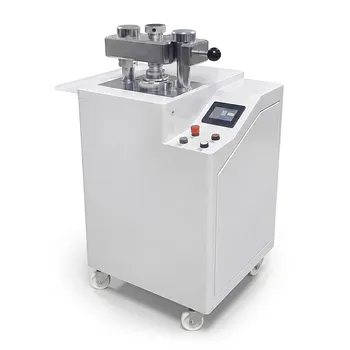
Achieving reliable CO2 electroreduction data starts with the perfect electrode interface. KINTEK specializes in high-precision laboratory hydraulic presses (pellet, hot, and isostatic) engineered to ensure the mechanical and electrochemical integrity of your catalyst layers.
Our extensive portfolio supports your entire research workflow—from crushing and milling systems for powder preparation to high-temperature furnaces (CVD, PECVD, vacuum, and atmosphere) and high-temperature high-pressure reactors for advanced material synthesis. Whether you are scaling up flow cells or conducting fundamental in-situ spectroscopy, KINTEK provides the reliable tools and essential consumables (PTFE, ceramics, crucibles) your lab requires for excellence.
Contact KINTEK today to find the ideal equipment for your laboratory needs.
References
- Changsheng Cao, Qi‐Long Zhu. Si Doping-Induced Electronic Structure Regulation of Single-Atom Fe Sites for Boosted CO <sub>2</sub> Electroreduction at Low Overpotentials. DOI: 10.34133/research.0079
This article is also based on technical information from Kintek Solution Knowledge Base .
Related Products
- Automatic Hydraulic Hot Press with 500x500mm Heating Plates and Multi Stage PLC Control for Material Sintering
- Fully Automatic Heated Hydraulic Lab Press for Materials Sintering and Sample Preparation
- Laboratory Hydraulic Press Split Electric Lab Pellet Press
- Laboratory Hydraulic Press Lab Pellet Press Machine for Glove Box
- Automatic High Temperature Heated Hydraulic Press Machine with Heated Plates for Lab
People Also Ask
- How do hydraulic presses facilitate material solidification in Low-Temperature LPS? Optimize Your Material Densification
- Why is 800 MPa required for TiNiPdCu alloy green bodies? Master High-Density Compaction for Superior Material Strength
- How does KBr pellet preparation facilitate FTIR of high-ash mud? Precision Sample Prep for Structural Analysis
- Why is an industrial hydraulic press with precision stainless steel molds used? For Uniform Mo-Fe Precursor Compacts.
- Purpose of Coaxial Ring Molds & Presses in EM Testing? Achieve Precise VNA Data & Fit