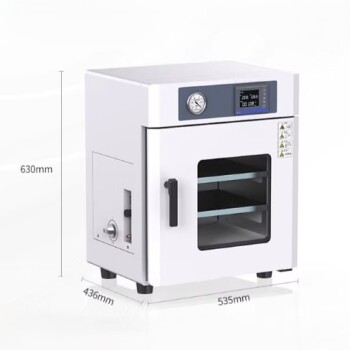
The application of a vacuum drying oven is a definitive step in stabilizing LiMn2O4 (LMO) cathodes. This process utilizes controlled heat and vacuum pressure—specifically at 80°C for 48 hours—to deeply dehydrate the electrode slurry coated on aluminum foil. By rigorously removing solvents and trace moisture, the oven cures the electrode materials and eliminates the root causes of detrimental side reactions.
By effectively removing residual moisture, vacuum drying significantly lowers interfacial resistance within the cell. This reduction is the primary driver for improved rate performance and long-term cycling stability in solid-state batteries.
The Mechanism of Deep Dehydration
Removing Solvents and Moisture
The primary function of the vacuum drying oven is the complete removal of volatile components. During the manufacturing phase, the LMO slurry contains solvents that must be evaporated to leave behind a solid, functional electrode.
Beyond solvents, the process targets trace moisture. Even microscopic amounts of water left in the cathode can be catastrophic to battery chemistry, making this deep dehydration step non-negotiable.
Curing the Electrode Structure
The drying process does more than just evaporate liquids; it cures the electrode material onto the aluminum foil current collectors.
Subjecting the materials to 80°C for 48 hours ensures the physical integrity of the electrode coating. This creates a stable, cohesive structure ready for assembly into the final battery cell.
Impact on Electrochemical Performance
Reducing Interfacial Resistance
The most significant technical benefit of vacuum drying is the reduction of interfacial resistance.
Moisture and solvents act as insulators or reaction sites that impede the flow of ions. By eliminating these contaminants, the interface between the electrode and the electrolyte remains clean and highly conductive.
Enhancing Rate Performance
A direct consequence of lowered resistance is improved rate performance.
When interfacial resistance is minimized, lithium ions can move more freely during charge and discharge cycles. This allows the battery to handle higher currents efficiently without significant voltage drops.
Ensuring Cycling Stability
Long-term reliability is heavily dependent on the purity of the internal environment.
Residual moisture is a known catalyst for unwanted side reactions that degrade battery materials over time. By removing this moisture, the vacuum drying process prevents these reactions, thereby extending the cycle life of the LMO cathode.
Understanding the Process Constraints
The Necessity of Strict Parameters
While vacuum drying is beneficial, it introduces a significant time constraint to the manufacturing workflow.
The process requires a sustained duration of 48 hours to be effective. Cutting this time short to increase production speed risks leaving residual moisture in the porous electrode structure.
Sensitivity to Temperature
The standard operating temperature is set specifically at 80°C.
Deviating from this temperature can compromise the process. Lower temperatures may fail to fully dehydrate the deep pores of the electrode, while incorrect thermal management could affect the binder or active material structure.
Optimizing LMO Cathode Production
To maximize the performance of your LiMn2O4 cathodes, adherence to the drying protocol is critical.
- If your primary focus is Cycle Life: Strictly maintain the 48-hour drying duration to ensure the elimination of moisture-induced side reactions.
- If your primary focus is High-Rate Capability: Prioritize the deep dehydration process to achieve the lowest possible interfacial resistance for rapid ion transport.
The vacuum drying stage is not merely a drying step; it is a foundational process that dictates the final efficiency and longevity of the battery.
Summary Table:
| Feature | Process Parameter | Impact on LMO Performance |
|---|---|---|
| Drying Temperature | 80°C | Ensures deep dehydration without damaging binder structure |
| Drying Duration | 48 Hours | Guarantees complete removal of solvents and trace moisture |
| Vacuum Environment | Low Pressure | Lowers boiling points of solvents; prevents oxidative side reactions |
| Electrode Integrity | Curing Process | Secures material adhesion to aluminum foil current collectors |
| Electrical Benefit | Lower Resistance | Minimizes interfacial resistance for superior high-rate capability |
| Durability Benefit | Cycling Stability | Eliminates moisture-induced catalysts to extend battery cycle life |
Elevate Your Battery Research with KINTEK
Precision in the drying process is the foundation of high-performance LiMn2O4 cathodes. KINTEK specializes in advanced laboratory solutions, providing the high-performance vacuum drying ovens and battery research tools necessary to achieve deep dehydration and structural integrity.
Whether you are focusing on minimizing interfacial resistance or maximizing cycle life, our comprehensive range of equipment—including vacuum and atmosphere furnaces, battery research consumables, and precision cooling solutions—is designed to meet the rigorous demands of material science.
Ready to optimize your electrode manufacturing? Contact our experts today to find the perfect drying solution and high-temperature systems tailored to your laboratory's needs.
Related Products
- 56L Vertical Laboratory Vacuum Drying Oven
- 23L Laboratory Vacuum Drying Oven
- Laboratory Scientific Electric Heating Blast Drying Oven
- Benchtop Laboratory Vacuum Freeze Dryer
- Dental Porcelain Zirconia Sintering Ceramic Vacuum Press Furnace
People Also Ask
- Why is a laboratory vacuum drying oven recommended for rice straw residues? Protect Your Biomass Integrity
- What role does a laboratory vacuum drying oven play in the preparation of modified multi-walled carbon nanotubes?
- What is the importance of using a laboratory vacuum drying oven? Preserving Slow-Release Microcapsule Integrity
- Why is a Laboratory Vacuum Drying Oven recommended for PBAT microspheres? Protect Sensitive Polymer Integrity
- What role does a laboratory vacuum drying oven play in processing nanoparticle powder samples? Protect Sample Integrity