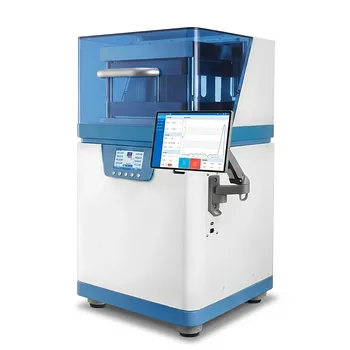
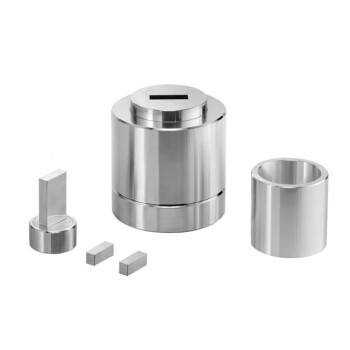
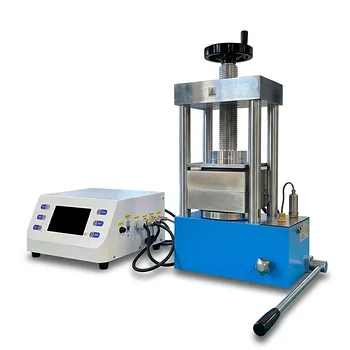
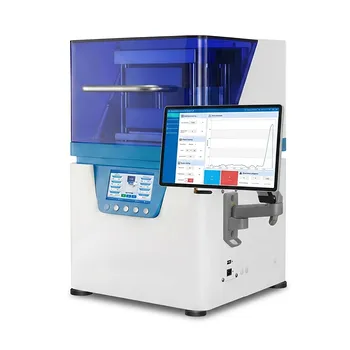
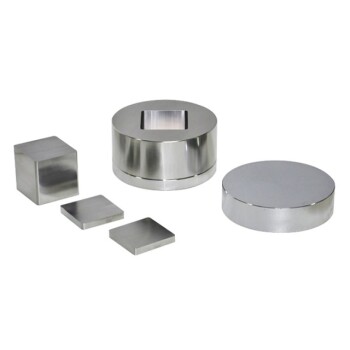
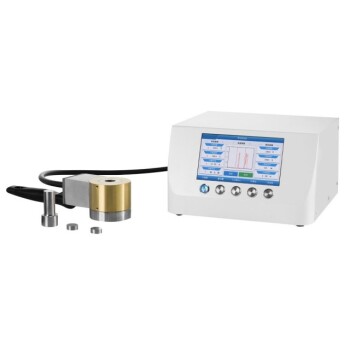
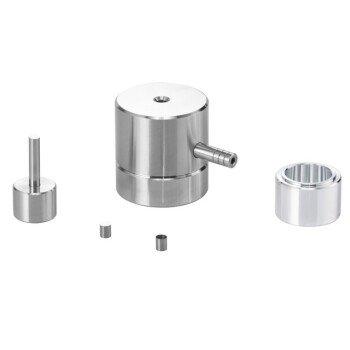
A laboratory hydraulic press serves as the critical interface for characterizing the electrochemical potential of MoN/MoC powders. By applying controlled, variable pressure, the press transforms loose nanoparticles into a dense, standardized compact. This process is essential for eliminating air gaps and minimizing contact resistance, allowing researchers to measure the intrinsic electrical conductivity of the material rather than the artifacts of its loose-powder state.
Core Takeaway: The laboratory hydraulic press enables the evaluation of MoN/MoC powders by creating a repeatable, high-density environment where electrical conductivity can be measured as a direct function of applied pressure and compaction density.
The Role of Compaction in Conductivity Analysis
Eliminating Inter-particle Contact Resistance
In their loose state, MoN/MoC powders are separated by air gaps that act as insulators, leading to artificially low conductivity readings. The hydraulic press applies high pressure to force micron or nano-sized particles to undergo plastic deformation and pack closely together. This physical rearrangement effectively excludes air and ensures tight contact, which is necessary to capture the material's true physical properties.
Standardizing Sample Geometry
For accurate conductivity calculations, the sample must have fixed, known dimensions. The press compacts the powder into dense cylindrical pellets or discs with standardized diameters and thicknesses. Having a uniform green body allows for the application of the four-probe resistance test, ensuring that the resulting data is both reliable and repeatable across different batches.
Measuring the Dynamic Relationship
Simulating Real-World Electrode Environments
MoN/MoC materials are often intended for use in high-performance electrodes where they will exist under various states of mechanical stress. By using a continuously variable pressure setting, the hydraulic press simulates these different compaction states. This allows researchers to observe how the conductive network within the material evolves as it is compressed.
Synchronous Data Acquisition
Advanced setups integrate the hydraulic press with a conductivity measurement module. This integration allows for the synchronous recording of the dynamic relationship between applied pressure, compaction density, and electrical conductivity. This data is vital for identifying which MoN/MoC formulations will maintain a high-performance conductive network under the mechanical loads found in commercial battery or capacitor cells.
Understanding the Trade-offs
Risk of Material Over-Compaction
While high pressure is required to eliminate voids, excessive force can lead to the crushing of nanostructures or unintended phase changes in the MoN/MoC particles. If the pressure exceeds the material's structural limits, the measured conductivity may reflect a damaged state rather than the functional characteristics of the powder.
Pressure Decay and Measurement Timing
Powder compacts often experience elastic recovery or pressure decay once the hydraulic press stops active pumping. If conductivity measurements are taken too quickly or too late after the pressure is applied, the density of the pellet may have shifted. Consistency in "dwell time"—the duration the pressure is held—is critical to prevent data drift.
Optimizing Your Conductivity Testing Workflow
How to Apply This to Your Project
To achieve the most accurate evaluation of MoN/MoC powders, your methodology should align with your specific research or production goals.
- If your primary focus is fundamental material characterization: Use the press to form high-density pellets at maximum safe pressure to eliminate all air voids and measure intrinsic conductivity using the four-probe method.
- If your primary focus is electrode manufacturing: Utilize variable pressure cycles to map the "conductivity-to-pressure" curve, identifying the minimum compaction density required to reach the desired electrical performance.
- If your primary focus is quality control and repeatability: Standardize the mass of the powder and the dwell time of the hydraulic press to ensure every sample disc has identical geometric dimensions for side-by-side comparison.
Precise pressure control is the foundation of turning unpredictable loose powders into the reliable, measurable data sets required for advanced materials science.
Summary Table:
| Feature | Role in MoN/MoC Evaluation | Research Benefit |
|---|---|---|
| High-Pressure Compaction | Eliminates air gaps and reduces contact resistance. | Captures intrinsic electrical conductivity. |
| Geometric Standardization | Creates uniform cylindrical pellets or discs. | Ensures repeatable four-probe resistance data. |
| Variable Pressure Control | Simulates mechanical stress in electrodes. | Maps the dynamic conductivity-to-density relationship. |
| Dwell Time Management | Compensates for elastic recovery/pressure decay. | Prevents data drift for consistent comparisons. |
Elevate Your Material Research with KINTEK Precision
Precise characterization of advanced materials like MoN/MoC requires equipment that guarantees repeatability and control. KINTEK specializes in high-performance laboratory solutions designed to turn unpredictable powders into reliable data.
Our extensive portfolio includes:
- Hydraulic Presses: Manual and automated systems for pellet, hot, and isostatic pressing to ensure perfect sample density.
- Thermal Processing: High-temperature furnaces (muffle, tube, vacuum, and CVD) for material synthesis and sintering.
- Material Preparation: Crushing, milling, and sieving systems to achieve ideal nanoparticle distributions.
- Advanced Reactors: High-temperature high-pressure reactors and autoclaves for complex electrochemical studies.
Whether you are characterizing conductivity, developing next-gen batteries, or performing quality control, KINTEK provides the technical expertise and durable tools—from electrolytic cells to ceramic crucibles—to drive your innovation forward.
Ready to optimize your testing workflow? Contact KINTEK today for a consultation on the best laboratory solutions for your specific application.
References
- Cheng Wang, Kaifu Huo. In‐Plane Heterostructured MoN/MoC Nanosheets with Enhanced Interfacial Charge Transfer for Superior Pseudocapacitive Storage. DOI: 10.1002/adfm.202311040
This article is also based on technical information from Kintek Solution Knowledge Base .
Related Products
- Automatic Laboratory Hot Press 400x400 mm with Programmable High Temperature and Hydraulic Force Control
- Assemble Square Lab Press Mold for Laboratory Applications
- Manual Lab Heat Press
- Ball Press Mold for Lab
- Fully Automatic Heated Hydraulic Lab Press for Materials Sintering and Sample Preparation
People Also Ask
- What is the primary function of a laboratory hot press in MEA assembly? Optimize Fuel Cell Bonding & Performance
- What specific conditions does a laboratory hot press provide for the assembly of fuel cell MEA? Expert Bond Tips.
- How do a laboratory hydraulic hot press and standardized steel molds ensure the quality of WPC test specimens?
- What are the core advantages of using a laboratory hot press to produce Bi2Se3? Achieve 93% Density & High Conductivity
- How does a laboratory heating hydraulic press contribute to the preparation of recycled graphite green bodies? - Optimize Density.