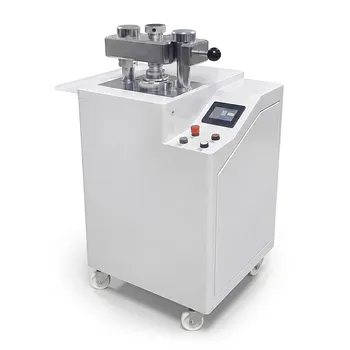
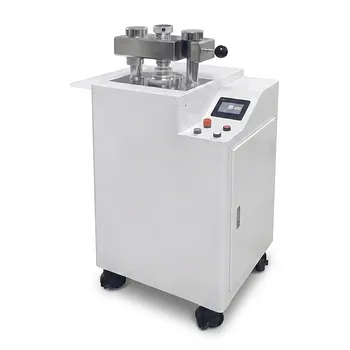
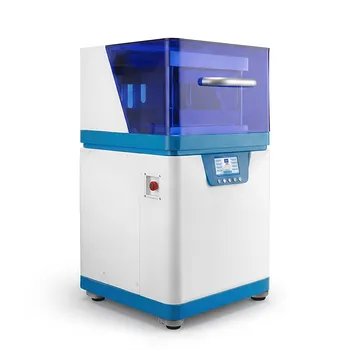
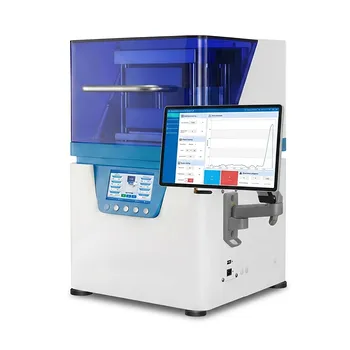
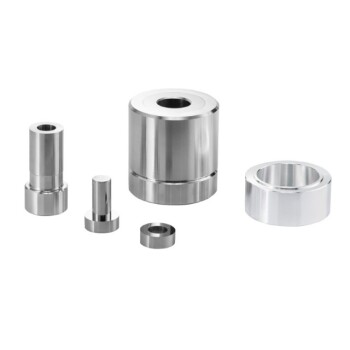
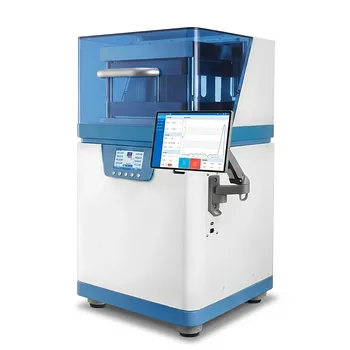
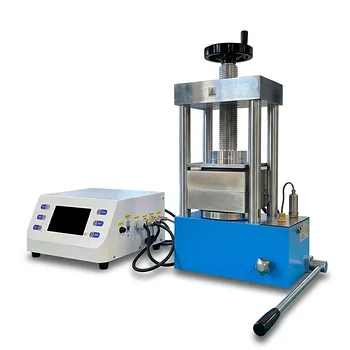
The laboratory hydraulic press is the foundational tool for preparing YDC-BCY samples for electrochemical analysis. It compacts raw ceramic powder into standardized "green bodies" with the high initial density required for high-temperature sintering at 1400 °C. This process minimizes internal voids and air gaps, ensuring that subsequent measurements reflect the material's intrinsic mixed proton-electron conductivity rather than structural defects or porosity.
A laboratory hydraulic press ensures YDC-BCY materials achieve the necessary density and particle contact to provide reliable conductivity data. By eliminating internal pores and reducing grain boundary resistance, the press enables a true assessment of ion transport properties during performance testing.
The Role of Compaction in Material Synthesis
Forming the Standardized Green Body
The primary function of the press is to transform loose YDC-BCY powder into a standardized rectangular or cylindrical "green body." This pre-sintered form must have a uniform density to prevent warping or cracking during the high-heat phase.
Establishing Particle Contact Networks
Applying high pressure—often ranging from 10 MPa to 400 MPa—forces individual ceramic particles into intimate contact. This establishes a continuous contact network that is essential for the flow of charge carriers once the material is densified.
Minimizing Post-Sintering Voids
High initial compaction provides the necessary density to ensure a dense block forms during sintering at 1400 °C. Without this step, residual voids would act as insulators, artificially lowering the measured conductivity of the material.
Enhancing Conductivity Measurement Accuracy
Reducing Grain Boundary Resistance
In YDC-BCY materials, resistance often occurs at the interfaces between particles, known as grain boundaries. The hydraulic press minimizes these boundaries by packing particles tightly, ensuring that Electrochemical Impedance Spectroscopy (EIS) accurately reflects the material's bulk properties.
Optimizing Electrode Contact
A smooth, dense surface created by the press allows for better contact between the ceramic sample and the blocking electrodes. This intimate contact is critical for obtaining precise data during two-point or four-point probe conductivity testing.
Simulating Compaction States
Precision hydraulic presses can record the dynamic relationship between applied pressure and compaction density. This allows researchers to identify the specific pressure thresholds required to achieve a high-performance conductive network in different electrolyte formulations.
Understanding the Trade-offs and Pitfalls
The Risk of Over-Compaction
Applying excessive pressure can lead to lamination or "capping," where the pellet splits into layers upon release. Researchers must find the "sweet spot" where density is maximized without compromising the structural integrity of the YDC-BCY sample.
Pressure Non-Uniformity
If the press does not apply force evenly, it creates internal density gradients. These gradients cause uneven shrinkage during sintering, leading to distorted samples that produce inconsistent conductivity readings across different surface areas.
Contamination During Pressing
The use of steel dies can introduce metallic impurities into the YDC-BCY powder if not properly cleaned or lubricated. These impurities can create parasitic conductive paths, leading to an overestimation of the material's actual ionic performance.
How to Apply This to Your Research
Implementing the Best Pressing Strategy
- If your primary focus is intrinsic material properties: Utilize high-pressure compaction (up to 400 MPa) to eliminate as much porosity as possible before sintering, ensuring your data reflects bulk ion transport.
- If your primary focus is manufacturing scalability: Use the press to determine the minimum pressure required to reach the "percolation threshold," where the conductive network becomes fully functional.
- If your primary focus is electrochemical testing (EIS): Ensure the press creates a uniform thickness (typically 1mm to 2mm) to simplify the geometric calculations required for calculating total conductivity.
Precise hydraulic compaction is the essential bridge between raw ceramic powders and the highly conductive solid electrolytes required for next-generation energy applications.
Summary Table:
| Process Element | Impact on YDC-BCY Materials | Key Benefit |
|---|---|---|
| Pressure Range | 10 MPa to 400 MPa | Achieves optimal compaction density |
| Green Body Formation | Uniform particle contact networks | Prevents warping/cracking during sintering |
| Void Minimization | Eliminates insulating air gaps | Ensures intrinsic mixed proton-electron flow |
| Grain Boundaries | Reduces interface resistance | Enhances Electrochemical Impedance Spectroscopy (EIS) |
| Surface Quality | Creates smooth, dense surfaces | Optimizes electrode contact for accurate probes |
Elevate Your Material Research with KINTEK Precision
Empower your laboratory with the tools needed for breakthrough discoveries in solid electrolytes and energy storage. KINTEK specializes in high-performance laboratory equipment, offering a comprehensive range of hydraulic presses (pellet, hot, and isostatic) designed to ensure the uniform density and structural integrity essential for accurate YDC-BCY conductivity testing.
Beyond compaction, we provide a full ecosystem for material synthesis, including high-temperature muffle and tube furnaces, advanced crushing and milling systems, and specialized high-pressure reactors. Whether you are optimizing grain boundaries or scaling up battery research, our expert solutions deliver the reliability and precision your data demands.
Ready to enhance your lab's efficiency and measurement accuracy? Contact KINTEK today to find the perfect equipment for your research goals!
References
- Yuepeng Hei, Shaomin Liu. Ce0.8Y0.2O2-δ-BaCe0.8Y0.2O3-δ Dual-Phase Hollow Fiber Membranes for Hydrogen Separation. DOI: 10.3390/inorganics11090360
This article is also based on technical information from Kintek Solution Knowledge Base .
Related Products
- Automatic Laboratory Hydraulic Pellet Press Machine for Lab Use
- Laboratory Hydraulic Press Lab Pellet Press Machine for Glove Box
- Laboratory Manual Hydraulic Pellet Press for Lab Use
- Laboratory Hydraulic Press Lab Pellet Press for Button Battery
- Laboratory Manual Hydraulic Pellet Press for Lab Use
People Also Ask
- What is the role of a laboratory hydraulic pellet press and stainless steel molds in the fabrication of RuO2/NbC anodes?
- What role does a laboratory pellet press play in the enhancement of biomass energy products? Optimize Fuel Efficiency
- What is the purpose of using a laboratory pellet press when evaluating the electronic conductivity of carbon powders? Guide
- How does a laboratory hydraulic pellet press contribute to SiCw/2024 aluminum composite preforms? Optimize Densification
- What is the significance of applying 200 MPa of pressure with a laboratory hydraulic pellet press for composite ceramics?