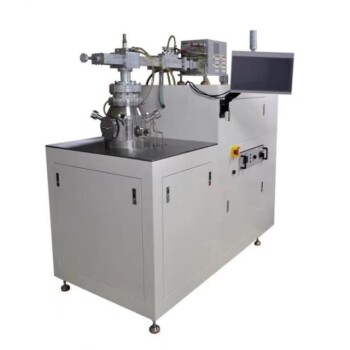
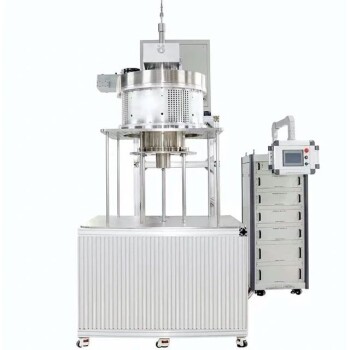
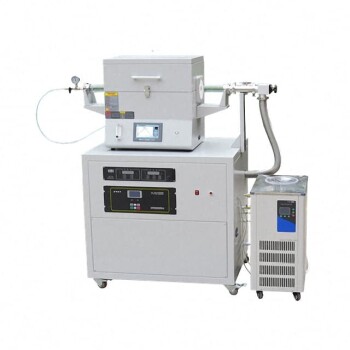
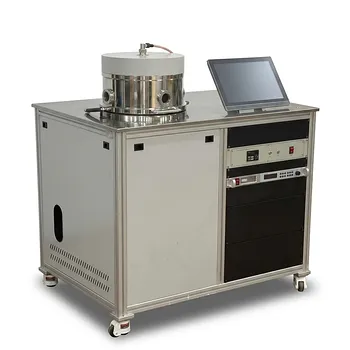
A laboratory-scale Chemical Vapor Deposition (CVD) reactor functions as a high-precision furnace that drives a thermochemical reaction between aluminum source precursor gases and a substrate previously plated with platinum. Operating at temperatures around 1100 degrees Celsius, the reactor creates an environment where aluminum is deposited onto the surface and reacts deeply with the platinum to form a specific beta-phase structure.
Core Takeaway The CVD reactor is not merely a coating tool but a reaction chamber that transforms surface chemistry. By strictly regulating gas flow, temperature, and time, it converts a platinum-plated surface into a uniform, 40-micrometer thick platinum-modified aluminide layer, even on parts with complex geometries.
The Mechanics of Layer Formation
The Thermochemical Environment
The process relies on extreme heat to facilitate the reaction. The reactor heats the internal chamber to approximately 1100 degrees Celsius.
At this temperature, the thermodynamic energy is sufficient to break down precursor gases and drive the diffusion necessary for alloy formation.
Interaction of Elements
The reaction involves three distinct components: the aluminum source precursor gases, the pre-plated platinum layer, and the substrate material itself.
Inside the reactor, the aluminum does not just sit on top; it chemically interacts with the platinum and the substrate. This deep interaction is required to synthesize the target beta-phase aluminide structure.
Precision Control Factors
Success depends on the operator's ability to manipulate three variables: gas flow rate, temperature, and reaction time.
Adjusting these parameters allows the engineer to "tune" the properties of the final layer, moving beyond simple deposition to actual material engineering.
Achieving Uniformity and Depth
Coverage of Complex Shapes
One of the primary advantages of this CVD application is its non-line-of-sight capability. Because the reactants are gases, they can penetrate intricate features of the sample.
This ensures that the aluminum is uniformly deposited across the entire surface profile, regardless of the component's geometric complexity.
Controlling Layer Thickness
The reactor allows for the production of layers with specific dimensional requirements.
Through precise management of the reaction duration and precursor availability, the process reliably yields a layer thickness of approximately 40 micrometers.
Customization of Properties
While the target is a beta-phase structure, the versatile nature of CVD allows for customization.
By altering production parameters, the crystallinity and specific phase structure can be fine-tuned to meet specific performance criteria.
Understanding the Trade-offs
High Thermal Demands
This process is energy-intensive. Maintaining a stable environment at 1100 degrees Celsius requires robust heating elements and significant power consumption compared to lower-temperature coating methods.
Parameter Sensitivity
The versatility of CVD is also a source of complexity. Minor fluctuations in gas flow or temperature can alter the film from crystalline to amorphous or deviate from the target thickness.
Strict process monitoring is essential to prevent the formation of inconsistent material phases.
Making the Right Choice for Your Goal
To maximize the utility of a laboratory-scale CVD reactor for aluminide layers, align your parameters with your specific objective:
- If your primary focus is Geometric Uniformity: Prioritize the optimization of gas flow rates to ensure reactants reach all surfaces of complex shapes without depletion.
- If your primary focus is Phase Purity: Concentrate on maintaining precise temperature stability at 1100°C to ensure the correct thermochemical reaction occurs between the platinum and aluminum.
- If your primary focus is Dimensional Accuracy: Strictly calibrate the reaction time to cap the layer growth at exactly 40 micrometers.
Ultimately, the CVD reactor serves as a bridge between raw chemical precursors and advanced material performance, delivering a protective layer defined by its uniformity and structural integrity.
Summary Table:
| Feature | Specification/Detail |
|---|---|
| Operating Temperature | Approximately 1100°C |
| Target Layer Thickness | ~40 micrometers (adjustable) |
| Key Reactants | Aluminum precursor gases & Pt-plated substrate |
| Phase Structure | Beta-phase platinum-modified aluminide |
| Primary Control Factors | Gas flow rate, Temperature, Reaction time |
| Key Advantage | Uniform coating of complex geometries (Non-line-of-sight) |
Elevate Your Material Research with KINTEK Precision Solutions
Unlock superior performance in thin-film deposition and alloy synthesis with KINTEK’s advanced laboratory equipment. Whether you are developing platinum-modified aluminide layers or exploring next-generation semiconductor materials, our specialized CVD and PECVD systems provide the thermal stability and gas flow precision required for rigorous research.
Our comprehensive portfolio includes:
- High-Temperature Reactors: Muffle, tube, vacuum, and atmosphere furnaces designed for environments up to 1100°C and beyond.
- Specialized Systems: Rotary, CVD, and MPCVD reactors for tailored material engineering.
- Lab Infrastructure: Crushing/milling systems, hydraulic presses, and high-pressure autoclaves.
- Essential Consumables: High-purity ceramics, crucibles, and PTFE products.
Don't let process fluctuations compromise your phase purity. Partner with KINTEK to access the reliable tools and technical expertise needed to achieve uniform, high-integrity results every time.
Contact Our Technical Experts Today to find the perfect configuration for your laboratory needs!
References
- B. Pint, Y. Zhang. The Effect of Water Vapor and Superalloy Composition on Thermal Barrier Coating Lifetime. DOI: 10.7449/2012/superalloys_2012_723_732
This article is also based on technical information from Kintek Solution Knowledge Base .
Related Products
- Microwave Plasma Chemical Vapor Deposition MPCVD Machine System Reactor for Lab and Diamond Growth
- Cylindrical Resonator MPCVD Machine System Reactor for Microwave Plasma Chemical Vapor Deposition and Lab Diamond Growth
- 915MHz MPCVD Diamond Machine Microwave Plasma Chemical Vapor Deposition System Reactor
- Customer Made Versatile CVD Tube Furnace Chemical Vapor Deposition Chamber System Equipment
- Split Chamber CVD Tube Furnace with Vacuum Station Chemical Vapor Deposition System Equipment Machine
People Also Ask
- How does a microwave plasma reactor facilitate the synthesis of diamond? Master MPCVD with Precision Technology
- What are the advantages of a Microwave Plasma CVD reactor for MCD/NCD coatings? Precision Multilayer Diamond Engineering
- How do vacuum pumps and valves collaborate in MPCVD? Achieve Precise Pressure Control for Superior CNT Synthesis
- How does MPCVD work? A Guide to Low-Temperature, High-Quality Film Deposition
- What is microwave plasma chemical vapor deposition? A Guide to High-Purity Diamond Film Growth