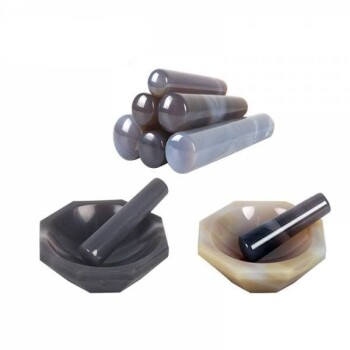
The agate mortar serves as a critical manual tool for the preparation of LiMn2O4 cathode composite materials. It is specifically utilized to grind and physically mix the cathode material with solid electrolyte powders. This process is designed to achieve a high degree of homogeneity, ensuring the components are blended uniformly before they are formed into the final battery structure.
The primary objective of using an agate mortar is not merely size reduction, but the creation of effective ion-conducting channels through microscopic uniformity. This physical dispersion is a determining factor in the capacity performance of all-solid-state batteries.
The Physical Preparation Process
Manual Grinding and Mixing
The preparation of LiMn2O4 composites begins with physical mixing.
Operators use the agate mortar to manually combine the active LiMn2O4 cathode material with solid electrolyte powders.
This manual grinding action is essential for breaking down agglomerates and forcing the two distinct powder types to interact closely.
Achieving Microscopic Dispersion
The utility of the agate mortar lies in its ability to affect the mixture on a microscopic scale.
Simple stirring is often insufficient for solid-state reactions; the grinding pressure ensures that the active material and the electrolyte are uniformly distributed.
This prevents the formation of isolated "islands" of material that are electrically disconnected from the rest of the cell.
The Electrochemical Impact
Creating Ion-Conducting Channels
The ultimate goal of this grinding process is the establishment of ion-conducting channels.
For an all-solid-state battery to function, lithium ions must move freely between the cathode and the electrolyte.
The intimate contact achieved via the agate mortar creates continuous pathways for these ions to travel.
Influence on Capacity Performance
The quality of the mixing process directly correlates to the battery's final output.
Without the well-dispersed mixture provided by the mortar, the battery's capacity performance will suffer due to high internal resistance or poor material utilization.
Understanding the Trade-offs
The Necessity of Physical Labor
Using an agate mortar is a manual process, which inherently requires time and physical effort compared to automated milling.
However, for specific composite preparations, this manual control allows for immediate feedback and precise cessation of grinding once uniformity is observed.
Risks of Inconsistent Mixing
The trade-off of this technique is its reliance on the thoroughness of the grinding.
If the grinding is insufficient, the active materials and electrolyte will not be uniformly distributed.
This lack of uniformity leads to poor ion conductivity, rendering the cathode material significantly less effective regardless of its intrinsic chemical quality.
Making the Right Choice for Your Goal
When preparing LiMn2O4 composites, the use of the agate mortar should be driven by the need for intimate material contact.
- If your primary focus is Maximizing Capacity: Prioritize extended, consistent grinding to ensure robust ion-conducting channels are fully established.
- If your primary focus is Process Consistency: Standardize the grinding time and technique to ensure the "microscopic scale" distribution remains constant across different batches.
The agate mortar remains a fundamental tool because establishing a well-dispersed mixture is the prerequisite for high-performance solid-state energy storage.
Summary Table:
| Process Step | Primary Function | Impact on Performance |
|---|---|---|
| Manual Grinding | Breaks down agglomerates and physical mixing | Ensures microscopic material dispersion |
| Material Blending | Combines LiMn2O4 with solid electrolyte | Establishes continuous ion-conducting channels |
| Homogenization | Prevents material 'islands' | Minimizes internal resistance and boosts capacity |
| Quality Control | Precise manual feedback | Consistent batch-to-batch electrochemical output |
Elevate Your Battery Research with KINTEK Precision Tools
Achieving the perfect microscopic dispersion in LiMn2O4 cathode composites requires high-quality preparation equipment. KINTEK specializes in premium laboratory tools designed for the rigorous demands of battery research and material science.
Whether you need precision agate mortars and pestles, advanced crushing and milling systems, or high-performance pellet and isostatic hydraulic presses, we provide the equipment necessary to ensure your materials reach their maximum electrochemical potential. Our portfolio also includes essential high-temperature furnaces, battery research consumables, and crucibles to support every stage of your workflow.
Ready to optimize your lab’s efficiency and battery capacity? Contact our technical experts today to find the perfect solution for your research needs!
Related Products
- Nature Agate Mortar and Pestle for Grinding and Mixing
- Laboratory Jar Mill with Agate Grinding Jar and Balls
People Also Ask
- Why are agate mortars and pestles used for grinding iron oxide? Ensure Sample Purity for XRD Analysis
- What is the function of an agate mortar and pestle? Ensure Purity in Halide Solid-State Electrolyte Synthesis
- What is the primary function of an agate mortar and pestle? Optimize VO2+ CaZn2(PO4)2 Nanopowder Pre-Treatment
- Why is an agate mortar and pestle required for grinding Zr3(Al1-xSix)C2? Ensure Maximum Sample Purity
- Why is an agate mortar and pestle preferred for grinding MAX phase? Ensure Sample Purity & Zero Contamination