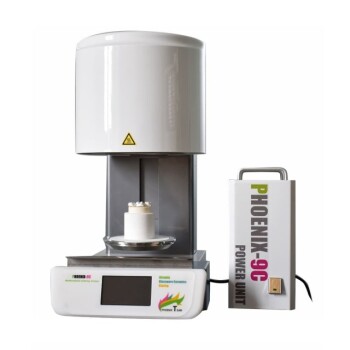
Restoring the functionality of saturated biochar requires precise thermal intervention. An atmosphere sintering furnace facilitates this by heating the biochar to 500°C within a controlled nitrogen environment, which triggers the pyrolysis or desorption of trapped organic pollutants. This process effectively clears blocked pores and restores active sites, allowing the material to recover over 96% of its initial adsorption capacity.
The atmosphere sintering furnace provides a high-temperature, oxygen-free environment that removes contaminants without destroying the biochar's carbon skeleton. By balancing heat and inert gas flow, the furnace transforms a waste product back into a high-performance adsorbent, significantly improving project sustainability.
The Mechanism of Thermal Regeneration
Thermal Desorption and Pyrolysis
The primary function of the furnace is to provide the energy necessary to break the bonds between the biochar and the adsorbed contaminants. At temperatures around 500°C, organic molecules—such as dyes or pharmaceuticals—undergo thermal decomposition or desorption. This phase transition converts the pollutants into gases, which are then swept away by the furnace's internal airflow.
Restoring the Porous Architecture
Saturated biochar loses its effectiveness because its internal "cages," or pores, are physically blocked by captured matter. The atmosphere sintering furnace clears these obstructions, re-opening the micro- and mesoporous structures that give biochar its high surface area. This restoration is what enables the material to achieve a regeneration efficiency of over 96%.
Preservation of the Carbon Skeleton
Unlike open-air heating, the furnace operates in an oxygen-limited environment by introducing a continuous flow of high-purity nitrogen. This prevents the biochar from combusting or turning into ash during the high-temperature cycle. By avoiding combustion, the furnace maintains the aromatic structure and physical integrity of the carbon skeleton for multiple reuse cycles.
Technical Precision in the Sintering Process
Controlled Heating Rates
Precision is critical to avoid structural collapse; furnaces often utilize specific heating rates, such as 10°C to 15°C per minute. This gradual increase allows for steady degassing and dehydration of the material. Controlled ramping ensures that the polycyclic aromatic hydrocarbons within the biochar remain stable while contaminants are purged.
The Role of Inert Gas Displacement
The furnace uses nitrogen or argon to displace oxygen, creating a strictly anaerobic condition. This atmosphere is essential not only for regeneration but also for regulating the fixed carbon content of the material. Consistent gas flow ensures that the volatile byproducts of the cleaned pollutants do not re-settle on the biochar surface.
Understanding the Trade-offs and Pitfalls
Energy Demand and Operational Cost
Operating an atmosphere sintering furnace at 500°C for extended periods requires significant electrical energy. For smaller operations, the cost of the nitrogen gas and the power required may rival the cost of producing new biochar. A careful economic analysis is required to ensure that recycling is more cost-effective than replacement.
Material Degradation Over Successive Cycles
While the first few regeneration cycles can recover nearly all capacity, biochar eventually experiences structural fatigue. Repeated heating and cooling can lead to "pore sintering," where the delicate walls of the pores begin to shrink or collapse. Over time, this reduces the specific surface area, leading to a diminishing return on each subsequent regeneration.
Byproduct Management
The regeneration process does not make the pollutants disappear; it simply moves them from a solid phase to a gaseous phase. These exhaust gases may contain toxic volatile organic compounds (VOCs) that were previously adsorbed. Facilities must be equipped with scrubbers or secondary combustion chambers to treat the furnace exhaust and prevent secondary environmental pollution.
Applying This to Your Biochar Project
Strategic Recommendations for Implementation
Effective regeneration depends on aligning the furnace settings with your specific material and pollutant type.
- If your primary focus is Maximum Reusability: Utilize a consistent 500°C setpoint under nitrogen to ensure over 96% capacity recovery while preserving the carbon skeleton.
- If your primary focus is Process Efficiency: Implement a gradual heating rate (10-15°C/min) to prevent material fracturing and ensure thorough degassing of complex organic molecules.
- If your primary focus is Environmental Compliance: Ensure the furnace is integrated with a gas filtration system to capture the pollutants released during the thermal desorption phase.
By leveraging the precise control of an atmosphere sintering furnace, you transform saturated biochar from a waste stream into a renewable technical asset.
Summary Table:
| Feature | Specification/Requirement | Impact on Biochar Regeneration |
|---|---|---|
| Operating Temperature | ~500°C | Triggers pyrolysis & desorption of pollutants |
| Inert Atmosphere | Nitrogen ($N_2$) or Argon | Prevents carbon combustion; preserves skeleton |
| Heating Rate | 10°C to 15°C per minute | Prevents pore collapse; ensures steady degassing |
| Recovery Efficiency | Over 96% | Restores surface area & active adsorption sites |
| Key Outcome | Structural Integrity | Maintains aromatic structure for multiple cycles |
Maximize Your Biochar Lifecycle with KINTEK Precision
Is your research or industrial process hindered by the high cost of adsorbent replacement? KINTEK provides the advanced thermal solutions necessary to transform waste into a high-performance resource. Our specialized atmosphere and vacuum furnaces offer the precise temperature control and inert environment required to achieve over 96% regeneration efficiency for saturated biochar.
Beyond biochar recovery, KINTEK specializes in a comprehensive range of laboratory equipment including:
- High-Temperature Furnaces: Muffle, tube, rotary, and atmosphere-controlled systems for diverse thermal processing.
- Material Processing: Crushing, milling, and hydraulic presses (pellet, hot, isostatic) for sample preparation.
- Advanced Reactors: High-temperature high-pressure reactors and autoclaves for complex chemical synthesis.
- Laboratory Essentials: Electrolytic cells, cooling solutions (ULT freezers), and high-durability ceramics/crucibles.
Ready to enhance your lab’s sustainability and efficiency? Contact our technical experts today to find the perfect furnace configuration for your regeneration project.
References
- Yiting Mao, Zhongqing Ma. A sustainable preparation strategy for the nitrogen-doped hierarchical biochar with high surface area for the enhanced removal of organic dye. DOI: 10.1007/s42773-023-00269-z
This article is also based on technical information from Kintek Solution Knowledge Base .
Related Products
- Mesh belt controlled atmosphere furnace
- Controlled Nitrogen Inert Hydrogen Atmosphere Furnace
- 1200℃ Controlled Atmosphere Furnace Nitrogen Inert Atmosphere Furnace
- 1700℃ Controlled Atmosphere Furnace Nitrogen Inert Atmosphere Furnace
- 1400℃ Controlled Atmosphere Furnace with Nitrogen and Inert Atmosphere
People Also Ask
- Why is a furnace equipped with a controlled atmosphere necessary for the preparation of active metal catalysts?
- What are some of the reasons why a controlled atmosphere furnace is desirable in sintering? Achieve Superior Sintering Results
- What role does a controlled atmosphere furnace with argon gas flow play in the production of reduced graphene oxide (rGO)?
- What is the process of a mesh belt furnace? Achieve Consistent, High-Volume Heat Treatment
- How does a mesh belt furnace work? Achieve High-Volume, Repeatable Heat Treatment