Knowledge tube furnace How to clean an alumina tube furnace? Extend Tube Life and Ensure Experimental Purity
Author avatar

Tech Team · Kintek Solution

Updated 2 months ago

How to clean an alumina tube furnace? Extend Tube Life and Ensure Experimental Purity


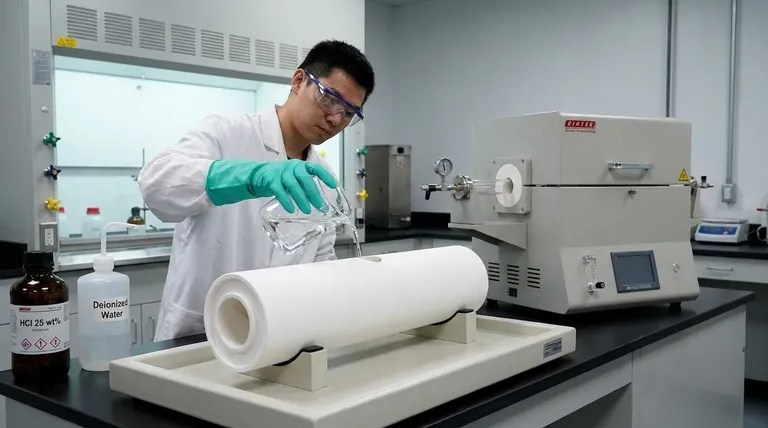
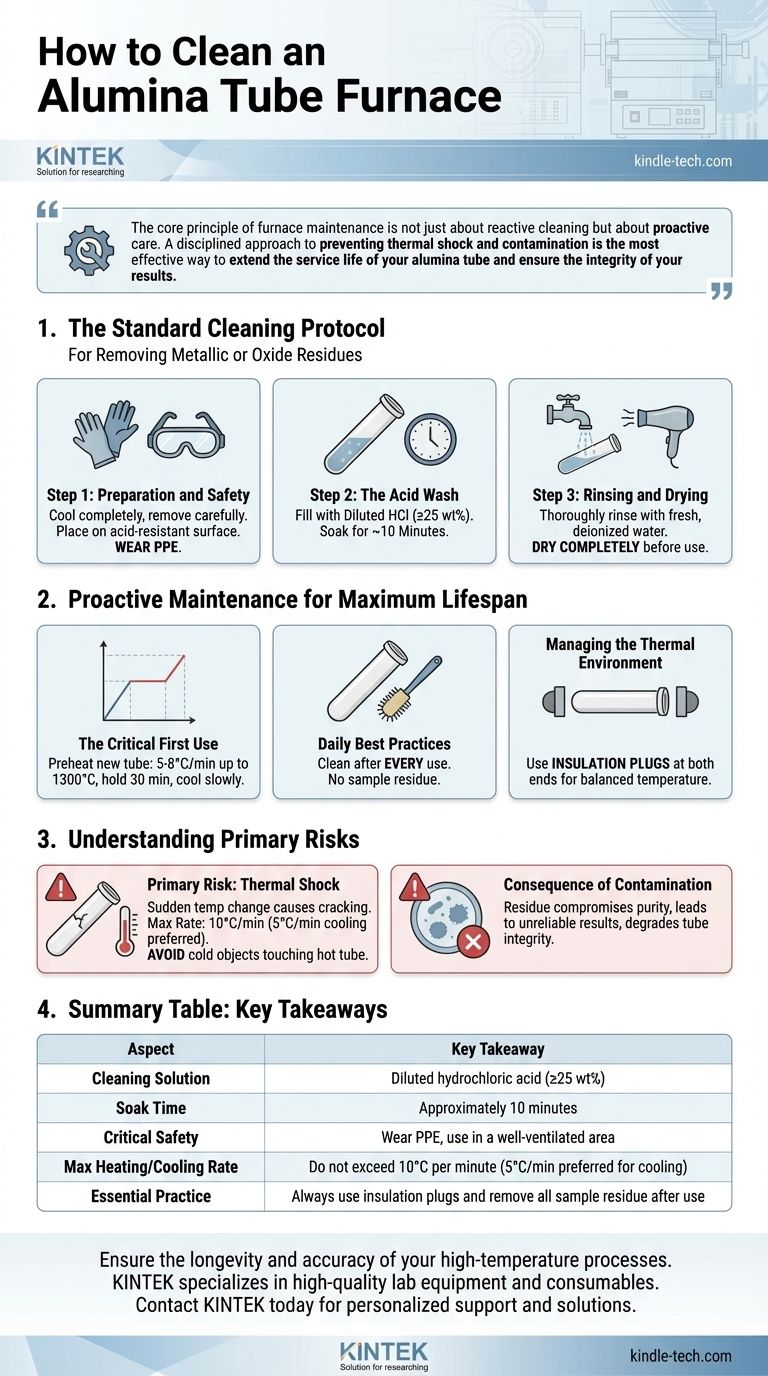
To properly clean an alumina furnace tube, you must first remove it from the furnace and let it cool completely. The standard procedure involves carefully filling the tube with a diluted hydrochloric acid solution (at least 25 wt%), allowing it to soak for approximately 10 minutes to dissolve contaminants, and then thoroughly rinsing it with fresh water until all traces of acid are gone.

The core principle of furnace maintenance is not just about reactive cleaning but about proactive care. A disciplined approach to preventing thermal shock and contamination is the most effective way to extend the service life of your alumina tube and ensure the integrity of your results.
How to clean an alumina tube furnace? Extend Tube Life and Ensure Experimental Purity

The Standard Cleaning Protocol

For removing metallic or oxide residues, an acid wash is the accepted method. This should be performed in a well-ventilated area with appropriate personal protective equipment (PPE).

Step 1: Preparation and Safety

First, ensure the alumina tube is completely cool and has been carefully removed from the furnace assembly. Place it on a stable, clean surface that is resistant to acid. Always wear gloves and eye protection when handling chemicals.

Step 2: The Acid Wash

Carefully fill the tube with a hydrochloric acid (HCl) solution with a concentration of at least 25 wt%. Be mindful of the chemical's reactivity with the specific contaminants you are trying to remove.

Let the tube soak for about 10 minutes. This duration is typically sufficient to dissolve common residues without damaging the alumina surface.

Step 3: Rinsing and Drying

After soaking, carefully drain the acid into an appropriate waste container. Thoroughly rinse the inside of the tube with fresh, deionized water multiple times to neutralize and remove any remaining acid.

Allow the tube to dry completely before placing it back into service. Introducing moisture into a high-temperature environment can cause thermal shock and damage the tube.

Proactive Maintenance for Maximum Lifespan

Cleaning is a necessary task, but the best strategy is to minimize the need for it. Proper operational procedures are critical for protecting your investment.

The Critical First Use

When using a new alumina tube, it must be preheated to eliminate manufacturing stresses and burn off any surface pollutants. A typical program involves heating at a rate of 5-8°C per minute up to 1300°C, holding for 30 minutes, and then cooling slowly.

Daily Best Practices

After every use, ensure the inside of the tube is clean and that no sample material remains. Residue left at high temperatures can fuse to the tube wall, making it difficult to remove and potentially contaminating future experiments.

Managing the Thermal Environment

Insulation plugs are essential for proper operation. Place ceramic plugs at both ends of the tube to help create a balanced temperature field. This prevents the ends of the tube from overheating, which can damage the O-ring seals and compromise the system's air tightness.

Understanding the Primary Risks

Mishandling an alumina tube can lead to premature failure. Understanding the two main risks—thermal shock and contamination—is key to avoiding them.

The Primary Risk: Thermal Shock

Alumina is a ceramic and is brittle. A sudden, drastic change in temperature will cause it to crack. This is known as thermal shock.

Never allow a low-temperature object to touch the furnace tube while it is hot. Most critically, adhere to strict heating and cooling rates. A rate not exceeding 10°C per minute is a safe guideline, with a slower cooling rate of 5°C per minute being preferable.

The Consequence of Contamination

Any sample residue left inside the tube can become a source of contamination for subsequent runs. This compromises the purity of your work and can lead to inaccurate or unreliable results. Over time, fused residue can also chemically attack the alumina, degrading the tube's structural integrity.

Making the Right Choice for Your Goal

Your maintenance approach should align with your operational priorities.

  • If your primary focus is routine cleaning after a run: Follow the acid wash protocol carefully, ensuring thorough rinsing and complete drying.
  • If your primary focus is maximizing tube lifespan: Prioritize slow, controlled heating and cooling rates and always avoid introducing cold items into a hot furnace.
  • If your primary focus is ensuring experimental purity: Pre-bake every new tube and maintain a strict cleaning discipline, never leaving sample residue behind after a cycle.

Ultimately, consistent and careful handling is the definitive factor in the long-term performance and reliability of your furnace tube.

Summary Table:

Aspect Key Takeaway
Cleaning Solution Diluted hydrochloric acid (≥25 wt%)
Soak Time Approximately 10 minutes
Critical Safety Wear PPE, use in a well-ventilated area
Max Heating/Cooling Rate Do not exceed 10°C per minute (5°C/min preferred for cooling)
Essential Practice Always use insulation plugs and remove all sample residue after use

Ensure the longevity and accuracy of your high-temperature processes. Properly maintaining your alumina furnace tubes is critical for reliable results and protecting your lab equipment investment. KINTEK specializes in high-quality lab equipment and consumables, including furnace tubes and accessories, to serve all your laboratory needs. Let our experts help you optimize your furnace maintenance protocol. Contact KINTEK today for personalized support and solutions.

Visual Guide
How to clean an alumina tube furnace? Extend Tube Life and Ensure Experimental Purity Visual Guide

Related Products

People Also Ask

Related Products

High Temperature Alumina (Al2O3) Furnace Tube for Engineering Advanced Fine Ceramics

High Temperature Alumina (Al2O3) Furnace Tube for Engineering Advanced Fine Ceramics

High temperature alumina furnace tube combines the advantages of high hardness of alumina, good chemical inertness and steel, and has excellent wear resistance, thermal shock resistance and mechanical shock resistance.

1700℃ Laboratory High Temperature Tube Furnace with Alumina Tube

1700℃ Laboratory High Temperature Tube Furnace with Alumina Tube

Looking for a high-temperature tube furnace? Check out our 1700℃ Tube Furnace with Alumina Tube. Perfect for research and industrial applications up to 1700C.

1400℃ Laboratory High Temperature Tube Furnace with Alumina Tube

1400℃ Laboratory High Temperature Tube Furnace with Alumina Tube

Looking for a tube furnace for high-temperature applications? Our 1400℃ Tube Furnace with Alumina Tube is perfect for research and industrial use.

High Temperature Aluminum Oxide (Al2O3) Protective Tube for Engineering Advanced Fine Ceramics

High Temperature Aluminum Oxide (Al2O3) Protective Tube for Engineering Advanced Fine Ceramics

Alumina oxide protective tube, also known as high temperature resistant corundum tube or thermocouple protection tube, is a ceramic tube mainly made of alumina (aluminum oxide).

Engineering Advanced Fine Alumina Al2O3 Ceramic Crucible for Laboratory Muffle Furnace

Engineering Advanced Fine Alumina Al2O3 Ceramic Crucible for Laboratory Muffle Furnace

Alumina ceramic crucibles are used in some materials and metal melting tools, and flat-bottomed crucibles are suitable for melting and processing larger batches of materials with better stability and uniformity.

Rotary Tube Furnace Split Multi Heating Zone Rotating Tube Furnace

Rotary Tube Furnace Split Multi Heating Zone Rotating Tube Furnace

Multi zone rotary furnace for high-precision temperature control with 2-8 independent heating zones. Ideal for lithium ion battery electrode materials and high-temperature reactions. Can work under vacuum and controlled atmosphere.

1200℃ Split Tube Furnace with Quartz Tube Laboratory Tubular Furnace

1200℃ Split Tube Furnace with Quartz Tube Laboratory Tubular Furnace

KT-TF12 split tube furnace: high-purity insulation, embedded heating wire coils, and max. 1200C. Widely used for new materials and chemical vapour deposition.

Vacuum Sealed Continuous Working Rotary Tube Furnace Rotating Tube Furnace

Vacuum Sealed Continuous Working Rotary Tube Furnace Rotating Tube Furnace

Experience efficient material processing with our vacuum-sealed rotary tube furnace. Perfect for experiments or industrial production, equipped with optional features for controlled feeding and optimized results. Order now.

Laboratory Vacuum Tilt Rotary Tube Furnace Rotating Tube Furnace

Laboratory Vacuum Tilt Rotary Tube Furnace Rotating Tube Furnace

Discover the versatility of Laboratory Rotary Furnace: Ideal for calcination, drying, sintering, and high-temperature reactions. Adjustable rotating and tilting functions for optimal heating. Suitable for vacuum and controlled atmosphere environments. Learn more now!

Vertical Laboratory Tube Furnace

Vertical Laboratory Tube Furnace

Elevate your experiments with our Vertical Tube Furnace. Versatile design allows for operation under various environments and heat treatment applications. Order now for precise results!

Laboratory High Pressure Vacuum Tube Furnace

Laboratory High Pressure Vacuum Tube Furnace

KT-PTF High Pressure Tube Furnace: Compact split tube furnace with strong positive pressure resistance. Working temp up to 1100°C and pressure up to 15Mpa. Also works under controller atmosphere or high vacuum.

Multi-zone Laboratory Tube Furnace

Multi-zone Laboratory Tube Furnace

Experience precise, efficient thermal testing with our Multi Zone Tube Furnace. Independent heating zones and temperature sensors allow for controlled high-temperature gradient heating fields. Order now for advanced thermal analysis!

Multi Heating Zones CVD Tube Furnace Machine Chemical Vapor Deposition Chamber System Equipment

Multi Heating Zones CVD Tube Furnace Machine Chemical Vapor Deposition Chamber System Equipment

KT-CTF14 Multi Heating Zones CVD Furnace - Precise Temperature Control and Gas Flow for Advanced Applications. Max temp up to 1200℃, 4 channels MFC mass flow meter, and 7" TFT touch screen controller.

Laboratory Rapid Thermal Processing (RTP) Quartz Tube Furnace

Laboratory Rapid Thermal Processing (RTP) Quartz Tube Furnace

Get lightning-fast heating with our RTP Rapid Heating Tube Furnace. Designed for precise, high-speed heating and cooling with convenient sliding rail and TFT touch screen controller. Order now for ideal thermal processing!

Engineering Advanced Fine Ceramics Alumina Crucibles (Al2O3) for Thermal Analysis TGA DTA

Engineering Advanced Fine Ceramics Alumina Crucibles (Al2O3) for Thermal Analysis TGA DTA

TGA/DTA thermal analysis vessels are made of aluminum oxide (corundum or aluminum oxide). It can withstand high temperature and is suitable for analyzing materials that require high temperature testing.

1200℃ Controlled Atmosphere Furnace Nitrogen Inert Atmosphere Furnace

1200℃ Controlled Atmosphere Furnace Nitrogen Inert Atmosphere Furnace

Discover our KT-12A Pro Controlled atmosphere furnace - high precision, heavy duty vacuum chamber, versatile smart touch screen controller, and excellent temperature uniformity up to 1200C. Ideal for both laboratory and industrial application.

1700℃ Controlled Atmosphere Furnace Nitrogen Inert Atmosphere Furnace

1700℃ Controlled Atmosphere Furnace Nitrogen Inert Atmosphere Furnace

KT-17A Controlled atmosphere furnace: 1700℃ heating, vacuum sealing technology, PID temperature control, and versatile TFT smart touch screen controller for laboratory and industrial use.

Ceramic Evaporation Boat Set Alumina Crucible for Laboratory Use

Ceramic Evaporation Boat Set Alumina Crucible for Laboratory Use

It can be used for vapor deposition of various metals and alloys. Most metals can be evaporated completely without loss. Evaporation baskets are reusable.1

Arc-Shaped Alumina Ceramic Crucible High Temperature Resistant for Engineering Advanced Fine Ceramics

Arc-Shaped Alumina Ceramic Crucible High Temperature Resistant for Engineering Advanced Fine Ceramics

In the journey of scientific exploration and industrial production, every detail is crucial. Our arc-shaped alumina ceramic crucibles, with their excellent high temperature resistance and stable chemical properties, have become a powerful assistant in laboratories and industrial fields. They are made of high-purity alumina materials and manufactured through precision processes to ensure excellent performance in extreme environments.

Engineering Advanced Fine Ceramics Alumina Al2O3 Crucible With Lid Cylindrical Laboratory Crucible

Engineering Advanced Fine Ceramics Alumina Al2O3 Crucible With Lid Cylindrical Laboratory Crucible

Cylindrical Crucibles Cylindrical crucibles are one of the most common crucible shapes, suitable for melting and processing a wide variety of materials, and are easy to handle and clean.


Leave Your Message