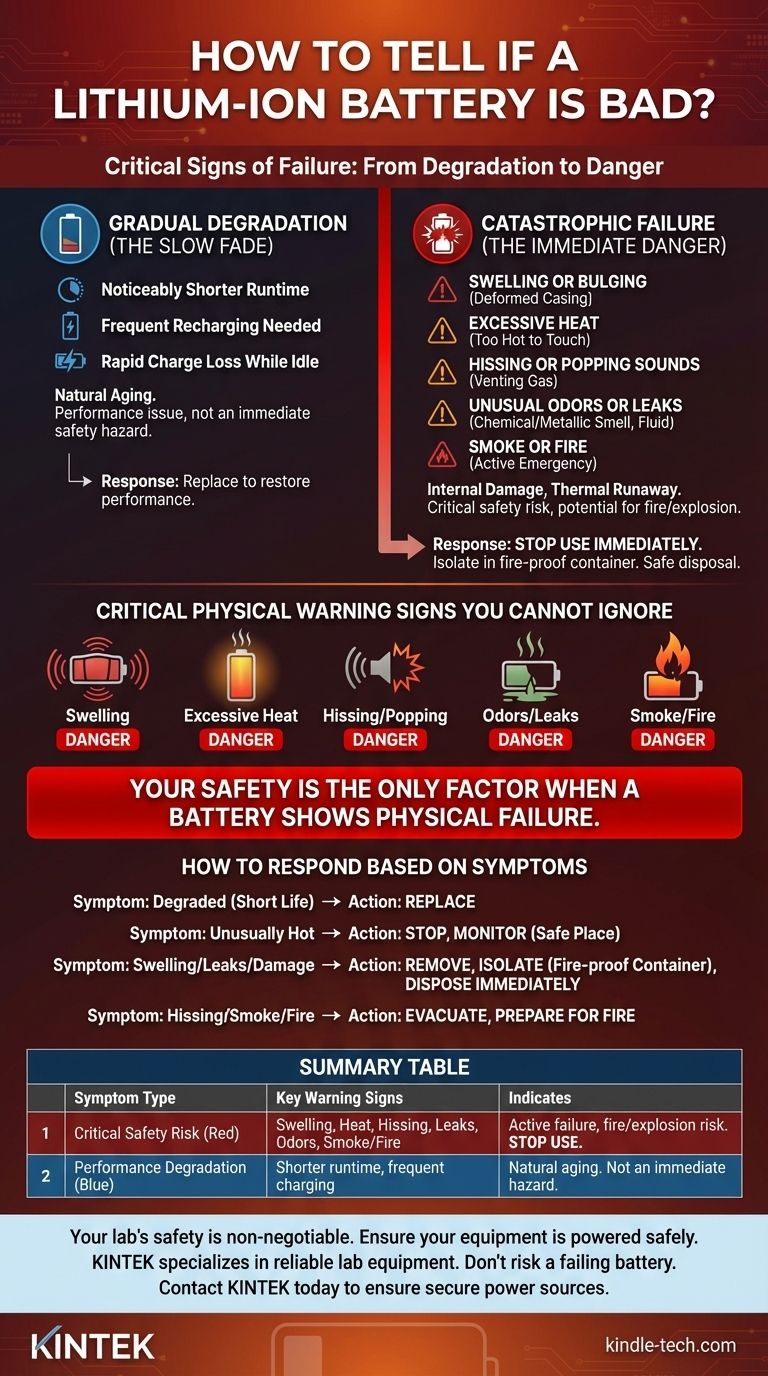
To tell if a lithium-ion battery is bad, look for critical physical warning signs. The most immediate indicators of a dangerous failure are swelling or bulging, excessive heat during charging or use, and any leaking fluid. Additionally, listen for hissing or cracking sounds and be aware of any strange, metallic, or acrid odors, as these signal a severe internal chemical reaction that could lead to fire.
The core issue is that battery failure is not a single event; it exists on a spectrum from simple performance degradation to catastrophic, hazardous failure. Recognizing the difference between a battery that is merely old and one that is actively dangerous is crucial for your safety.
The Two Faces of Battery Failure: Degradation vs. Danger
A "bad" battery can mean two very different things. One is an inconvenience, while the other is a serious safety risk. Understanding the distinction is the first step in correctly diagnosing the problem.
Gradual Degradation (The Slow Fade)
This is the most common type of battery failure and is a natural part of the aging process. It is a performance issue, not an immediate safety hazard.
Key symptoms include a noticeably shorter runtime and the need to charge your device far more frequently than when it was new. Another sign is a battery that loses its charge quickly even when the device isn't being used.
Catastrophic Failure (The Immediate Danger)
This type of failure is caused by internal damage or defects, leading to a volatile and unstable state. This is not a performance issue; it is a critical safety alert.
The signs are unambiguous and indicate an internal short circuit or a process called thermal runaway has begun. Ignoring these warnings can result in fire or explosion.
Critical Physical Warning Signs You Cannot Ignore
If you observe any of the following symptoms, you are dealing with a potentially dangerous battery. You must stop using the device and handle the situation with extreme care.
Visual Damage: Swelling and Punctures
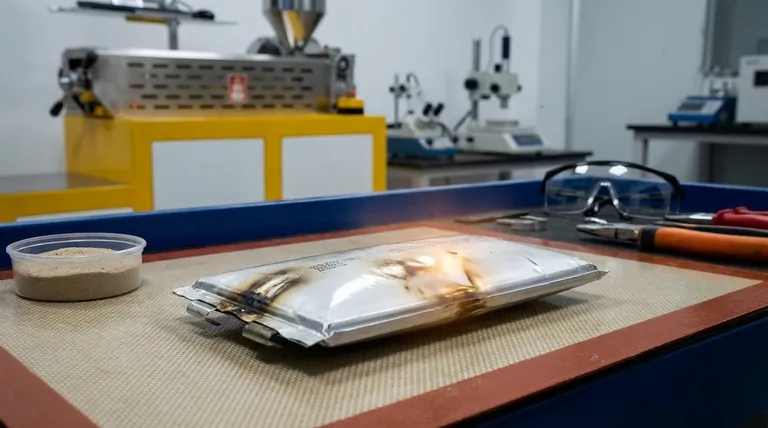
A battery swells or bulges because the internal chemical reaction is failing and producing gas. This buildup of gas creates pressure, deforming the battery's casing. A swollen battery is highly unstable and must be treated as a significant fire risk.
Audible Warnings: Hissing or Popping
Failing lithium-ion batteries can emit hissing, popping, or crackling sounds. This is the sound of the high-pressure gas venting from the battery cells. It's an audible sign that the internal structure is compromised.
Unusual Odors or Leaks
If you notice a strong, unusual chemical or metallic odor, the battery's seals have likely been breached. These fumes are toxic and flammable. Any sign of liquid leaking from the battery is also a clear indicator of a critical failure.
Excessive Heat
It's normal for a battery to feel slightly warm during charging or heavy use. However, if a battery becomes too hot to comfortably touch, it is a major red flag. This excessive heat is a primary indicator of an internal short circuit that can lead to thermal runaway.
Smoke or Fire
This is the most extreme sign. If your device or battery is smoking, a fire has likely already started inside. This is an active emergency, not just a warning sign.
Understanding the Trade-offs
Knowing what to do depends entirely on the type of failure you're observing. The decision process for a degraded battery is completely different from that for a physically damaged one.
The Cost of Ignoring Degradation
Using a battery with poor capacity is not a safety risk. The only trade-off is performance and convenience. You'll be tethered to a charger, and your device will be less reliable, but it is not inherently dangerous.
The Non-Negotiable Risk of Physical Damage
There are no acceptable trade-offs when it comes to physical damage. A swollen, leaking, or overheating battery is a hazard. Continuing to use or charge it creates a serious and unnecessary risk of fire and injury to yourself and others. The only correct action is its immediate and safe removal.
How to Respond Based on the Symptoms
Your response should be directly proportional to the symptoms you observe.
- If your battery simply doesn't hold a charge: Your battery has degraded and should be replaced to restore your device's performance and reliability.
- If your battery gets unusually hot during use: Immediately stop using and charging the device, and monitor it in a safe place away from flammable materials.
- If you see any swelling, leaking, or physical damage: This is a critical safety risk. Safely remove the battery, place it in a fire-proof container (like a metal can with sand), and take it to a proper e-waste or battery disposal facility immediately.
- If you hear hissing, smell strange odors, or see smoke: This is an active emergency. Move the device to a safe location away from flammable materials if possible, evacuate the area, and prepare for a potential fire.
Ultimately, your safety is the only factor that matters when a battery shows signs of physical failure.
Summary Table:
| Symptom Type | Key Warning Signs | Indicates |
|---|---|---|
| Critical Safety Risk | Swelling/Bulging, Excessive Heat, Hissing Sounds, Leaking Fluid, Strange Odors | Active internal failure, potential for fire or explosion. Stop use immediately. |
| Performance Degradation | Shorter runtime, frequent need to recharge, loses charge while idle | Natural aging, reduced capacity. Not an immediate safety hazard. |
Your lab's safety is non-negotiable. Ensure your equipment is powered safely.
KINTEK specializes in providing reliable lab equipment and consumables. A failing battery in a critical instrument like a furnace or analyzer can compromise your research and safety. Don't risk it.
Let our experts help you maintain a safe and efficient lab environment. Contact KINTEK today to discuss your laboratory equipment needs and ensure your power sources are secure.
Visual Guide
Related Products
- Filter Testing Machine FPV for Dispersion Properties of Polymers and Pigments
- Laboratory Vortex Mixer Orbital Shaker Multifunctional Rotation Oscillation Mixer
- Laboratory Test Sieves and Vibratory Sieve Shaker Machine
- Battery Lab Equipment 304 Stainless Steel Strip Foil 20um Thick for Battery Test
- Aluminum Foil Current Collector for Lithium Battery
People Also Ask
- Is there a battery tester for lithium batteries? Unlock Accurate Health Diagnostics Beyond Voltage
- Why is coating thickness important? Achieve Optimal Performance and Cost Control
- What is the minimum coating thickness? How Steel Thickness Determines Your Galvanizing Needs
- How do you test the capacity of a lithium-ion battery? A Guide to Accurate Measurement
- What is the significance of compression set? Predict Material Failure and Ensure Long-Term Reliability