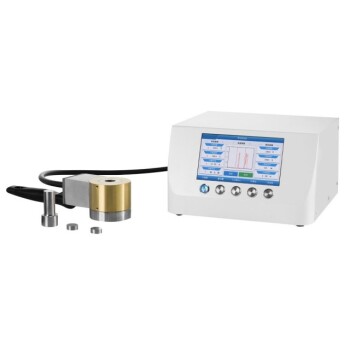
Knowledge What are the advantages of using a heating die for Li6PS5Cl pellets? Optimize Electrolyte Molding and Densification
Author avatar

Tech Team · Kintek Solution

Updated 1 day ago

What are the advantages of using a heating die for Li6PS5Cl pellets? Optimize Electrolyte Molding and Densification


Using a heated die set between 150 and 200 degrees Celsius during Li6PS5Cl electrolyte pellet molding primarily serves to soften the material, which significantly enhances particle flowability and bonding under pressure. This process yields superior structural integrity compared to cold pressing by actively healing grain boundaries and minimizing internal defects.

The application of moderate heat (150–200°C) allows for the direct production of high-performance pellets by mitigating stress and enhancing densification. This effectively eliminates the need for subsequent, energy-intensive high-temperature sintering steps.

The Physics of Thermal-Assisted Molding

Softening the Material

At temperatures between 150 and 200 degrees Celsius, the Li6PS5Cl material undergoes a softening process.

This thermal state is critical because it reduces the yield strength of the particles. Consequently, the material becomes more compliant, allowing for superior particle flowability when pressure is applied.

Enhancing Particle Bonding

The heat applied during the molding process facilitates better contact between individual particles.

This promotes stronger adhesion at the microscopic level. The result is a more cohesive pellet structure that is difficult to achieve through room-temperature mechanical force alone.

Healing Grain Boundaries

One of the most distinct advantages of this temperature range is the ability to heal grain boundaries.

In cold pressing, the interfaces between particles often remain distinct and weak. The heated die ensures these boundaries fuse more effectively, creating a continuous, denser electrolyte network.

Structural Integrity and Defect Reduction

Reducing Internal Stress

Cold pressing often locks internal stresses into the pellet, which can lead to failure over time.

By molding in a heated environment, the material can relax during densification. This thermal relaxation prevents the buildup of internal stress that typically occurs during compaction.

Minimizing Micro-Cracks

A direct result of reduced internal stress is the significant reduction of micro-cracks.

Micro-cracks are common defects in cold-pressed ceramics that compromise ionic conductivity and mechanical strength. The 150–200°C window effectively mitigates these flaws, ensuring a robust final product.

Process Efficiency and Trade-offs

Eliminating Post-Process Sintering

The most significant process advantage is the removal of the sintering stage.

Because the heated die produces a dense, well-bonded pellet, manufacturers can skip the high-temperature sintering usually required to fix cold-pressed defects. This saves time and reduces energy consumption.

Temperature Precision Requirements

While this method simplifies the overall workflow, it introduces complexity at the molding stage.

You must maintain the 150 to 200 degrees Celsius range with high precision. Deviating below this range may result in insufficient bonding, while exceeding it could potentially alter the material's phase or degrade its properties.

Making the Right Choice for Your Goal

To maximize the benefits of this molding technique, align your process parameters with your specific manufacturing objectives.

  • If your primary focus is mechanical reliability: Utilize the 150–200°C range to minimize micro-cracks and internal stress, ensuring the pellet can withstand handling and integration.
  • If your primary focus is manufacturing speed: Leverage the heated die to produce finished, high-performance pellets in a single step, bypassing the bottleneck of a secondary sintering cycle.

By integrating moderate heat into the die set, you transform the molding process from simple shaping into a dual-action step of densification and structural healing.

Summary Table:

Feature Cold Pressing Heated Die Molding (150-200°C)
Particle Flowability Limited; high friction Enhanced; material softening
Grain Boundaries Distinct and weak Fused and healed
Internal Stress High; prone to cracks Low; thermal relaxation
Sintering Step Usually required Often eliminated
Structural Integrity Lower; brittle Superior; high density

Precision is key in solid-state battery research. KINTEK specializes in advanced laboratory equipment, including heated hydraulic presses and pellet dies specifically designed for high-performance electrolyte molding. Whether you are working with Li6PS5Cl or other sulfide electrolytes, our solutions ensure uniform temperature control (up to 200°C+) and superior structural integrity. From crushing and milling systems to high-temperature vacuum furnaces and dental furnaces, we provide the tools to accelerate your material innovation. Contact KINTEK today to optimize your laboratory workflow!

Related Products

People Also Ask

Related Products

Special Shape Press Mold for Lab

Special Shape Press Mold for Lab

Discover high-pressure special shape press molds for diverse applications, from ceramics to automotive parts. Ideal for precise, efficient molding of various shapes and sizes.

Special Heat Press Mold for Lab Use

Special Heat Press Mold for Lab Use

Square, round and flat plate forming dies for hot presses.

Cylindrical Lab Electric Heating Press Mold for Laboratory Applications

Cylindrical Lab Electric Heating Press Mold for Laboratory Applications

Efficiently prepare samples with Cylindrical Lab Electric Heating Press Mold. Fast heating, high temp & easy operation. Custom sizes available. Perfect for battery, ceramic & biochemical research.

No Demolding Lab Infrared Press Mold for Laboratory Applications

No Demolding Lab Infrared Press Mold for Laboratory Applications

Effortlessly test your samples with no demolding required using our lab infrared press mold. Enjoy high transmittance and customizable sizes for your convenience.

Multi-Punch Rotary Tablet Press Mold Ring for Rotating Oval and Square Molds

Multi-Punch Rotary Tablet Press Mold Ring for Rotating Oval and Square Molds

The multi-punch rotary tablet press mold stands as a pivotal component in pharmaceutical and manufacturing industries, revolutionizing the process of tablet production. This intricate mold system comprises multiple punches and dies arranged in a circular fashion, facilitating rapid and efficient tablet formation.

Assemble Lab Cylindrical Press Mold

Assemble Lab Cylindrical Press Mold

Get reliable and precise molding with Assemble Lab Cylindrical Press Mold. Perfect for ultra-fine powder or delicate samples, widely used in material research and development.

Cylindrical Press Mold with Scale for Lab

Cylindrical Press Mold with Scale for Lab

Discover precision with our Cylindrical Press Mold. Ideal for high-pressure applications, it molds various shapes and sizes, ensuring stability and uniformity. Perfect for lab use.

XRF Boric Acid Lab Powder Pellet Pressing Mold for Laboratory Use

XRF Boric Acid Lab Powder Pellet Pressing Mold for Laboratory Use

Get accurate results with our XRF Boric Acid lab Powder Pellet Pressing Mold. Perfect for preparing samples for X-ray fluorescence spectrometry. Custom sizes available.

XRF & KBR plastic ring lab Powder Pellet Pressing Mold for FTIR

XRF & KBR plastic ring lab Powder Pellet Pressing Mold for FTIR

Get precise XRF samples with our plastic ring lab powder pellet pressing mold. Fast tableting speed and customizable sizes for perfect molding every time.

Polygon Press Mold for Lab

Polygon Press Mold for Lab

Discover precision polygon press molds for sintering. Ideal for pentagon-shaped parts, our molds ensure uniform pressure and stability. Perfect for repeatable, high-quality production.

Ball Press Mold for Lab

Ball Press Mold for Lab

Explore versatile Hydraulic Hot Press molds for precise compression molding. Ideal for creating various shapes and sizes with uniform stability.

Assemble Square Lab Press Mold for Laboratory Applications

Assemble Square Lab Press Mold for Laboratory Applications

Achieve perfect sample preparation with Assemble Square Lab Press Mold. Quick disassembly eliminates sample deformation. Perfect for battery, cement, ceramics, and more. Customizable sizes available.

Automatic Laboratory Hydraulic Pellet Press Machine for Lab Use

Automatic Laboratory Hydraulic Pellet Press Machine for Lab Use

Experience efficient sample preparation with our Automatic Lab Press Machine. Ideal for material research, pharmacy, ceramics, and more. Features a compact size and hydraulic press functionality with heating plates. Available in various sizes.

Square Lab Press Mold for Laboratory Applications

Square Lab Press Mold for Laboratory Applications

Create uniform samples easily with Square Lab Press Mold - available in various sizes. Ideal for battery, cement, ceramics, and more. Custom sizes available.

Carbide Lab Press Mold for Laboratory Applications

Carbide Lab Press Mold for Laboratory Applications

Form ultra-hard samples with Carbide Lab Press Mold. Made of Japanese high-speed steel, it has a long service life. Custom sizes available.

Automatic High Temperature Heated Hydraulic Press Machine with Heated Plates for Lab

Automatic High Temperature Heated Hydraulic Press Machine with Heated Plates for Lab

The High Temperature Hot Press is a machine specifically designed for pressing, sintering and processing materials in a high temperature environment. It is capable of operating in the range of hundreds of degrees Celsius to thousands of degrees Celsius for a variety of high temperature process requirements.

Manual High Temperature Heated Hydraulic Press Machine with Heated Plates for Lab

Manual High Temperature Heated Hydraulic Press Machine with Heated Plates for Lab

The High Temperature Hot Press is a machine specifically designed for pressing, sintering and processing materials in a high temperature environment. It is capable of operating in the range of hundreds of degrees Celsius to thousands of degrees Celsius for a variety of high temperature process requirements.

Manual Heated Hydraulic Press Machine with Heated Plates for Laboratory Hot Press

Manual Heated Hydraulic Press Machine with Heated Plates for Laboratory Hot Press

The Manual Heat Press is a versatile piece of equipment suitable for a variety of applications, operated by a manual hydraulic system that applies controlled pressure and heat to the material placed on the piston.

24T 30T 60T Heated Hydraulic Press Machine with Heated Plates for Laboratory Hot Press

24T 30T 60T Heated Hydraulic Press Machine with Heated Plates for Laboratory Hot Press

Looking for a reliable Hydraulic Heated Lab Press? Our 24T / 40T model is perfect for material research labs, pharmacy, ceramics, and more. With a small footprint and the ability to work inside a vacuum glove box, it's the efficient and versatile solution for your sample preparation needs.

Laboratory Manual Hydraulic Pellet Press for Lab Use

Laboratory Manual Hydraulic Pellet Press for Lab Use

Efficient Manure Lab Hydraulic Press with Safety Cover for sample preparation in material research, pharmacy, and electronic industries. Available in 15T to 60T.


Leave Your Message