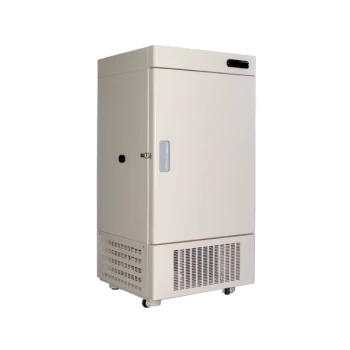
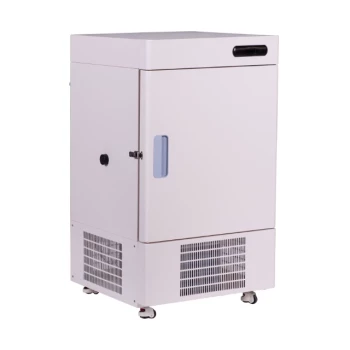
The decisive advantage of using a laboratory freeze dryer over a conventional oven is the prevention of hard agglomeration during the solvent removal process. While conventional ovens induce capillary forces that pull nanoparticles into dense, hard clumps, freeze drying utilizes sublimation to remove solvents, preserving the precursor as a loose, porous, and highly reactive powder.
Core Takeaway Conventional heat drying creates high surface tension in the liquid phase, causing the pore structure to collapse and particles to fuse into hard aggregates. Freeze drying bypasses this liquid phase entirely through vacuum sublimation, locking the particle structure in place to ensure superior dispersibility and sintering performance in the final ceramic product.
The Mechanism of Agglomeration Control
To understand why freeze drying is superior for nanopowders, you must look at the physics of how the solvent leaves the material.
The Problem with Oven Drying
In a conventional drying oven, heat causes the solvent to evaporate. As the liquid volume decreases, menisci form between the nanoparticles.
These liquid bridges create significant capillary forces (surface tension). This tension pulls the particles tightly together, causing the delicate lattice structure to collapse.
The result is "hard agglomeration"—dense clumps of material that are chemically bonded or physically fused. These are extremely difficult to break apart during subsequent processing steps.
The Freeze Drying Solution
A laboratory freeze dryer takes a different thermodynamic path. The precursor is first frozen, solidifying the solvent and locking the particles into their original dispersed state.
Under a high vacuum, the machine induces sublimation. The frozen solvent transitions directly from a solid to a gas, completely bypassing the liquid phase.
Because there is no liquid phase, there is no surface tension. The capillary forces that usually crush the nanopowder structure are eliminated.
Impact on Material Performance
The method of drying dictates the physical characteristics of your fluoride nanopowder and its behavior in later stages.
Preserving Porosity
Freeze drying maintains the original three-dimensional network of the precursor.
Instead of a dense brick, you are left with a loose, porous structure. The void spaces previously occupied by ice crystals remain open, acting as a spatial template that prevents particles from touching and fusing.
Soft vs. Hard Agglomerates
While freeze-dried powders may still clump, they form "soft agglomerates."
Unlike the hard aggregates from an oven, soft agglomerates are held together by weak van der Waals forces rather than strong chemical bonds. They can be easily broken down into individual nanoparticles during handling or mixing.
Enhanced Sintering Activity
For fluoride nanopowders, the ultimate goal is often sintering—fusing the powder into a solid ceramic.
A freeze-dried precursor with a porous, non-agglomerated structure offers higher sintering activity. The high specific surface area allows for more uniform densification at lower temperatures, leading to a higher quality final product.
Understanding the Trade-offs
While freeze drying produces a superior precursor, it is important to recognize the operational differences compared to oven drying.
Process Complexity and Time
Oven drying is a rapid, "set-and-forget" process. Freeze drying is a multi-step batch process that often requires 24 to 48 hours to complete depending on the solvent volume.
Equipment Requirements
A freeze dryer is a complex system involving vacuum pumps, condensers, and precise temperature controls. It requires more maintenance and energy than a resistive heating oven.
Making the Right Choice for Your Goal
The decision between these two methods depends entirely on the required quality of your final material.
- If your primary focus is material performance: Use the freeze dryer. The gains in dispersibility, porosity, and sintering activity are essential for high-performance ceramics and cannot be replicated by oven drying.
- If your primary focus is rough bulk processing: Use the drying oven. If the powder will be melted down or if agglomeration size is irrelevant to your application, the speed of oven drying is more efficient.
Summary: Use freeze drying when the microstructure matters; use oven drying when only the chemical composition matters.
Summary Table:
| Feature | Laboratory Freeze Dryer | Conventional Drying Oven |
|---|---|---|
| Mechanism | Sublimation (Solid to Gas) | Evaporation (Liquid to Gas) |
| Agglomeration | Soft (Easy to disperse) | Hard (Difficult to break) |
| Capillary Force | Eliminated (No surface tension) | High (Causes pore collapse) |
| Microstructure | Loose, porous, and reactive | Dense, fused, and clumped |
| Best Use Case | High-performance nanomaterials | Basic bulk processing |
Elevate Your Material Research with KINTEK
Don't let hard agglomeration compromise your experimental results. KINTEK specializes in advanced laboratory solutions designed to preserve the integrity of your most delicate precursors. From high-performance freeze dryers and cold traps to precision crushing and milling systems, we provide the tools you need for superior material synthesis.
Whether you are working on high-performance ceramics, battery research, or advanced chemical processing, our expert team is ready to help you select the ideal equipment for your workflow. Explore our range of high-temperature furnaces, hydraulic presses, and high-pressure reactors tailored for modern research labs.
Ready to achieve superior dispersibility and sintering activity?
Contact KINTEK Today for a Professional Consultation
Related Products
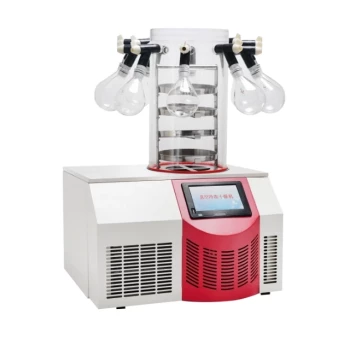
- High Performance Laboratory Freeze Dryer
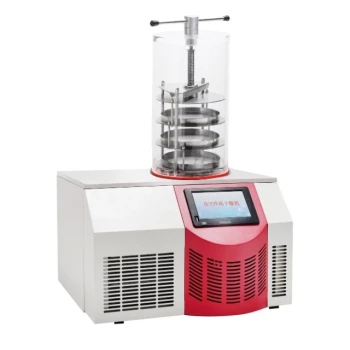
- High Performance Laboratory Freeze Dryer for Research and Development
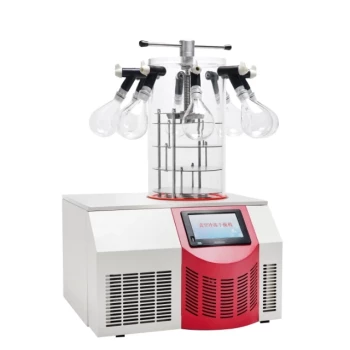
- Benchtop Laboratory Freeze Dryer for Lab Use
- Benchtop Laboratory Vacuum Freeze Dryer
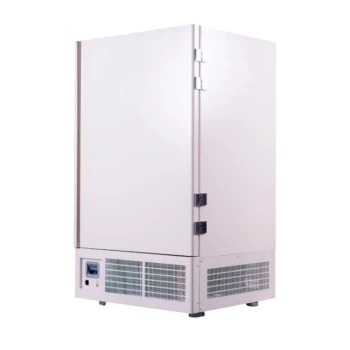
- 808L Precision Laboratory Vertical Ultra Low Temperature Freezer
People Also Ask
- What role does a laboratory freeze dryer play in the synthesis of graphene-based electrocatalysts? Preserve 3D Structures
- What are the technical advantages of using a laboratory freeze dryer for porous carbon precursors? Preserve 3D Networks
- What types of liquid samples can be processed using a laboratory freeze dryer? Preserve Your Sensitive Materials
- How do laboratory freeze dryers support scientific research? Preserve Sample Integrity for Reproducible Results
- Why is a laboratory freeze dryer preferred over traditional heating? Preserve Biochar Structure & Maximize Porosity