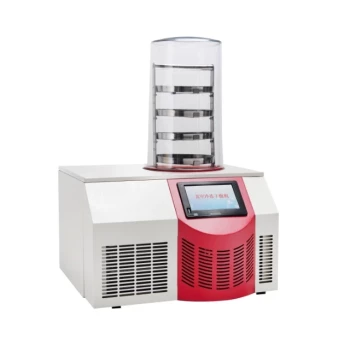
The definitive advantage of using a laboratory vacuum drying oven is the ability to thoroughly dry catalyst samples at significantly reduced temperatures. By lowering the environmental pressure, you facilitate rapid solvent evaporation at safe temperatures, such as 70 °C, which preserves the critical physical and chemical properties of the palladium-gold (Pd-Au) system.
Core Insight: The vacuum environment solves the two primary causes of catalyst deactivation during preparation: it eliminates the heat that causes nanoparticles to fuse (sintering) and removes the atmospheric oxygen that leads to surface oxidation.
Preserving Nanostructure Integrity
The most critical factor in catalyst performance is the surface area available for reactions. A conventional oven poses a direct threat to this metric.
Preventing Nanoparticle Sintering
High temperatures often required in conventional ovens can cause sintering. This is a process where individual nanoparticles merge to form larger agglomerates.
In a vacuum oven, the reduced pressure lowers the boiling point of solvents. This allows for effective drying at lower thermal thresholds (e.g., 70 °C), preventing the nanoparticles from growing and ensuring the original nanostructure remains intact.
Maintaining Active Surface Area
The catalytic activity of a Pd-Au bimetallic system is heavily dependent on particle size. Smaller particles provide a higher surface-to-volume ratio.
By avoiding high-heat exposure, you preserve the dispersion of the metal on the carbon support. This ensures that the maximum number of active sites remains available for the intended chemical reaction.
Mitigating Chemical Degradation
Beyond physical structure, the chemical state of the metal surface is paramount. Conventional ovens expose samples to heated air, which is chemically reactive.
Eliminating Oxidation Risks
A conventional oven surrounds the sample with hot atmospheric oxygen. For active metals, this environment accelerates surface oxidation.
A vacuum oven operates by evacuating the chamber. This creates an oxygen-depleted environment that significantly reduces the risk of oxidizing the active metal surfaces.
Protecting the Bimetallic Synergy
The interaction between palladium and gold is delicate. Unwanted oxidation can alter the electronic state of these metals.
By drying under vacuum, you ensure the metallic nature of the Pd-Au system is preserved. This maintains the specific catalytic behavior engineered into the bimetallic combination.
Operational Efficiency and Solvent Removal
The mechanism of drying in a vacuum oven differs fundamentally from convective heating, offering efficiency benefits.
Accelerated Evaporation
Reducing the internal pressure allows residual solvents to volatilize rapidly. This speeds up the drying process without requiring a proportional increase in temperature.
Deep Pore Cleaning
Carbon supports are often porous. Conventional drying may trap solvents deep within these pores if the surface dries and "skins" over too quickly.
The pressure differential in a vacuum oven helps pull moisture and solvents out from the internal pore structure. This results in a more thoroughly dried sample compared to atmospheric heating.
Understanding the Trade-offs
While vacuum drying offers superior quality for sensitive materials, it introduces specific operational requirements compared to conventional methods.
Equipment Complexity
Vacuum drying requires a sealed system and an external pump. This introduces more variables to monitor, such as vacuum levels and seal integrity, compared to the "set-and-forget" simplicity of a standard gravity convection oven.
Throughput Limitations
Because vacuum drying relies on a sealed chamber and often uses trays to maximize surface area exposure to the vacuum, the batch volume may be lower than what is possible in large industrial convection ovens. It is a process optimized for quality and precision rather than bulk throughput.
Making the Right Choice for Your Goal
When preparing carbon-supported Pd-Au catalysts, the choice of drying method dictates the final quality of the material.
- If your primary focus is Maximizing Catalytic Activity: Use the vacuum oven to prevent sintering, as keeping particle size small is the most effective way to ensure high reaction rates.
- If your primary focus is Compositional Purity: Rely on the vacuum environment to eliminate atmospheric oxygen, preventing the formation of unwanted oxide layers on the metal surface.
- If your primary focus is Structural Stability: Prioritize the low-temperature capabilities of vacuum drying to avoid thermally shocking the carbon support or altering the metal distribution.
The vacuum drying oven is not just a drying tool; it is a preservation chamber that locks in the nanostructure and chemical potential you worked to synthesize.
Summary Table:
| Feature | Vacuum Drying Oven | Conventional Oven |
|---|---|---|
| Drying Mechanism | Low-pressure evaporation | Convective heat transfer |
| Sintering Risk | Minimal (Low temperature) | High (Requires higher heat) |
| Oxidation Risk | Near Zero (Oxygen-depleted) | Significant (Atmospheric exposure) |
| Solvent Removal | Rapid & Deep (Pore extraction) | Slower (Surface-level drying) |
| Nanostructure | Preserved (Small particle size) | Risk of agglomeration |
| Complexity | Requires vacuum pump & seals | Simple "Set-and-Forget" |
Elevate Your Catalyst Performance with KINTEK
Don't compromise your research with thermal degradation or surface oxidation. KINTEK specializes in precision laboratory equipment designed to protect your most sensitive materials. Our advanced vacuum drying ovens ensure your Pd-Au catalysts maintain their nanostructure and active surface area through superior pressure control and temperature uniformity.
From high-temperature furnaces and vacuum systems to specialized crushing, milling, and hydraulic presses, KINTEK provides the comprehensive tools needed for advanced material synthesis and battery research.
Ready to achieve superior drying results? Contact our laboratory specialists today to find the perfect solution for your research and production needs!
References
- Zhun Zhao, Michael S. Wong. Volcano-shape glycerol oxidation activity of palladium-decorated gold nanoparticles. DOI: 10.1039/c4sc01001a
This article is also based on technical information from Kintek Solution Knowledge Base .
Related Products
- 56L Vertical Laboratory Vacuum Drying Oven
- 23L Laboratory Vacuum Drying Oven
- Laboratory Scientific Electric Heating Blast Drying Oven
- Benchtop Laboratory Vacuum Freeze Dryer
- Dental Porcelain Zirconia Sintering Ceramic Vacuum Press Furnace
People Also Ask
- Why is a laboratory vacuum drying oven recommended for rice straw residues? Protect Your Biomass Integrity
- What role does a laboratory vacuum drying oven play in the preparation of modified multi-walled carbon nanotubes?
- What is the importance of using a laboratory vacuum drying oven? Preserving Slow-Release Microcapsule Integrity
- Why is a Laboratory Vacuum Drying Oven recommended for PBAT microspheres? Protect Sensitive Polymer Integrity
- What role does a laboratory vacuum drying oven play in processing nanoparticle powder samples? Protect Sample Integrity