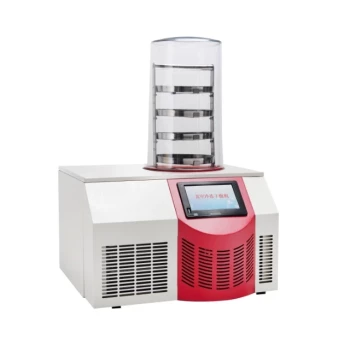
The primary advantage of using a laboratory vacuum drying oven is the preservation of biological viability through low-temperature moisture removal. By lowering the environmental pressure, this equipment allows excess surface moisture and residual solvents to evaporate rapidly without requiring high heat. This protects the sensitive internal activity of the Sulfate-Reducing Bacteria (SRB) from thermal degradation.
Core Takeaway Standard drying methods often rely on high temperatures that can kill bacteria or collapse particle structures. Vacuum drying decouples evaporation from heat, ensuring that SRB particles retain both their biological activity and porous structure for effective heavy metal removal over multiple cycles.
Preserving Biological Viability
The Risk of Thermal Damage
Sulfate-Reducing Bacteria (SRB) are biological entities driven by enzymatic processes. High temperatures, typically required in standard convection ovens to remove moisture, can denature these enzymes and kill the bacteria.
Vacuum drying mitigates this risk entirely. It enables effective drying at significantly lower temperatures, such as 45°C, ensuring the bacteria remain active and capable of metabolic function.
Enhancing Regeneration Cycles
The goal of regeneration is to restore the particle's ability to treat wastewater without manufacturing new particles.
By preventing heat-induced damage during the drying phase, the SRB retain their "internal activity." This ensures that the particles maintain high efficiency in removing heavy metals even after being regenerated and reused multiple times.
Maintaining Physical and Chemical Integrity
Protecting the Porous Structure
SRB are immobilized within a specific particle structure to maximize their contact with contaminants. The drying process must not collapse this structure.
Vacuum drying gently removes moisture from within the pores. This controlled process maintains the open, porous architecture necessary for water to flow through and for bacteria to access heavy metals.
Preventing Surface Cross-Linking
Beyond the bacteria themselves, the chemical properties of the particle surface matter.
As noted in advanced processing contexts, vacuum drying prevents the thermal degradation or surface cross-linking of functional groups (like sulfonic acid groups). This maximizes the retention of active sites, ensuring the chemical component of the filtration remains as effective as the biological component.
Efficient Solvent Removal
Regeneration processes often involve solvents like ethanol to wash the particles.
A vacuum environment causes these residual solvents to evaporate rapidly. This ensures thorough removal without subjecting the particle to prolonged processing times or harsh conditions that could degrade the immobilization matrix.
Understanding the Trade-offs
Equipment Complexity
While superior for biological preservation, vacuum ovens are more complex than standard drying ovens. They require a pump mechanism and vacuum seals, which introduces additional maintenance requirements compared to simple gravity or convection ovens.
Batch Size Limitations
Vacuum drying is typically a batch process constrained by the size of the vacuum chamber.
Unlike continuous belt dryers or large industrial convection ovens, the throughput may be lower. This requires careful planning of regeneration cycles to match the operational pace of the water treatment facility.
Making the Right Choice for Your Goal
To determine if this equipment is critical for your specific application, consider your primary operational metrics:
- If your primary focus is Cycle Longevity: You must use vacuum drying to prevent cumulative thermal damage, thereby extending the total lifespan of each immobilized particle batch.
- If your primary focus is Filtration Efficiency: The preservation of the porous structure provided by vacuum drying is essential to maintain high hydraulic conductivity and metal uptake rates.
- If your primary focus is Speed/Throughput: Evaluate if the batch limitations of the vacuum oven create a bottleneck, or if the rapid low-temp evaporation actually speeds up the drying phase enough to compensate.
Vacuum drying is not just a drying step; it is a preservation strategy that safeguards the biological engine of your water treatment process.
Summary Table:
| Feature | Vacuum Drying Advantage | Impact on SRB Regeneration |
|---|---|---|
| Temperature | Lower boiling point at low pressure | Prevents thermal degradation of bacterial enzymes |
| Structure | Gentle moisture removal | Maintains porous architecture for water flow |
| Chemistry | Prevents surface cross-linking | Maximizes retention of active sites for metal uptake |
| Efficiency | Rapid solvent evaporation | Ensures thorough removal of ethanol/washing agents |
Optimize Your Biological Research with KINTEK
Ensure the integrity of your immobilized particles and biological samples with KINTEK’s high-precision laboratory vacuum drying ovens. As specialists in advanced laboratory equipment, we provide the cooling and heating solutions necessary to maintain enzymatic activity and structural porosity in sensitive materials.
From vacuum ovens and freeze dryers to crushing systems and high-pressure reactors, KINTEK delivers the reliable tools needed for efficient material regeneration and heavy metal removal research.
Ready to extend the cycle longevity of your SRB particles?
Contact KINTEK Today for Professional Laboratory Solutions
References
- Wenbo An, Junzhen Di. Experimental study on the treatment of AMD by SRB immobilized particles containing “active iron” system. DOI: 10.1371/journal.pone.0295616
This article is also based on technical information from Kintek Solution Knowledge Base .
Related Products
- 56L Vertical Laboratory Vacuum Drying Oven
- 23L Laboratory Vacuum Drying Oven
- Laboratory Scientific Electric Heating Blast Drying Oven
- Vacuum Heat Treat Sintering Brazing Furnace
- Benchtop Laboratory Vacuum Freeze Dryer
People Also Ask
- Why is a laboratory vacuum drying oven recommended for rice straw residues? Protect Your Biomass Integrity
- What role does a laboratory vacuum drying oven play in the preparation of modified multi-walled carbon nanotubes?
- What is the importance of using a laboratory vacuum drying oven? Preserving Slow-Release Microcapsule Integrity
- Why is a Laboratory Vacuum Drying Oven recommended for PBAT microspheres? Protect Sensitive Polymer Integrity
- What role does a laboratory vacuum drying oven play in processing nanoparticle powder samples? Protect Sample Integrity