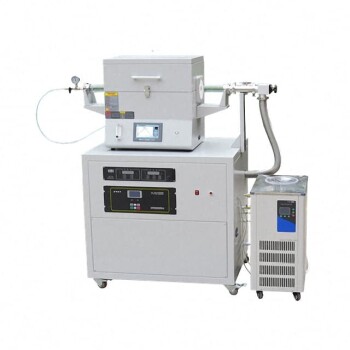
The distinct advantage of Plasma-Enhanced Chemical Vapor Deposition (PECVD) lies in its ability to synthesize vertically aligned carbon nanotubes (CNTs) at significantly lower substrate temperatures than traditional thermal methods. By using plasma to excite reaction gases, this equipment allows for the direct growth of multi-walled CNTs on conductive transparent substrates, creating high-performance composite photoelectrodes.
PECVD fundamentally changes the fabrication landscape by decoupling growth kinetics from thermal energy. It uses plasma-generated electric fields to force vertical alignment while maintaining low enough temperatures to preserve delicate substrates, optimizing both surface area and electrical conductivity.
The Mechanics of Enhanced Growth
Low-Temperature Synthesis
Traditional Chemical Vapor Deposition (CVD) often requires high heat to activate reaction gases, which can damage sensitive substrates. PECVD circumvents this by using plasma to energize the reactive gas (such as silane or oxygen).
This allows the synthesis of CNTs to proceed at much lower substrate temperatures. Consequently, this compatibility extends to "soft matter" and other temperature-sensitive materials essential for advanced electrode designs.
Directional Alignment via Electric Fields
A unique benefit of the PECVD environment is the generation of an electric field within the plasma sheath. This field plays a critical role in guiding the physical structure of the nanomaterials.
Under the influence of catalytic particles, CNTs are forced to grow vertically along the electric field lines. This mechanism is essential for creating organized, vertically aligned carbon nanotube arrays rather than tangled, random networks.
Optimizing Photoelectrode Performance
Maximizing Specific Surface Area
In photoelectrochemical applications, surface area dictates how much interaction occurs between the electrode and the electrolyte.
The vertical alignment achieved through PECVD prevents the CNTs from collapsing onto one another. This "standing" orientation ensures the highest possible specific surface area, maximizing the reactive interface for photon capture and chemical reactions.
Creating Superior Conductive Paths
Efficiency in photoelectrodes relies on moving electrons quickly to the external circuit. Randomly oriented nanotubes often suffer from poor contact resistance and convoluted electron pathways.
PECVD facilitates the direct growth of multi-walled CNTs onto the substrate, establishing a robust mechanical and electrical connection. The vertical alignment acts as a direct highway for electrons, significantly enhancing the conductive paths compared to post-synthesis deposition methods.
Precision and Control
Manipulating Material Properties
PECVD equipment offers granular control over critical process variables, including gas flow rates, catalyst ratios, and plasma power types (RF, DC, or microwave).
This precision allows researchers to manipulate not just the thickness of the deposition, but the conformational properties of the film. You can fine-tune the density and structure of the CNTs to meet specific electrochemical requirements.
Understanding the Trade-offs
Deposition Rate Limitations
While standard Radio Frequency (RF) PECVD excels at low-temperature operation, it can face limitations regarding the speed of film formation. Specifically, when using dilute silane for low-temperature deposition, the rate can be restricted.
However, technologies like Very High Frequency (VHF) PECVD are being utilized to mitigate this. VHF plasmas have higher density and lower electron temperature, which can significantly increase deposition rates compared to conventional RF setups.
Making the Right Choice for Your Goal
To maximize the value of PECVD for your specific photoelectrode project, consider your primary constraints:
- If your primary focus is substrate integrity: Utilize PECVD to grow high-quality CNTs on glass, polymers, or indium tin oxide (ITO) without risking thermal degradation or warping.
- If your primary focus is electron transport efficiency: Leverage the electric field generation of the plasma to ensure strict vertical alignment, reducing electron scattering and improving overall conductivity.
PECVD is not just a deposition tool; it is a structural engineering platform that allows you to build highly conductive, high-surface-area interfaces compatible with the next generation of photoelectrochemical devices.
Summary Table:
| Feature | PECVD Advantage | Impact on Photoelectrodes |
|---|---|---|
| Substrate Temperature | Low-temperature synthesis | Enables use of glass, polymers, and ITO substrates |
| Structural Alignment | Vertical growth via electric fields | Maximizes specific surface area and reduces entanglement |
| Electron Transport | Direct growth on conductive layers | Creates direct, high-speed highways for electrons |
| Process Control | Fine-tuning of plasma power & gas flow | Precise manipulation of CNT density and film properties |
| Material Integrity | Preserves delicate 'soft matter' | Prevents thermal degradation and warping of substrates |
Elevate Your Nanomaterial Research with KINTEK
Unlock the full potential of your photoelectrochemical applications with KINTEK’s precision PECVD systems. Whether you are synthesizing vertically aligned carbon nanotubes or developing next-generation composite electrodes, our equipment provides the granular control over plasma power and temperature that your research demands.
Why choose KINTEK for your laboratory?
- Advanced PECVD & CVD Solutions: Optimized for high-performance nanomaterial synthesis.
- Comprehensive Lab Portfolio: From high-temperature furnaces and vacuum systems to crushing, milling, and hydraulic presses.
- Specialized Tools: We offer state-of-the-art electrolytic cells, electrodes, and battery research consumables designed for precision.
Ready to enhance your lab's efficiency and achieve superior conductive paths? Contact KINTEK today to discuss your specific project requirements and find the perfect equipment for your material science goals.
References
- Wen He, Haowei Huang. Advancements in Transparent Conductive Oxides for Photoelectrochemical Applications. DOI: 10.3390/nano14070591
This article is also based on technical information from Kintek Solution Knowledge Base .
Related Products
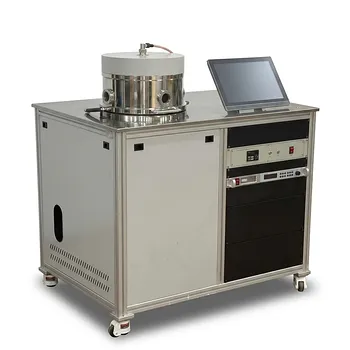
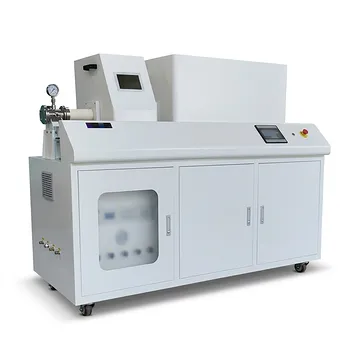
- Chemical Vapor Deposition CVD Equipment System Chamber Slide PECVD Tube Furnace with Liquid Gasifier PECVD Machine
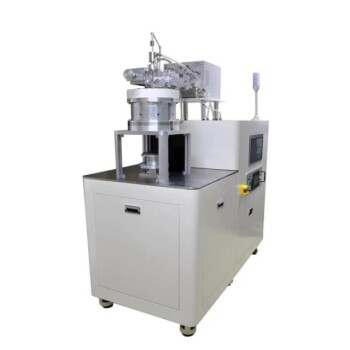
- Inclined Rotary Plasma Enhanced Chemical Vapor Deposition PECVD Equipment Tube Furnace Machine
- Inclined Rotary Plasma Enhanced Chemical Vapor Deposition PECVD Equipment Tube Furnace Machine
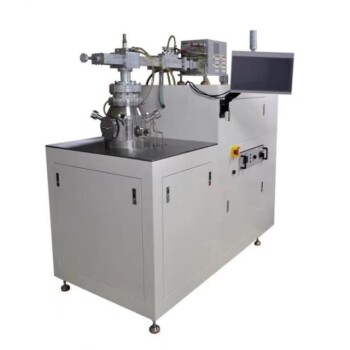
- RF PECVD System Radio Frequency Plasma-Enhanced Chemical Vapor Deposition RF PECVD
- Microwave Plasma Chemical Vapor Deposition MPCVD Machine System Reactor for Lab and Diamond Growth
People Also Ask
- What are the advantages of chemical vapor deposition? Achieve Superior Thin Films for Your Lab
- What types of substrates are used in CVD to facilitate graphene films? Optimize Graphene Growth with the Right Catalyst
- What is the chemical vapor deposition growth process? Build Superior Thin Films from the Atom Up
- How expensive is chemical vapor deposition? Understanding the True Cost of High-Performance Coating
- Why is Chemical Vapor Deposition (CVD) equipment uniquely suited for constructing hierarchical superhydrophobic structures?