Knowledge What are the disadvantages of tungsten filament? Key Limitations in Lighting Technology
Author avatar

Tech Team · Kintek Solution

Updated 6 days ago

What are the disadvantages of tungsten filament? Key Limitations in Lighting Technology


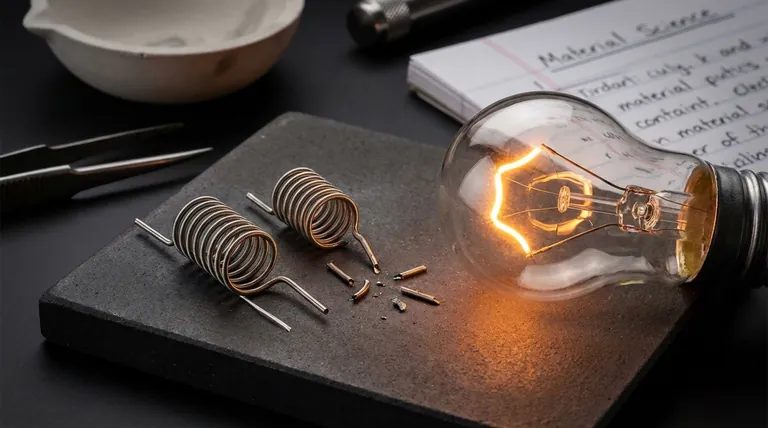
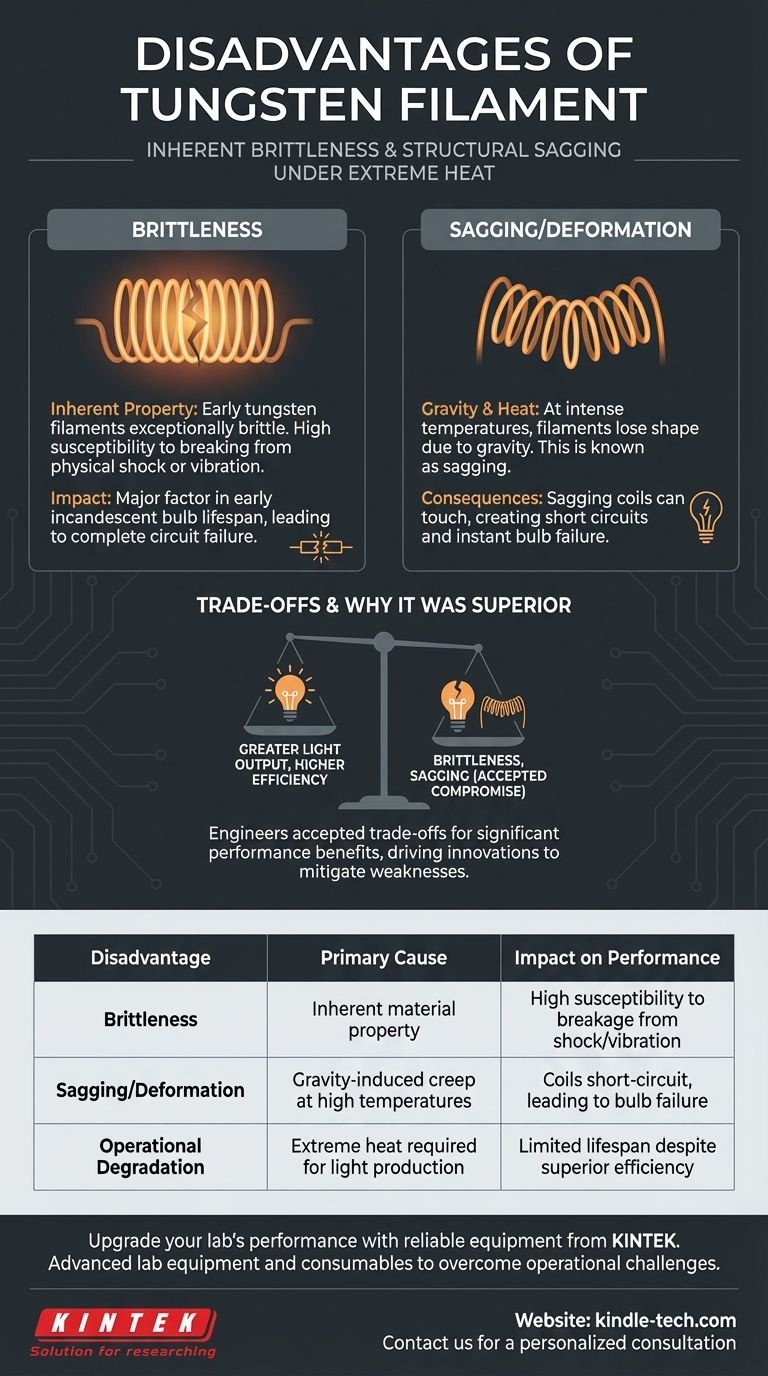
Despite its revolutionary impact on lighting, the primary disadvantages of the tungsten filament are its inherent brittleness and its tendency to physically deform under the extreme heat required for operation. These material limitations create significant engineering challenges and are the root cause of bulb failure.

The core challenge of the tungsten filament lies in a paradox: the very high temperatures required for efficient light production also accelerate its physical degradation, primarily through structural sagging and eventual material failure.
What are the disadvantages of tungsten filament? Key Limitations in Lighting Technology

The Fundamental Material Challenge: Brittleness

An Inherent Property

Early tungsten filaments were exceptionally brittle. This characteristic made them fragile and highly susceptible to breaking from physical shock or vibration.

Impact on Durability

This brittleness was a major factor in the lifespan of early incandescent bulbs. While tungsten was strong, its lack of ductility meant that any small fracture could lead to complete failure of the filament circuit.

The Operational Failure Mode: Sagging

The Effect of Gravity

At the intense temperatures needed to produce light, coiled tungsten filaments would slowly lose their shape due to the constant pull of gravity. This phenomenon is known as sagging.

Consequences of Deformation

As the filament sagged, the coils could eventually touch, creating a short circuit that would cause the bulb to fail instantly. This deformation was a significant and predictable point of failure in bulb design.

Understanding the Trade-offs

Why Tungsten Was Still Superior

Despite these clear disadvantages, tungsten was a massive improvement over the carbon filaments it replaced. It offered far greater light output and higher efficiency, measured in lumens per watt.

A Necessary Compromise

Engineers accepted the trade-offs of brittleness and sagging because tungsten's performance benefits were so significant. The problem then shifted from finding a new material to engineering solutions that could mitigate tungsten's known weaknesses.

How to Apply This Understanding

  • If your primary focus is historical technology: Recognize that tungsten's flaws directly drove innovations in filament manufacturing and bulb design to improve durability.
  • If your primary focus is material science: View the tungsten filament as a classic case study where a material's primary strength (heat resistance) is undermined by secondary operational stresses like gravity-induced creep.

Understanding these limitations reveals why the search for more durable and efficient lighting technologies was destined to continue.

Summary Table:

Disadvantage Primary Cause Impact on Performance
Brittleness Inherent material property High susceptibility to breakage from shock/vibration
Sagging/Deformation Gravity-induced creep at high temperatures Coils short-circuit, leading to bulb failure
Operational Degradation Extreme heat required for light production Limited lifespan despite superior efficiency

Upgrade your lab's performance with reliable equipment from KINTEK. Just as material limitations drove innovation beyond tungsten filaments, KINTEK provides advanced lab equipment and consumables to overcome your operational challenges. Whether you need durable heating elements, precise temperature control systems, or long-lasting laboratory tools, our solutions are engineered for efficiency and longevity.

Contact us today to discuss how KINTEK can enhance your laboratory's capabilities and reliability. Reach out via our contact form for a personalized consultation.

Visual Guide
What are the disadvantages of tungsten filament? Key Limitations in Lighting Technology Visual Guide

Related Products

People Also Ask

Related Products

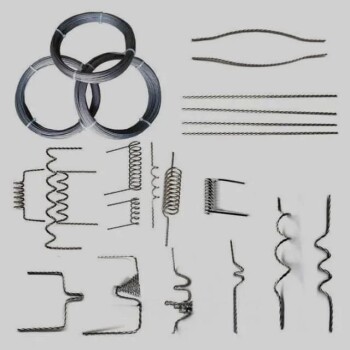
Thermally Evaporated Tungsten Wire for High Temperature Applications

Thermally Evaporated Tungsten Wire for High Temperature Applications

It has a high melting point, thermal and electrical conductivity, and corrosion resistance. It is a valuable material for high temperature, vacuum and other industries.

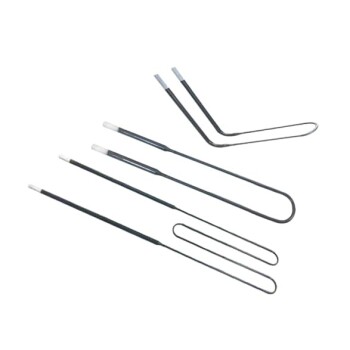
Molybdenum Disilicide (MoSi2) Thermal Elements Electric Furnace Heating Element

Molybdenum Disilicide (MoSi2) Thermal Elements Electric Furnace Heating Element

Discover the power of Molybdenum Disilicide (MoSi2) Heating Element for high-temperature resistance. Unique oxidation resistance with stable resistance value. Learn more about its benefits now!

High-Purity Titanium Foil and Sheet for Industrial Applications

High-Purity Titanium Foil and Sheet for Industrial Applications

Titanium is chemically stable, with a density of 4.51g/cm3, which is higher than aluminum and lower than steel, copper, and nickel, but its specific strength ranks first among metals.

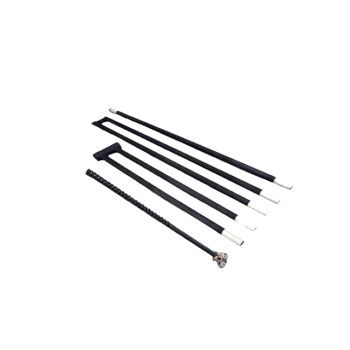
Silicon Carbide SiC Thermal Heating Elements for Electric Furnace

Silicon Carbide SiC Thermal Heating Elements for Electric Furnace

Experience the advantages of Silicon Carbide (SiC) Heating Element: Long service life, high corrosion and oxidation resistance, fast heating speed, and easy maintenance. Learn more now!

Small Vacuum Heat Treat and Tungsten Wire Sintering Furnace

Small Vacuum Heat Treat and Tungsten Wire Sintering Furnace

The small vacuum tungsten wire sintering furnace is a compact experimental vacuum furnace specially designed for universities and scientific research institutes. The furnace features a CNC welded shell and vacuum piping to ensure leak-free operation. Quick-connect electrical connections facilitate relocation and debugging, and the standard electrical control cabinet is safe and convenient to operate.

Custom PTFE Teflon Parts Manufacturer for PTFE Buchner Funnel and Triangular Funnel

Custom PTFE Teflon Parts Manufacturer for PTFE Buchner Funnel and Triangular Funnel

The PTFE funnel is a piece of laboratory equipment used primarily for filtration processes, particularly in the separation of solid and liquid phases in a mixture. This setup allows for efficient and rapid filtration, making it indispensable in various chemical and biological applications.

High Temperature Constant Temperature Heating Circulator Water Bath Chiller Circulator for Reaction Bath

High Temperature Constant Temperature Heating Circulator Water Bath Chiller Circulator for Reaction Bath

Efficient and reliable, KinTek KHB Heating Circulator is perfect for your lab needs. With a max. heating temperature of up to 300℃, it features accurate temperature control and fast heating.

High Purity Zinc Foil for Battery Lab Applications

High Purity Zinc Foil for Battery Lab Applications

There are very few harmful impurities in the chemical composition of zinc foil, and the surface of the product is straight and smooth; it has good comprehensive properties, processability, electroplating colorability, oxidation resistance and corrosion resistance, etc.

Optical Ultra-Clear Glass Sheet for Laboratory K9 B270 BK7

Optical Ultra-Clear Glass Sheet for Laboratory K9 B270 BK7

Optical glass, while sharing many characteristics with other types of glass, is manufactured using specific chemicals that enhance properties crucial for optics applications.

Warm Isostatic Press for Solid State Battery Research

Warm Isostatic Press for Solid State Battery Research

Discover the advanced Warm Isostatic Press (WIP) for semiconductor lamination. Ideal for MLCC, hybrid chips, and medical electronics. Enhance strength and stability with precision.

Infrared Heating Quantitative Flat Plate Press Mold

Infrared Heating Quantitative Flat Plate Press Mold

Discover advanced infrared heating solutions with high-density insulation and precise PID control for uniform thermal performance in various applications.

Double Plate Heating Press Mold for Lab

Double Plate Heating Press Mold for Lab

Discover precision in heating with our Double Plate Heating Mold, featuring high-quality steel and uniform temperature control for efficient lab processes. Ideal for various thermal applications.

Aluminum Foil Current Collector for Lithium Battery

Aluminum Foil Current Collector for Lithium Battery

The surface of aluminum foil is extremely clean and hygienic, and no bacteria or microorganisms can grow on it. It is a non-toxic, tasteless and plastic packaging material.

Custom PTFE Teflon Parts Manufacturer for PTFE Ball Valve Seat

Custom PTFE Teflon Parts Manufacturer for PTFE Ball Valve Seat

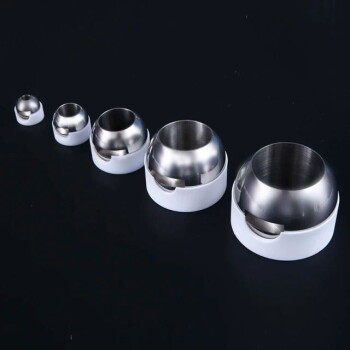
Seats and inserts are vital components in the valve industry. As a key component, polytetrafluoroethylene is usually selected as the raw material.

Custom PTFE Teflon Parts Manufacturer Corrosion Resistant Cleaning Rack Flower Basket

Custom PTFE Teflon Parts Manufacturer Corrosion Resistant Cleaning Rack Flower Basket

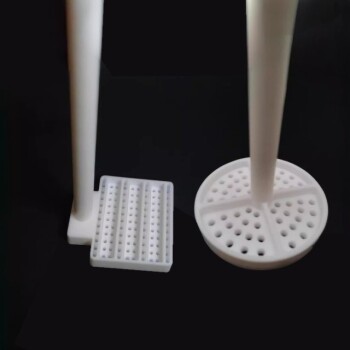
The PTFE cleaning rack, also known as the PTFE flower basket cleaning flower basket, is a specialized laboratory tool designed for the efficient cleaning of PTFE materials. This cleaning rack ensures thorough and safe cleaning of PTFE items, maintaining their integrity and performance in laboratory settings.

Custom PTFE Teflon Parts Manufacturer for PTFE Measuring Cylinder 10/50/100ml

Custom PTFE Teflon Parts Manufacturer for PTFE Measuring Cylinder 10/50/100ml

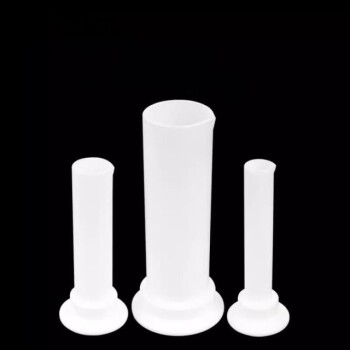
PTFE measuring cylinder are a rugged alternative to traditional glass cylinders. They are chemically inert over a wide temperature range (up to 260º C), have excellent corrosion resistance and maintain a low coefficient of friction, ensuring ease of use and cleaning.

Proton Exchange Membrane for Batteries Lab Applications

Proton Exchange Membrane for Batteries Lab Applications

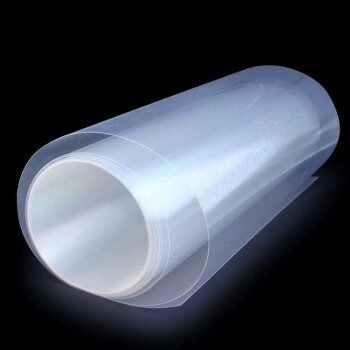
Thin proton exchange membrane with low resistivity; high proton conductivity; low hydrogen permeation current density; long life; suitable for electrolyte separators in hydrogen fuel cells and electrochemical sensors.

Manual High Temperature Heated Hydraulic Press Machine with Heated Plates for Lab

Manual High Temperature Heated Hydraulic Press Machine with Heated Plates for Lab

The High Temperature Hot Press is a machine specifically designed for pressing, sintering and processing materials in a high temperature environment. It is capable of operating in the range of hundreds of degrees Celsius to thousands of degrees Celsius for a variety of high temperature process requirements.

Automatic Laboratory Heat Press Machine

Automatic Laboratory Heat Press Machine

Precision automatic heat press machines for labs—ideal for material testing, composites, and R&D. Customizable, safe, and efficient. Contact KINTEK today!

Vacuum Hot Press Furnace Machine for Lamination and Heating

Vacuum Hot Press Furnace Machine for Lamination and Heating

Experience clean and precise lamination with Vacuum Lamination Press. Perfect for wafer bonding, thin-film transformations, and LCP lamination. Order now!


Leave Your Message