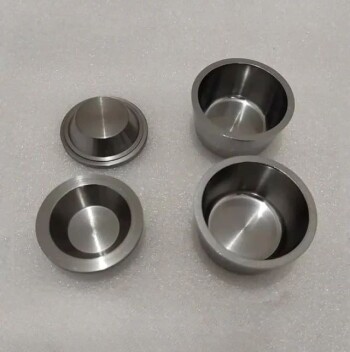
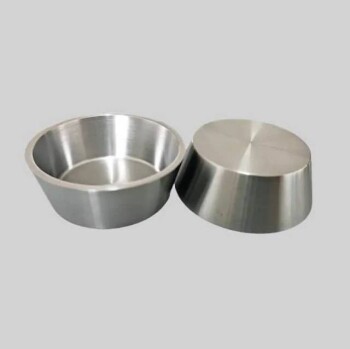
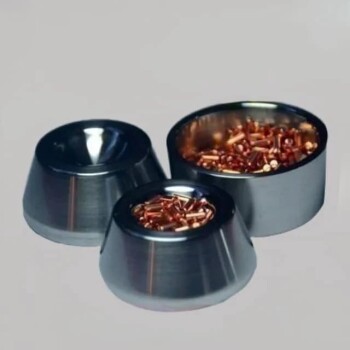
In liquid metal electrochemical corrosion testing, the high-strength stainless steel crucible serves a role that goes beyond simple storage. It performs two distinct, simultaneous functions: it acts as the physical containment vessel for the liquid Lead-Bismuth Eutectic (LBE) alloy and operates as the counter electrode within the electrochemical circuit.
By merging the containment and electrical roles into a single component, this design removes the need for complex internal electrode assemblies. This simplifies high-temperature testing significantly while ensuring a more stable and uniform electrical environment.
The Mechanics of the Dual-Function Design
Function 1: Physical Containment
The most immediate function of the crucible is structural. It provides a robust reservoir for the liquid Lead-Bismuth Eutectic (LBE) alloy.
Because the environment involves high temperatures and liquid metal, the crucible is fabricated from high-strength stainless steel. This material choice ensures the vessel maintains integrity under thermal stress and the specific physical demands of holding heavy liquid metals.
Function 2: The Counter Electrode
Simultaneously, the crucible wall itself is wired to function as the counter electrode. In a standard three-electrode setup, the counter electrode completes the circuit, allowing current to flow between it and the working electrode (the sample being tested).
By using the conductive stainless steel walls as this electrode, the system utilizes the entire inner surface of the container as an active electrical component.
Why This Configuration Matters
Simplifying High-Temperature Setups
Testing in liquid metal environments often requires complex lids with multiple feedthroughs for sensors and electrodes.
By turning the container into the counter electrode, researchers eliminate the need to insert a separate, bulky electrode rod into the melt. This simplifies the electrode configuration, freeing up space and reducing points of failure in the experimental rig.
Ensuring Uniform Current Distribution
The geometry of the counter electrode dictates how current flows through the electrolyte (the liquid metal).
Because the crucible surrounds the working electrode, it offers a large surface area. This geometry facilitates a highly uniform current distribution, which prevents "hot spots" of current density that can occur with smaller, rod-shaped counter electrodes.
Operational Considerations
The Necessity of High-Strength Material
While the dual function is efficient, it places a heavy burden on the crucible material. It must be mechanically strong enough to contain the LBE while being conductive enough to serve as an electrode.
The reference specifically notes the use of high-strength stainless steel. Standard steel might deform or degrade too quickly under the combined thermal and chemical stress of the LBE, compromising both the containment and the electrical test.
Surface Area Implications
The benefit of uniform current distribution relies on the crucible being significantly larger than the sample being tested.
If the surface area of the crucible were too small relative to the sample, it could limit the electrochemical reactions. The design works specifically because the container naturally provides a massive surface area compared to the test specimen.
Optimizing Your Experimental Setup
To maximize the benefits of this dual-functional crucible design, align your approach with your specific testing goals:
- If your primary focus is experimental simplicity: Utilize the crucible walls as the ground/counter electrode to reduce the number of ports required in your test cell lid, minimizing thermal leaks.
- If your primary focus is data precision: Rely on the crucible's large surface area to ensure uniform current density, which is critical for obtaining noise-free corrosion rate measurements.
This approach transforms a passive component into an active tool, streamlining the path to accurate high-temperature corrosion data.
Summary Table:
| Feature | Physical Containment Function | Counter Electrode Function |
|---|---|---|
| Primary Role | Robust reservoir for liquid metal (LBE) | Completes the electrochemical circuit |
| Material Benefit | High-strength steel resists thermal stress | Conductive walls provide active surface area |
| Design Advantage | Simplifies complex high-temp assemblies | Ensures uniform current distribution |
| Impact on Data | Maintains structural integrity | Provides stable, noise-free measurements |
Elevate Your Corrosion Research with KINTEK Precision
Optimize your liquid metal electrochemical testing with high-performance laboratory solutions from KINTEK. Our expertise in high-temperature environments ensures you get the most reliable equipment for your research needs.
From high-strength stainless steel crucibles and high-temperature high-pressure reactors to specialized electrolytic cells and electrodes, KINTEK provides the robust tools required for challenging material science applications. Whether you are conducting battery research or high-temperature metal analysis, our comprehensive range of muffle furnaces, vacuum systems, and ceramic consumables is designed to enhance your lab's efficiency and data precision.
Ready to streamline your experimental setup? Contact KINTEK today to discover how our high-performance systems can support your next breakthrough.
References
- R. Auguste, John R. Scully. A multimodal approach to revisiting oxidation defects in Cr2O3. DOI: 10.1038/s41529-022-00269-7
This article is also based on technical information from Kintek Solution Knowledge Base .
Related Products
- High Purity Pure Graphite Crucible for Electron Beam Evaporation
- Electron Beam Evaporation Coating Tungsten Crucible and Molybdenum Crucible for High Temperature Applications
- High Purity Pure Graphite Crucible for Evaporation
- E Beam Crucibles Electron Gun Beam Crucible for Evaporation
- Flat Corrosion Electrolytic Electrochemical Cell
People Also Ask
- What is the container that holds the metal source material called in e-beam evaporation? Ensure Purity and Quality in Your Thin-Film Deposition
- What role do high-purity graphite crucibles play in molten salt corrosion research? Ensure Reactor-Grade Precision
- Why is a high-purity graphite crucible ideal for nitrogen-doped graphene at 1500 °C? Maximize Purity and Stability
- What dual roles do high-purity graphite crucibles play? Expert Insights into Fluoride Salt Testing
- What role does a high-purity graphite crucible play in CaO-MgO-Al2O3-SiO2 system equilibrium experiments? Maximize Accuracy