Knowledge universal laboratory press What are the hazards of press machine? Mitigate Crushing, Amputation, and Other Critical Risks
Author avatar

Tech Team · Kintek Solution

Updated 2 months ago

What are the hazards of press machine? Mitigate Crushing, Amputation, and Other Critical Risks


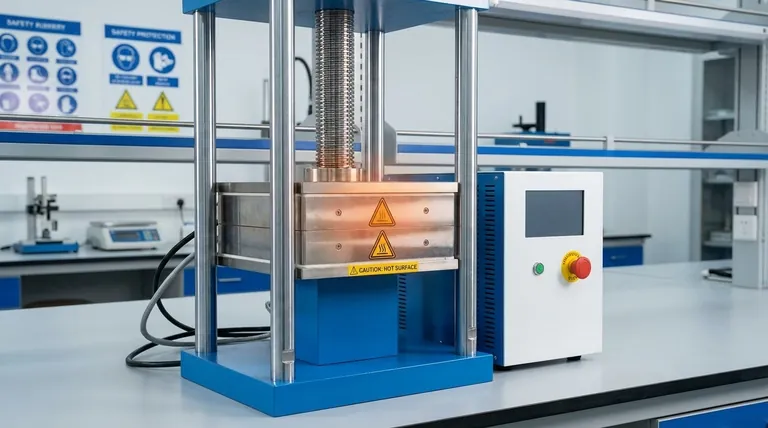
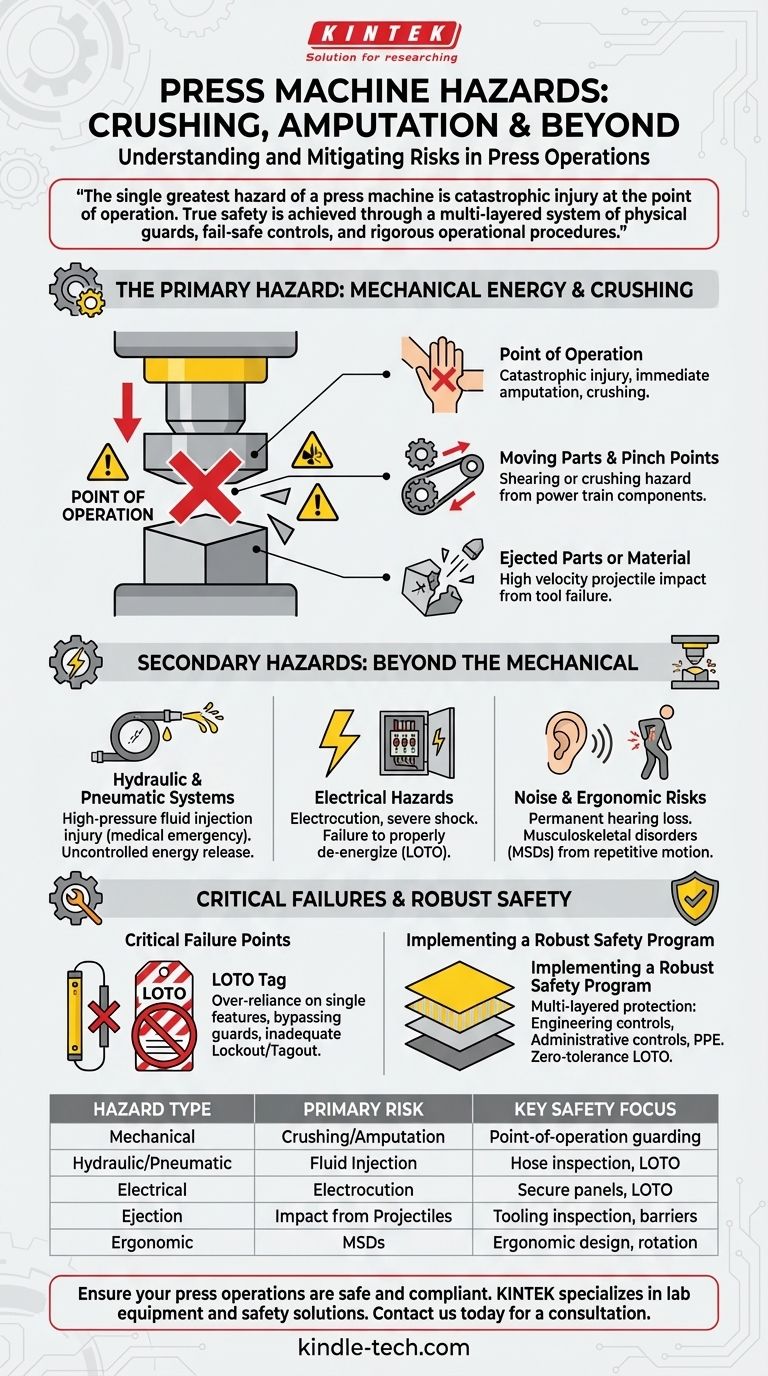
The single greatest hazard of a press machine is catastrophic injury at the point of operation. These machines generate immense force in a concentrated area, creating a severe and immediate risk of crushing and amputation for any operator who is not adequately protected. Beyond this primary danger, press machines also present significant mechanical, electrical, and hydraulic hazards.

The inherent danger of a press machine lies in its core function: the delivery of massive force. True safety is never guaranteed by a machine's design alone; it is achieved through a multi-layered system of physical guards, fail-safe controls, and rigorous operational procedures.
What are the hazards of press machine? Mitigate Crushing, Amputation, and Other Critical Risks

The Primary Hazard: Mechanical Energy and Crushing

The fundamental danger of any press is the mechanical force it is designed to deliver. Understanding where and how this energy is released is the first step in mitigating risk.

Point of Operation

The point of operation is where the die or tool performs work on the material. This is, without question, the most dangerous area of the machine.

Any body part, typically hands or arms, caught in this zone during a cycle will be subjected to forces capable of causing immediate amputation or life-altering crushing injuries.

Moving Parts and Pinch Points

Beyond the primary tool, the machine's power train—including flywheels, gears, belts, and linkages—creates numerous pinch points.

These are areas where a moving part of the machine moves past a stationary part, creating a shearing or crushing hazard for clothing, hair, or limbs.

Ejected Parts or Material

A press cycle subjects the tooling (dies) and the workpiece to extreme stress. A fractured die or shattered workpiece can be ejected from the machine at high velocity.

These projectiles pose a significant impact hazard to the operator and anyone else in the vicinity.

Secondary Hazards: Beyond the Mechanical

While mechanical force is the most obvious risk, the systems that power and control the press introduce their own set of serious hazards.

Hydraulic and Pneumatic Systems

Hydraulic presses operate using fluid under extremely high pressure. A pinhole leak in a hose can eject a nearly invisible stream of fluid powerful enough to penetrate skin and cause a severe fluid injection injury, which is a medical emergency.

Sudden failure of pneumatic or hydraulic components can also lead to an uncontrolled and rapid release of stored energy, causing the press ram to drop unexpectedly.

Electrical Hazards

Press machines are powerful electrical devices. The primary risks are electrocution or severe shock from contact with damaged wiring, open control panels, or improperly grounded equipment.

Failure to de-energize the machine correctly before maintenance is a leading cause of electrical accidents.

Noise and Ergonomic Risks

The constant, high-decibel impact of many presses can lead to permanent hearing loss over time.

Furthermore, the repetitive motions required to load and unload a press can lead to musculoskeletal disorders (MSDs) affecting the back, shoulders, and arms.

Understanding Critical Failure Points

Trusting a single safety feature is a common and dangerous mistake. A robust safety system acknowledges that any individual component can fail or be bypassed.

Over-reliance on a Single Safety Feature

No single guard is foolproof. A light curtain can be misaligned, a two-hand control can be defeated by a single operator, and a physical barrier can be removed.

Effective safety relies on layers of protection, often called "redundancy," where multiple systems work together to protect the operator.

Inadequate Lockout/Tagout (LOTO)

The most severe press-related injuries often occur during maintenance, setup, or jam-clearing, not during normal production.

Failing to implement and enforce a strict Lockout/Tagout (LOTO) program—which ensures the machine is completely de-energized and cannot be started—is a critical safety failure.

Bypassing Safety Guards

Operators or maintenance personnel may be tempted to disable or bypass safety devices to speed up production or make a task easier.

This practice eliminates crucial layers of protection and dramatically increases the risk of a catastrophic accident. It must be strictly prohibited.

Implementing a Robust Press Safety Program

Your approach to safety must be comprehensive, addressing the machine, the operator, and your procedures.

  • If your primary focus is operator protection: Your absolute priority must be effective point-of-operation guarding, such as fixed barrier guards, light curtains, or properly implemented two-hand controls.
  • If your primary focus is maintenance safety: Mandate, audit, and enforce a zero-tolerance Lockout/Tagout (LOTO) program for any task that requires an employee to place any part of their body into a danger zone.
  • If your primary focus is overall risk reduction: Implement a multi-layered system that combines engineering controls (guards), administrative controls (rigorous training, supervision), and appropriate Personal Protective Equipment (PPE).

A safe operation is the product of continuous vigilance, not a one-time setup.

Summary Table:

Hazard Type Primary Risk Key Safety Focus
Mechanical Crushing/Amputation at Point of Operation Point-of-operation guarding (light curtains, two-hand controls)
Hydraulic/Pneumatic High-Pressure Fluid Injection Regular hose inspection, Lockout/Tagout (LOTO) procedures
Electrical Electrocution from Live Components Secure panels, proper grounding, strict LOTO enforcement
Ejection Impact from Projectiles Tooling inspection, use of barriers
Ergonomic Musculoskeletal Disorders (MSDs) Ergonomic workstation design, task rotation

Ensure your press operations are safe and compliant. The risks of crushing, amputation, and hydraulic injection are severe, but they can be managed with the right equipment and protocols. KINTEK specializes in lab equipment and consumables, serving laboratory needs. Our experts can help you identify the right safety solutions for your specific press machine application. Contact us today for a consultation and let us help you build a robust, multi-layered safety program to protect your team and your productivity.

Visual Guide
What are the hazards of press machine? Mitigate Crushing, Amputation, and Other Critical Risks Visual Guide

Related Products

People Also Ask

Related Products

Automatic High Temperature Heated Hydraulic Press Machine with Heated Plates for Lab

Automatic High Temperature Heated Hydraulic Press Machine with Heated Plates for Lab

The High Temperature Hot Press is a machine specifically designed for pressing, sintering and processing materials in a high temperature environment. It is capable of operating in the range of hundreds of degrees Celsius to thousands of degrees Celsius for a variety of high temperature process requirements.

Heated Hydraulic Press Machine with Heated Plates for Vacuum Box Laboratory Hot Press

Heated Hydraulic Press Machine with Heated Plates for Vacuum Box Laboratory Hot Press

Enhance your lab's precision with our lab press for vacuum box. Press pills and powders with ease and precision in a vacuum environment, reducing oxidation and improving consistency. Compact and easy to use with a digital pressure gauge.

Single Punch Tablet Press Machine and Mass Production Rotary Tablet Punching Machine for TDP

Single Punch Tablet Press Machine and Mass Production Rotary Tablet Punching Machine for TDP

Rotary tablet punching machine is an automatic rotating and continuous tableting machine. It is mainly used for tablet manufacturing in the pharmaceutical industry, and is also suitable for industrial sectors such as food, chemicals, batteries, electronics, ceramics, etc. to compress granular raw materials into tablets.

30T 40T Split Automatic Heated Hydraulic Press Machine with Heated Plates for Laboratory Hot Press

30T 40T Split Automatic Heated Hydraulic Press Machine with Heated Plates for Laboratory Hot Press

Discover our split automatic heated lab press 30T/40T for precise sample preparation in material research, pharmacy, ceramics, and electronics industries. With a small footprint and heating up to 300°C, it's perfect for processing under vacuum environment.

Automatic Heated Hydraulic Press Machine with Heated Plates for Laboratory Hot Press

Automatic Heated Hydraulic Press Machine with Heated Plates for Laboratory Hot Press

The Automatic High Temperature Heat Press is a sophisticated hydraulic hot press designed for efficient temperature control and product quality processing.

Heated Hydraulic Press Machine with Heated Plates for Vacuum Box Laboratory Hot Press

Heated Hydraulic Press Machine with Heated Plates for Vacuum Box Laboratory Hot Press

The lab press for vacuum box is a specialized piece of equipment designed for laboratory use. Its main purpose is to press pills and powders according to specific requirements.

Automatic Laboratory Heat Press Machine

Automatic Laboratory Heat Press Machine

Precision automatic heat press machines for labs—ideal for material testing, composites, and R&D. Customizable, safe, and efficient. Contact KINTEK today!

Cold Isostatic Pressing Machine CIP for Small Workpiece Production 400Mpa

Cold Isostatic Pressing Machine CIP for Small Workpiece Production 400Mpa

Produce uniformly high-density materials with our Cold Isostatic Press. Ideal for compacting small workpieces in production settings. Widely used in powder metallurgy, ceramics, and biopharmaceutical fields for high-pressure sterilization and protein activation.

Lab Scale Rotary Single Punch Tablet Press Machine TDP Tablet Punching Machine

Lab Scale Rotary Single Punch Tablet Press Machine TDP Tablet Punching Machine

This machine is a single-pressure automatic rotating, continuous tableting machine that compresses granular raw materials into various tablets. It is mainly used for tablet production in the pharmaceutical industry, and is also suitable for chemical, food, electronics and other industrial sectors.

Laboratory Hydraulic Press Lab Pellet Press Machine for Glove Box

Laboratory Hydraulic Press Lab Pellet Press Machine for Glove Box

Controlled environment lab press machine for glove box. Specialized equipment for material pressing and shaping with high precision digital pressure gauge.

Single Punch Electric Tablet Press Machine Laboratory Powder Tablet Punching TDP Tablet Press

Single Punch Electric Tablet Press Machine Laboratory Powder Tablet Punching TDP Tablet Press

The single-punch electric tablet press is a laboratory-scale tablet press suitable for corporate laboratories in pharmaceutical, chemical, food, metallurgical and other industries.

Single Punch Electric Tablet Press Machine TDP Tablet Punching Machine

Single Punch Electric Tablet Press Machine TDP Tablet Punching Machine

The electric tablet punching machine is a laboratory equipment designed for pressing various granular and powdery raw materials into discs and other geometric shapes. It is commonly used in pharmaceutical, healthcare products, food, and other industries for small batch production and processing. The machine is compact, lightweight, and easy to operate, making it suitable for use in clinics, schools, laboratories, and research units.

Single Punch Manual Tablet Press Machine TDP Tablet Punching Machine

Single Punch Manual Tablet Press Machine TDP Tablet Punching Machine

Single punch manual tablet punching machine can press various granular, crystal or powdery raw materials with good fluidity into disc-shaped, cylindrical, spherical, convex, concave and other various geometric shapes (such as square, triangle, ellipse, capsule shape, etc.), and can also press products with text and patterns.

Automatic Laboratory Hydraulic Pellet Press Machine for Lab Use

Automatic Laboratory Hydraulic Pellet Press Machine for Lab Use

Experience efficient sample preparation with our Automatic Lab Press Machine. Ideal for material research, pharmacy, ceramics, and more. Features a compact size and hydraulic press functionality with heating plates. Available in various sizes.

Manual Heated Hydraulic Press Machine with Heated Plates for Laboratory Hot Press

Manual Heated Hydraulic Press Machine with Heated Plates for Laboratory Hot Press

The Manual Heat Press is a versatile piece of equipment suitable for a variety of applications, operated by a manual hydraulic system that applies controlled pressure and heat to the material placed on the piston.

Manual Cold Isostatic Pressing Machine CIP Pellet Press

Manual Cold Isostatic Pressing Machine CIP Pellet Press

Lab Manual Isostatic Press is a high-efficient equipment for sample preparation widely used in material research, pharmacy, ceramics, and electronic industries. It allows for precision control of the pressing process and can work in a vacuum environment.

Automatic Lab Cold Isostatic Press CIP Machine Cold Isostatic Pressing

Automatic Lab Cold Isostatic Press CIP Machine Cold Isostatic Pressing

Efficiently prepare samples with our Automatic Lab Cold Isostatic Press. Widely used in material research, pharmacy, and electronic industries. Provides greater flexibility and control compared to electric CIPs.

Electric Split Lab Cold Isostatic Press CIP Machine for Cold Isostatic Pressing

Electric Split Lab Cold Isostatic Press CIP Machine for Cold Isostatic Pressing

Split cold isostatic presses are capable of providing higher pressures, making them suitable for testing applications that require high pressure levels.

Electric Lab Cold Isostatic Press CIP Machine for Cold Isostatic Pressing

Electric Lab Cold Isostatic Press CIP Machine for Cold Isostatic Pressing

Produce dense, uniform parts with improved mechanical properties with our Electric Lab Cold Isostatic Press. Widely used in material research, pharmacy, and electronic industries. Efficient, compact, and vacuum-compatible.

Automatic Laboratory Hydraulic Press for XRF & KBR Pellet Press

Automatic Laboratory Hydraulic Press for XRF & KBR Pellet Press

Fast and easy xrf sample pellet preparation with KinTek Automatic Lab Pellet Press. Versatile and accurate results for X-ray fluorescence analysis.


Leave Your Message