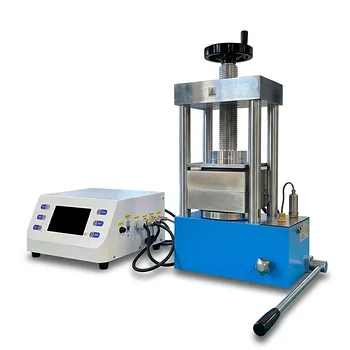
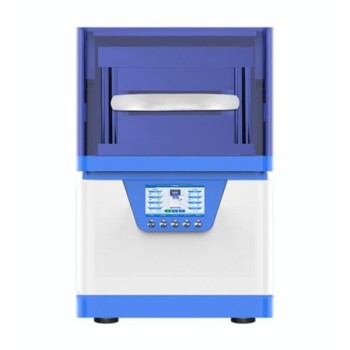
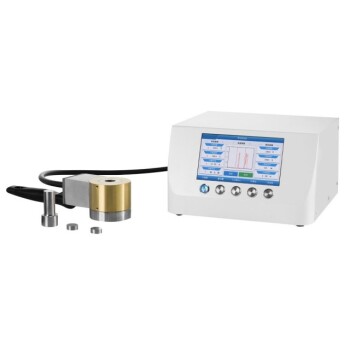
The core function of a laboratory heated hydraulic press in the Cold Sintering Process (CSP) is to provide a synergistic environment of high uniaxial pressure and moderate heat. By applying pressure ranging from 100 to 500 MPa while maintaining temperatures typically below 300°C, the press facilitates densification mechanisms that allow ceramic materials to settle and bond without the extreme heat required in traditional sintering.
Core Takeaway: The heated press replaces the need for high thermal energy with mechanical energy. By combining pressure with low temperatures, it activates a "mechanochemical" effect that rearranges particles and drives densification through solution-based processes rather than pure thermal diffusion.
The Mechanisms of Densification
The heated hydraulic press is not merely shaping the material; it is actively driving the chemical and physical changes required for sintering.
Simultaneous Heat and Pressure
The defining feature of this equipment is the ability to apply heat and pressure at the exact same time.
According to the primary technical data, the press typically operates below 300°C. However, it compensates for this low temperature by applying massive pressure (up to 500 MPa or more).
Mechanochemical Coupling
The combination of forces creates what is known as a mechanochemical coupling effect.
The mechanical stress applied by the press physically forces particles together. Simultaneously, the moderate heat accelerates chemical interactions at the particle interfaces.
Facilitating Particle Rearrangement
Before chemical bonding fully takes over, the physical arrangement of the powder is critical.
The high uniaxial pressure forces the particles to slide past one another. This rearrangement significantly reduces porosity and increases the number of contact points between particles.
The Role of the Transient Phase
While the primary reference focuses on pressure and heat, understanding the Deep Need requires looking at why this environment works. It is designed to support a specific chemical reaction involving a liquid phase.
Driving Dissolution and Precipitation
The pressure applied by the press is essential for the dissolution-precipitation-creep mechanism.
CSP relies on a transient solvent (such as water or DMF) introduced to the powder. The high pressure drives this solvent into the contact points between particles.
Mass Transport at Low Temperatures
Under high pressure, the solid material dissolves into the liquid phase at particle boundaries.
The material then precipitates (solidifies) on the non-contact areas. This moves mass efficiently and builds "necks" between particles, solidifying the structure at temperatures as low as 150°C.
Critical Process Variables
To achieve successful CSP, the press must be capable of precise control over specific variables.
Pressure Magnitude and Stability
The press must maintain constant high pressure throughout the holding time.
References indicate that pressures up to 400–780 MPa may be required depending on the material. If the pressure drops, the driving force for the solution-precipitation mechanism disappears, and densification stops.
Thermal Consistency
While the temperatures are low, they must be consistent.
The press must maintain a stable thermal field (e.g., 140°C–150°C) to ensure the transient liquid phase remains active long enough to facilitate mass transport before evaporating or reacting completely.
Making the Right Choice for Your Goal
The selection and operation of your press should be dictated by the specific densification mechanism you are trying to activate.
- If your primary focus is maximum density: Prioritize a press capable of higher pressure ranges (500+ MPa) to maximize particle rearrangement and the driving force for dissolution.
- If your primary focus is delicate materials: Ensure your press has precise low-temperature control (<200°C) to manage the evaporation rate of the transient solvent without degrading the material.
Summary: The laboratory heated press is the engine of CSP, translating mechanical force into chemical stability to achieve high-density ceramics at a fraction of the traditional energy cost.
Summary Table:
| Feature | Specification/Role in CSP | Benefit to Researcher |
|---|---|---|
| Pressure Range | 100 – 500+ MPa | Drives particle rearrangement and dissolution-precipitation. |
| Temperature Range | Typically < 300°C | Enables sintering of temperature-sensitive materials/composites. |
| Mechanism | Mechanochemical Coupling | Replaces high thermal energy with efficient mechanical energy. |
| Process Variable | Thermal Consistency | Ensures stable transient liquid phase for uniform mass transport. |
| Output | High-Density Ceramics | Achieves structural integrity at a fraction of traditional energy costs. |
Elevate Your Materials Research with KINTEK Precision
Unlock the full potential of Cold Sintering Processes (CSP) with KINTEK’s advanced laboratory solutions. Whether you are developing next-generation battery components or temperature-sensitive ceramics, our high-performance heated hydraulic presses and isostatic presses provide the stable pressure and precise thermal control required for successful densification.
Why partner with KINTEK?
- Comprehensive Range: From pellet, hot, and isostatic presses to high-temperature furnaces and crushing systems, we provide the tools for every stage of your workflow.
- Specialized Expertise: We support advanced research with high-pressure reactors, electrolytic cells, and specialized consumables like PTFE and ceramics.
- Tailored Solutions: Our equipment is designed for accuracy, durability, and the rigorous demands of modern material science.
Contact KINTEK today to find the perfect press for your lab!
Related Products
- 24T 30T 60T Heated Hydraulic Press Machine with Heated Plates for Laboratory Hot Press
- Heated Hydraulic Press Machine with Integrated Manual Heated Plates for Lab Use
- Automatic Heated Hydraulic Press Machine with Heated Plates for Laboratory Hot Press 25T 30T 50T
- Heated Hydraulic Press Machine with Heated Plates for Vacuum Box Laboratory Hot Press
- Automatic High Temperature Heated Hydraulic Press Machine with Heated Plates for Lab
People Also Ask
- What role does a heated hydraulic press play in Cold Sintering (CSP)? Enhancing LATP-Halide Densification
- Why is the heating function of a laboratory hydraulic press essential for MEA assembly in DEFC? Optimize Cell Bonding
- What technical conditions does a heated hydraulic press provide for PEO batteries? Optimize Solid-State Interfaces
- How is a heated hydraulic press used for Li-LLZO batteries? Optimize Interfacial Bonding with Thermal-Pressure
- What are heated hydraulic presses used for? Molding Composites, Vulcanizing Rubber, and More