Knowledge How does a laboratory hot press contribute to the formation of PEO-LiTFSI films? Enhance Battery Research Efficiency
Author avatar

Tech Team · Kintek Solution

Updated 1 day ago

How does a laboratory hot press contribute to the formation of PEO-LiTFSI films? Enhance Battery Research Efficiency


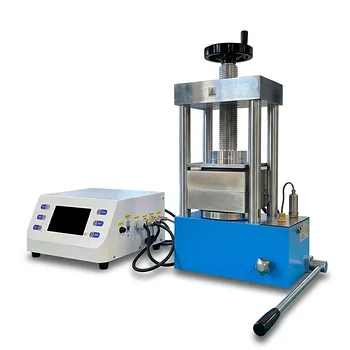
A laboratory hot press facilitates the formation of PEO-LiTFSI films by simultaneously applying precise heat (typically around 100–110°C) and pressure (e.g., 8 MPa) to a polymer-salt powder mixture. This mechanical and thermal combination melts the components and compacts them, transforming raw powder into a dense, self-supporting solid electrolyte film without the use of chemical solvents.

Core Takeaway The hot press utilizes a "melt-pressing" technique to physically transform powder into a solid film. By eliminating the need for volatile solvents, this method produces a denser, pore-free electrolyte with superior structural integrity and chemical purity compared to solvent-cast alternatives.

The Mechanics of Melt-Pressing

Simultaneous Heat and Pressure

The primary function of the hot press is to create a controlled environment where the PEO polymer can soften and flow.

By heating the plates to temperatures such as 110°C, the machine melts the PEO and LiTFSI mixture. Simultaneous axial pressure forces this molten material to coalesce, ensuring the polymer and salt integrate fully at a physical level.

Densification and Pore Elimination

Achieving high ionic conductivity requires a continuous path for ions to travel.

The hot press eliminates internal pores and voids that often occur in loosely packed powders. This densification process directly presses the material into a solid state, resulting in a transparent film that indicates a high degree of homogeneity.

Advantages Over Solvent Casting

Elimination of Chemical Residues

Traditional film formation often requires dissolving the polymer in volatile solvents, which must then be evaporated.

The hot press method is entirely solvent-free. This removes the risk of trapped solvent residues, which can degrade electrochemical performance, and eliminates the safety hazards associated with handling volatile chemicals.

Structural Uniformity

Consistency is vital for reliable experimental data.

Because the pressure is applied uniformly across the mold, the resulting film features uniform thickness. This mechanical consistency allows for the creation of self-supporting films that are robust enough to be handled and assembled into battery cells.

Understanding the Trade-offs

Thermal Sensitivity

While heat is necessary to melt the PEO, excessive temperature can degrade the polymer chains.

You must strictly control the temperature (e.g., keeping it near the 100-110°C range). If the temperature drifts too high, you risk altering the chemical structure of the electrolyte before the film is even formed.

Pressure Distribution

The quality of the film is entirely dependent on the flatness and alignment of the heating plates.

If the hydraulic press applies pressure unevenly, you will generate films with inconsistent thickness (wedge-shaped). This variation leads to uneven current distribution during battery testing, potentially skewing your results.

Making the Right Choice for Your Goal

To maximize the effectiveness of your electrolyte fabrication, align your parameters with your specific research objectives:

  • If your primary focus is maximizing ionic conductivity: Prioritize high pressure and sufficient hold time to ensure complete densification and the total elimination of resistive pores.
  • If your primary focus is chemical purity and safety: Leverage the solvent-free nature of the hot press to produce "green" electrolytes that are free from potential side-reaction contaminants.

By controlling heat and pressure simultaneously, you transform a simple powder mixture into a high-performance, structurally sound electrolyte component.

Summary Table:

Feature Solvent Casting Method Hot Press (Melt-Pressing)
Solvent Use High (requires volatile chemicals) Solvent-Free (Dry process)
Structural Density Lower (risk of micro-pores) High (dense, pore-free)
Chemical Purity Potential residue contamination High (no chemical additives)
Film Uniformity Dependent on evaporation rate Controlled by mechanical pressure
Process Time Longer (drying time required) Faster (direct physical formation)

Elevate Your Battery Research with KINTEK Precision

Unlock superior electrochemical performance with KINTEK’s advanced laboratory hydraulic presses (pellet, hot, isostatic). Our specialized systems are designed to provide the precise thermal control and uniform axial pressure required for the fabrication of high-density PEO-LiTFSI polymer electrolytes.

Beyond film formation, KINTEK offers a comprehensive suite of laboratory solutions, including battery research tools, high-temperature furnaces, and PTFE/ceramic consumables. Partner with us to eliminate solvent residues and achieve the structural integrity your research demands.

Ready to optimize your electrolyte fabrication? Contact KINTEK today for a tailored solution!

Related Products

People Also Ask

Related Products

Heated Hydraulic Press Machine with Heated Plates for Vacuum Box Laboratory Hot Press

Heated Hydraulic Press Machine with Heated Plates for Vacuum Box Laboratory Hot Press

The lab press for vacuum box is a specialized piece of equipment designed for laboratory use. Its main purpose is to press pills and powders according to specific requirements.

Automatic Laboratory Heat Press Machine

Automatic Laboratory Heat Press Machine

Precision automatic heat press machines for labs—ideal for material testing, composites, and R&D. Customizable, safe, and efficient. Contact KINTEK today!

Automatic High Temperature Heated Hydraulic Press Machine with Heated Plates for Lab

Automatic High Temperature Heated Hydraulic Press Machine with Heated Plates for Lab

The High Temperature Hot Press is a machine specifically designed for pressing, sintering and processing materials in a high temperature environment. It is capable of operating in the range of hundreds of degrees Celsius to thousands of degrees Celsius for a variety of high temperature process requirements.

Automatic Heated Hydraulic Press Machine with Heated Plates for Laboratory Hot Press

Automatic Heated Hydraulic Press Machine with Heated Plates for Laboratory Hot Press

The Automatic High Temperature Heat Press is a sophisticated hydraulic hot press designed for efficient temperature control and product quality processing.

Manual High Temperature Heated Hydraulic Press Machine with Heated Plates for Lab

Manual High Temperature Heated Hydraulic Press Machine with Heated Plates for Lab

The High Temperature Hot Press is a machine specifically designed for pressing, sintering and processing materials in a high temperature environment. It is capable of operating in the range of hundreds of degrees Celsius to thousands of degrees Celsius for a variety of high temperature process requirements.

Vacuum Hot Press Furnace Machine for Lamination and Heating

Vacuum Hot Press Furnace Machine for Lamination and Heating

Experience clean and precise lamination with Vacuum Lamination Press. Perfect for wafer bonding, thin-film transformations, and LCP lamination. Order now!

24T 30T 60T Heated Hydraulic Press Machine with Heated Plates for Laboratory Hot Press

24T 30T 60T Heated Hydraulic Press Machine with Heated Plates for Laboratory Hot Press

Looking for a reliable Hydraulic Heated Lab Press? Our 24T / 40T model is perfect for material research labs, pharmacy, ceramics, and more. With a small footprint and the ability to work inside a vacuum glove box, it's the efficient and versatile solution for your sample preparation needs.

Heated Hydraulic Press Machine with Heated Plates Split Manual Laboratory Hot Press

Heated Hydraulic Press Machine with Heated Plates Split Manual Laboratory Hot Press

Efficiently prepare your samples with our Split Manual Heated Lab Press. With a pressure range up to 40T and heating plates up to 300°C, it's perfect for various industries.

Manual Heated Hydraulic Press Machine with Heated Plates for Laboratory Hot Press

Manual Heated Hydraulic Press Machine with Heated Plates for Laboratory Hot Press

The Manual Heat Press is a versatile piece of equipment suitable for a variety of applications, operated by a manual hydraulic system that applies controlled pressure and heat to the material placed on the piston.

Automatic Heated Hydraulic Press Machine with Heated Plates for Laboratory Hot Press 25T 30T 50T

Automatic Heated Hydraulic Press Machine with Heated Plates for Laboratory Hot Press 25T 30T 50T

Efficiently prepare your samples with our Automatic Heated Lab Press. With a pressure range up to 50T and precise control, it's perfect for various industries.

Double Plate Heating Press Mold for Lab

Double Plate Heating Press Mold for Lab

Discover precision in heating with our Double Plate Heating Mold, featuring high-quality steel and uniform temperature control for efficient lab processes. Ideal for various thermal applications.

Warm Isostatic Press WIP Workstation 300Mpa for High Pressure Applications

Warm Isostatic Press WIP Workstation 300Mpa for High Pressure Applications

Discover Warm Isostatic Pressing (WIP) - A cutting-edge technology that enables uniform pressure to shape and press powdered products at a precise temperature. Ideal for complex parts and components in manufacturing.

Automatic Laboratory Hydraulic Pellet Press Machine for Lab Use

Automatic Laboratory Hydraulic Pellet Press Machine for Lab Use

Experience efficient sample preparation with our Automatic Lab Press Machine. Ideal for material research, pharmacy, ceramics, and more. Features a compact size and hydraulic press functionality with heating plates. Available in various sizes.

Manual Lab Heat Press

Manual Lab Heat Press

Manual hydraulic presses are mainly used in laboratories for various applications such as forging, molding, stamping, riveting and other operations. It allows the creation of complex shapes while saving material.

Laboratory Manual Hydraulic Pellet Press for Lab Use

Laboratory Manual Hydraulic Pellet Press for Lab Use

Efficient Manure Lab Hydraulic Press with Safety Cover for sample preparation in material research, pharmacy, and electronic industries. Available in 15T to 60T.

Laboratory Hydraulic Press Lab Pellet Press Machine for Glove Box

Laboratory Hydraulic Press Lab Pellet Press Machine for Glove Box

Controlled environment lab press machine for glove box. Specialized equipment for material pressing and shaping with high precision digital pressure gauge.

Laboratory Hydraulic Press Split Electric Lab Pellet Press

Laboratory Hydraulic Press Split Electric Lab Pellet Press

Efficiently prepare samples with a split electric lab press - available in various sizes and ideal for material research, pharmacy, and ceramics. Enjoy greater versatility and higher pressure with this portable and programmable option.

Infrared Heating Quantitative Flat Plate Press Mold

Infrared Heating Quantitative Flat Plate Press Mold

Discover advanced infrared heating solutions with high-density insulation and precise PID control for uniform thermal performance in various applications.

Ball Press Mold for Lab

Ball Press Mold for Lab

Explore versatile Hydraulic Hot Press molds for precise compression molding. Ideal for creating various shapes and sizes with uniform stability.

Laboratory Manual Hydraulic Pellet Press for Lab Use

Laboratory Manual Hydraulic Pellet Press for Lab Use

Efficient sample preparation with small footprint Manual Lab Hydraulic Press. Ideal for material researching labs, pharmacy, catalytic reaction, and ceramics.


Leave Your Message