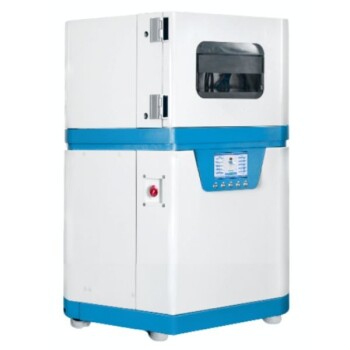
Hot pressing sintering technology is preferred because it introduces an external pressure field that acts as a critical driving force for densification, specifically in systems with poor miscibility.
For high-performance electrical contact materials, relying on thermal energy alone (traditional pressureless sintering) is often insufficient to bond incompatible materials like Chromium and Copper. Hot pressing solves this by applying heat and pressure simultaneously, forcing these materials to achieve rapid densification while inhibiting grain growth, resulting in a superior balance of hardness, strength, and electrical conductivity.
The Core Insight Traditional sintering often forces a compromise between material density and grain size, especially in complex alloys. Hot pressing creates a "thermoplastic state" that allows materials to achieve near-theoretical density at lower temperatures and shorter times, unlocking performance levels that pressureless methods simply cannot reach.
The Mechanism of Superior Densification
Overcoming Poor Miscibility
Many high-performance electrical contacts combine materials that do not naturally mix well, such as Chromium and Copper (Cr-Cu). In traditional pressureless sintering, these materials resist bonding, leading to structural weaknesses. Hot pressing introduces an external pressure field that physically forces these particles into contact, overcoming their natural resistance to mixing.
The Role of Plastic Flow
Under the simultaneous application of heat and pressure, the powder particles enter a thermoplastic state. This facilitates plastic flow, allowing the material to deform and fill voids much more effectively than thermal diffusion alone. This leads to a substantial reduction in internal porosity.
Enhanced Mass Transfer
The external pressure accelerates mass transfer processes, such as diffusion and particle rearrangement. This allows the material to densify rapidly, significantly reducing the time required to reach a solid state compared to pressureless methods.
Impact on Microstructure and Performance
Inhibiting Grain Growth
A major downside of traditional sintering is that long heating times often lead to excessive grain growth, which weakens the material. Because hot pressing achieves densification rapidly and at potentially lower temperatures, it effectively inhibits grain growth. This preserves a fine-grained structure, which is essential for mechanical strength.
Achieving Theoretical Density
Hot pressing can produce sintered bodies with near-zero porosity, approaching the material's theoretical density. Eliminating pores is critical for electrical contacts, as voids act as insulators and stress concentrators that degrade performance.
Balancing Strength and Conductivity
The result of this process is a material that does not sacrifice one property for another. You achieve the high hardness and strength required to resist mechanical wear, alongside the excellent electrical conductivity needed for efficient energy transmission.
Operational and Economic Advantages
Reduced Energy Consumption
Because the process is faster and often requires lower temperatures to achieve the same density, energy consumption is significantly reduced. Additionally, the pressure required is far lower (often 1/10th) than cold pressing methods because the heat softens the material, making it easier to mold.
Uniformity and Scale
Hot pressing equipment facilitates a uniform temperature field across the workpiece. This consistency allows for the production of large-diameter materials without the density gradients or defects often found in pressureless sintered parts of the same size.
Understanding the Trade-offs
Equipment Complexity vs. Throughput
While hot pressing requires a lower investment than Isostatic Pressing, it is more complex than a standard pressureless sintering furnace. Furthermore, hot pressing is typically a batch process. While it produces superior individual components, it may have lower throughput compared to continuous sintering methods used for lower-grade materials.
Geometric Constraints
Standard hot pressing typically applies uniaxial pressure. While it can produce accurate sizes, creating extremely complex internal geometries may be more difficult compared to methods like Hot Isostatic Pressing (HIP) or Metal Injection Molding (MIM), which apply pressure from all directions.
Making the Right Choice for Your Goal
To determine if hot pressing is the correct manufacturing route for your application, consider the following specific needs:
- If your primary focus is electrical performance: Choose hot pressing to eliminate porosity and maximize conductivity in composite materials like Cr-Cu.
- If your primary focus is mechanical durability: Prioritize hot pressing to maintain fine grain structures that offer superior hardness and wear resistance.
- If your primary focus is cost-efficiency for simple shapes: Leverage hot pressing to reduce energy consumption and sintering time compared to High Isostatic Pressing.
In summary, hot pressing is the definitive choice when the material system inherently resists mixing and you require a zero-compromise balance between mechanical strength and electrical conductivity.
Summary Table:
| Feature | Hot Pressing Sintering | Traditional Pressureless Sintering |
|---|---|---|
| Driving Force | Simultaneous Heat + External Pressure | Thermal Energy Only |
| Densification | Near-theoretical (Zero Porosity) | Lower (Remaining Voids) |
| Grain Structure | Fine Grained (Inhibits Growth) | Coarse Grained (Due to Long Heat) |
| Miscibility | Excellent for Incompatible Alloys | Poor for Non-miscible Systems |
| Performance | High Strength & Conductivity | Moderate Mechanical/Electrical Life |
Elevate Your Material Performance with KINTEK Precision
Maximize the potential of your electrical contact materials and advanced alloys using KINTEK’s industry-leading thermal processing solutions. Whether you require high-performance hot pressing systems, vacuum furnaces, or isostatic presses, we provide the precision engineering needed to achieve near-theoretical density and superior grain control.
From high-temperature high-pressure reactors to specialized crushing and milling systems, KINTEK specializes in laboratory equipment and consumables designed for the most demanding research and production environments. Our experts are ready to help you select the right technology to balance mechanical hardness with peak electrical conductivity.
Ready to optimize your sintering process? Contact KINTEK Today for a Expert Consultation
Related Products
- 600T Vacuum Induction Hot Press Furnace for Heat Treat and Sintering
- Vacuum Heat Treat and Pressure Sintering Furnace for High Temperature Applications
- Vacuum Heat Treat and Sintering Furnace with 9MPa Air Pressure
- Vacuum Hot Press Furnace Heated Vacuum Press Machine Tube Furnace
- Vacuum Hot Press Furnace Machine Heated Vacuum Press
People Also Ask
- What role does an induction vacuum hot pressing furnace play in sintering? Achieve 98% Density in Carbide Blocks
- What advantages does a vacuum hot press furnace provide for LSLBO ceramic electrolytes? Achieve 94% Relative Density
- What role does a Vacuum Hot Press (VHP) furnace play in the densification of austenitic stainless steel 316 composites?
- What are the advantages of a vacuum hot press furnace for W-50%Cu? Achieve 99.6% Density at Lower Temperatures
- What role does mechanical pressure play during the vacuum diffusion bonding of tungsten and copper? Keys to Solid Bonding