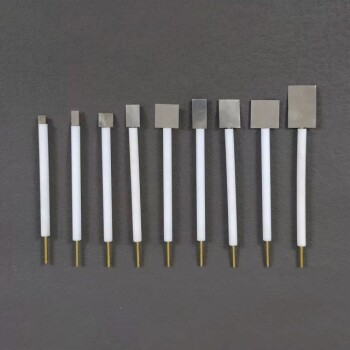
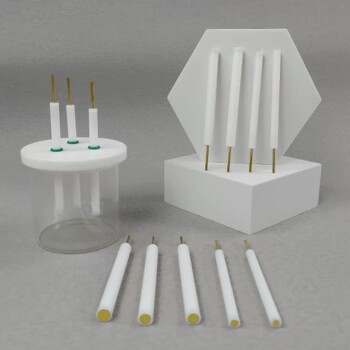
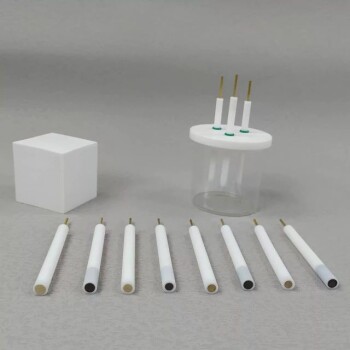
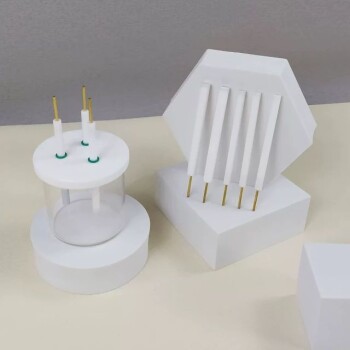
The selection of 316L stainless steel for alkaline water electrolysis is driven by a strategic balance between durability and economic viability. Researchers prioritize this material due to its specific nickel content and low cost, utilizing it as a stable baseline to study electrode geometry and reaction mechanics rather than purely for maximum catalytic output.
While 316L is not the highest-efficiency catalyst available, its superior corrosion resistance and affordability make it the premier substrate for isolating variables like electrode topology and spacing in fundamental studies.
The Material Advantages of 316L
The Role of Nickel Content
The suitability of 316L stainless steel begins with its chemical composition. It contains a significant amount of nickel, which provides essential catalytic properties necessary for the electrolysis process.
Superior Corrosion Resistance
Alkaline water electrolysis creates a harsh chemical environment that degrades many standard metals. 316L offers superior corrosion resistance, allowing it to withstand these conditions for extended periods without significant degradation.
Economic Feasibility
Cost is a major constraint in scaling electrolysis research. 316L is highly cost-effective, enabling researchers to fabricate multiple electrode iterations without exhausting their budget.
Utility in Experimental Research
A Stable Substrate for Topology Studies
Because the material is consistent and durable, it serves as an ideal "blank canvas." Researchers use it to investigate electrode topology—how the shape and surface structure of the electrode affect performance—without worrying about material instability skewing the results.
Investigating Electrode Spacing
The low cost and workability of 316L allow for precise experimentation with variations in electrode spacing. This helps researchers determine the optimal distance between electrodes to maximize efficiency.
Understanding Fundamental Reaction Behavior
316L provides a reliable baseline for observing fundamental reaction behavior. It allows scientists to establish control data regarding how reactions proceed within an alkaline environment before moving to more exotic or expensive materials.
Understanding the Trade-offs
Catalytic Efficiency Limitations
It is critical to acknowledge that 316L stainless steel is not the most efficient catalytic material available on the market.
The Purpose of Use
If your goal is to achieve the absolute highest hydrogen production rates, 316L may underperform compared to specialized noble metals. Its value lies in its role as a robust research tool and substrate, not necessarily as the final high-performance catalyst.
Making the Right Choice for Your Research
To determine if 316L is the correct material for your specific application, consider your primary research objectives:
- If your primary focus is investigating geometric variables: Use 316L as a cost-effective substrate to isolate the effects of electrode shape and spacing.
- If your primary focus is fundamental reaction mechanics: Rely on 316L to provide a stable, corrosion-resistant baseline for observing alkaline environment behaviors.
- If your primary focus is maximizing catalytic turnover: Recognize that 316L should be used primarily as a benchmark for comparison against more active, albeit more expensive, catalysts.
By leveraging the durability and affordability of 316L, you can build a solid foundation for understanding the physical dynamics of alkaline electrolysis.
Summary Table:
| Feature | 316L Stainless Steel Characteristic | Research Benefit |
|---|---|---|
| Composition | High Nickel Content | Provides essential baseline catalytic activity |
| Durability | Superior Corrosion Resistance | Stable performance in harsh alkaline environments |
| Economics | High Cost-Effectiveness | Allows for extensive iterative testing and scaling |
| Application | Consistent Substrate | Ideal for studying electrode topology and spacing |
| Trade-off | Moderate Catalytic Activity | Best used as a benchmark for high-performance catalysts |
Elevate Your Electrolysis Research with KINTEK Precision
Are you optimizing your alkaline water electrolysis setup? KINTEK specializes in providing high-quality laboratory equipment and consumables designed for the most demanding research environments. Whether you need reliable electrolytic cells and electrodes, advanced battery research tools, or high-performance high-temperature high-pressure reactors, we have the expertise to support your breakthroughs.
From 316L substrates to specialized ceramics and crucibles, our portfolio is built to ensure your experimental variables remain controlled and your results reproducible. Don't settle for sub-par materials—partner with KINTEK today.
Contact Our Technical Experts to find the perfect components for your laboratory needs!
References
- María José Lavorante, J. I. Franco. Straight-Parallel Electrodes and Variable Gap for Hydrogen and Oxygen Evolution Reactions. DOI: 10.1155/2019/5392452
This article is also based on technical information from Kintek Solution Knowledge Base .
Related Products
- Platinum Sheet Electrode for Laboratory and Industrial Applications
- Gold Disc Electrode
- Metal Disc Electrode Electrochemical Electrode
- Rotating Platinum Disk Electrode for Electrochemical Applications
- Reference Electrode Calomel Silver Chloride Mercury Sulfate for Laboratory Use
People Also Ask
- What is a common use for a platinum sheet electrode? As a Reliable Counter Electrode in Electrochemical Cells
- What is the most critical guideline for immersing a platinum sheet electrode in an electrolyte? Ensure Accurate Electrochemical Measurements
- What is the purity of the platinum sheet in a platinum sheet electrode? The Key to Reliable Electrochemical Data
- What is the expected lifespan of a platinum sheet electrode? Maximize Your Electrode's Service Life
- What are the available specifications for platinum sheet electrodes? Find the Perfect Fit for Your Electrochemical Needs