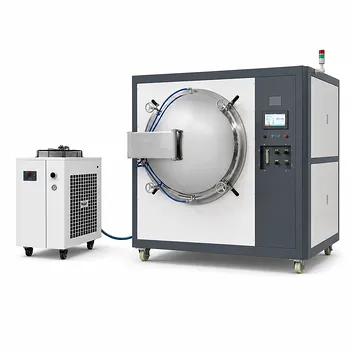
A vacuum hot pressing furnace acts as the central processing unit for creating high-performance Tungsten-Titanium (W-Ti) alloys.
Its primary function is to simultaneously apply high temperature (typically $1350\text{--}1550^\circ\text{C}$), high mechanical pressure (around $25\text{ MPa}$), and a high vacuum environment. This tri-fold approach densifies the material to near-perfect levels ($95%\text{--}100%$) while strictly controlling the atmosphere to prevent the degradation of reactive elements.
Core Takeaway The vacuum hot pressing furnace solves the two biggest challenges in W-Ti alloy preparation: preventing titanium oxidation and achieving high density. By applying mechanical pressure during sintering, it lowers the required activation energy, enabling the creation of low-porosity, high-strength alloys that would be impossible to achieve through standard sintering methods.
The Three Critical Roles of the Furnace
The effectiveness of this equipment relies on the integration of three distinct physical environments.
1. Oxidation Prevention via Vacuum
Titanium is highly reactive and susceptible to oxidation at elevated temperatures. A standard furnace atmosphere would ruin the alloy's chemical integrity.
The vacuum hot pressing furnace maintains a high vacuum (e.g., $5 \times 10^{-2}\text{ Pa}$) to eliminate oxygen from the chamber. This environment not only prevents the oxidation of titanium but also actively removes adsorbed gases and volatile impurities from the powder surfaces.
2. Accelerated Densification via Pressure
Heat alone is often insufficient to fully sinter W-Ti alloys due to the high melting point of tungsten.
By applying axial mechanical pressure (often via a hydraulic system), the furnace forces powder particles into intimate contact. This pressure promotes plastic deformation and particle rearrangement, significantly increasing the final density of the material.
3. Lowering Sintering Activation Energy
The combination of heat and pressure alters the thermodynamics of the process.
The applied mechanical pressure lowers the sintering activation energy. This allows the material to bond and densify at temperatures lower than those required for pressureless sintering, preserving the microstructure and reducing grain growth.
Key Mechanisms of Action
Understanding how the furnace manipulates the material at a microscopic level is essential for process control.
Breaking Oxide Barriers
Even with high-purity powders, thin oxide films can exist on particle surfaces, acting as barriers to bonding.
The pressure-assisted environment helps break down these surface oxide films. Once these barriers are breached, atomic diffusion accelerates, leading to stronger metallurgical bonding between the tungsten and titanium particles.
Elimination of Porosity
Gas pockets trapped between particles are the enemy of structural integrity.
The vacuum system continuously exhausts gases that escape from the gaps between powder particles during heating. Simultaneously, the mechanical pressure squeezes these gaps closed, resulting in an alloy with exceptionally low gas content and low porosity.
Operational Considerations and Trade-offs
While vacuum hot pressing is superior for W-Ti alloys, it introduces specific operational complexities that must be managed.
Management of Consumables
The process relies on a graphite indenter to transfer hydraulic pressure to the powder compact inside the hot zone.
This component is a high-temperature consumable. While graphite has excellent thermal stability up to $1550^\circ\text{C}$, it is subject to wear and thermal expansion. Operators must accurately calculate the expansion coefficient of the graphite to determine the true displacement and densification of the sample.
Interface Reactions
The high vacuum level influences more than just the atmosphere; it affects the chemical relationship between the sample and the mold.
Strict control of the vacuum level is required to manage interface reactions. If not monitored, the mold material can react with the alloy sample, potentially introducing impurities or altering surface properties.
Making the Right Choice for Your Goal
To maximize the utility of a vacuum hot pressing furnace, tailor your parameters to your specific outcome.
- If your primary focus is Purity: Prioritize the vacuum system capability, ensuring it can maintain pressures as low as $5 \times 10^{-2}\text{ Pa}$ to effectively exhaust volatile impurities and protect the titanium.
- If your primary focus is Density: Focus on the hydraulic capacity; ensuring the system can maintain consistent pressures (e.g., $25\text{ MPa}$) is critical for achieving $>98%$ relative density.
Ultimately, the vacuum hot pressing furnace is the only viable tool for converting loose W-Ti powder into a solid, oxidation-free component with industrial-grade strength.
Summary Table:
| Feature | Function in W-Ti Preparation | Impact on Material |
|---|---|---|
| High Vacuum ($5 \times 10^{-2}$ Pa) | Eliminates oxygen and removes volatile impurities | Prevents titanium oxidation and ensures high purity |
| Mechanical Pressure ($25$ MPa) | Forces particle contact and promotes plastic deformation | Achieves $95%\text{--}100%$ density and low porosity |
| Thermal Control ($1350\text{--}1550^\circ$C) | Lowers sintering activation energy | Preserves microstructure and reduces grain growth |
| Graphite Indenter | Transfers hydraulic pressure to powder compact | Enables precise densification control at high temperatures |
Elevate Your Material Research with KINTEK Precision
Unlock the full potential of your alloy development with KINTEK’s industry-leading thermal processing solutions. Whether you are producing W-Ti alloys, advanced ceramics, or aerospace components, our high-performance vacuum hot pressing furnaces and isostatic presses provide the precise atmosphere and pressure control necessary for near-perfect densification.
Why choose KINTEK?
- Comprehensive Laboratory Range: From high-temperature furnaces (vacuum, tube, muffle) to crushing systems and hydraulic pellet presses, we supply everything your lab needs.
- Advanced Sintering Tech: Our equipment excels in reducing sintering activation energy, ensuring superior structural integrity and low gas content.
- End-to-End Consumables: We provide high-quality crucibles, ceramics, and PTFE products to support your entire workflow.
Ready to achieve industrial-grade strength in your materials? Contact our technical experts today to find the perfect furnace or lab solution for your specific requirements.
Related Products
- Vacuum Hot Press Furnace Heated Vacuum Press Machine Tube Furnace
- 600T Vacuum Induction Hot Press Furnace for Heat Treat and Sintering
- Vacuum Hot Press Furnace Machine Heated Vacuum Press
- Vacuum Hot Press Furnace Machine for Lamination and Heating
- Vacuum Heat Treat and Pressure Sintering Furnace for High Temperature Applications
People Also Ask
- What advantages does a vacuum hot press furnace provide for LSLBO ceramic electrolytes? Achieve 94% Relative Density
- What role does a Vacuum Hot Press (VHP) furnace play in the densification of austenitic stainless steel 316 composites?
- What are the advantages of using a vacuum hot pressing furnace? Superior Densification for 2024Al/Gr/SiC Composites
- What are the advantages of a vacuum hot press furnace for LTPO solid electrolytes? Boost Density and Conductivity
- What core processing conditions does a vacuum hot press furnace provide? Achieve High-Density Cu-SiC/Diamond Composites