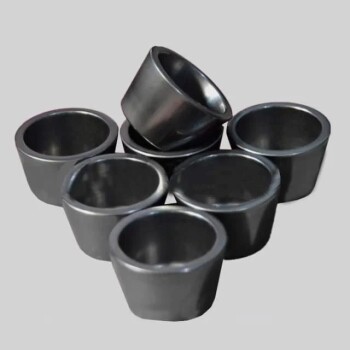
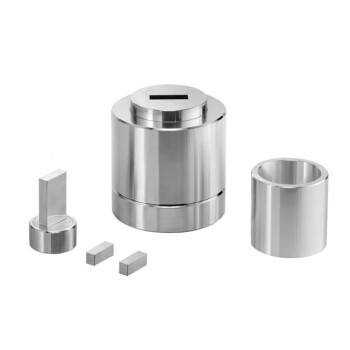
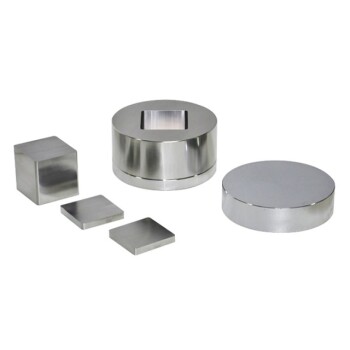
High-purity graphite molds act as the structural and chemical foundation for the hot-press sintering of Yttrium Aluminum Garnet (YAG) ceramics. Their primary functions are to serve as a high-strength containment vessel that defines the ceramic's shape, to ensure uniform heat distribution through high thermal conductivity, and to generate a protective reductive atmosphere that prevents oxidation.
Core Insight: While often viewed merely as tooling, the graphite mold is an active participant in the chemical thermodynamics of the process. Its ability to create a local reductive environment is just as critical to the final quality of the YAG ceramic as its ability to withstand physical pressure.
Mechanical Containment and Shaping
Withstanding Extreme Conditions
The sintering of YAG ceramics requires the application of significant heat and force simultaneously. Graphite molds are uniquely suited to maintain structural integrity under these dual stresses. They do not deform or fail, even when subjected to the high temperatures required to sinter ceramics.
Transmitting Uniaxial Pressure
Beyond holding the powder, the mold acts as the transmission medium for the hydraulic press. It must be rigid enough to transfer mechanical pressure uniformly to the powder. This pressure forces particle rearrangement and plastic deformation, which are essential mechanisms for removing voids and achieving high-density material.
Defining Final Geometry
The mold serves as the primary vessel that dictates the shape and dimensions of the final product. Because graphite maintains high dimensional stability during heating, the final ceramic billet retains precise tolerances, facilitating easier demolding and reducing post-processing requirements.
Thermal Regulation and Uniformity
Facilitating Uniform Heating
Graphite possesses excellent thermal and electrical conductivity. In hot-press sintering, this property allows the mold to act as an effective heat exchanger (or heating element in current-assisted processes).
Preventing Thermal Gradients
By transferring heat efficiently, the mold ensures that the YAG powder heats uniformly from all sides. This is critical for preventing thermal gradients within the sample, which could lead to internal stresses, cracking, or inconsistent densification across the ceramic body.
Chemical Protection and Atmosphere Control
Creating a Reductive Atmosphere
According to the primary technical data, the chemical properties of graphite naturally create a reductive atmosphere within the mold assembly. This is distinct from inert molds, which simply exist alongside the sample.
Preventing Oxidation
This reductive environment is vital for YAG ceramics. It actively protects the sample from excessive oxidation during the high-temperature cycle. By scavenging residual oxygen, the graphite mold helps maintain the chemical purity and phase stability of the Yttrium Aluminum Garnet structure.
Understanding the Trade-offs
Carbon Interaction
While the reductive atmosphere protects against oxidation, it implies the presence of carbon species. In some high-precision optical ceramics, there is a risk of carbon diffusion into the surface of the sample.
Mechanical Wear and Lifespan
Although high-strength graphite is durable, it is not indestructible. The combination of high pressure and abrasive ceramic powders can lead to surface wear on the mold over repeated cycles. This requires careful monitoring to ensure that surface degradation does not affect the dimensional accuracy of future YAG batches.
Making the Right Choice for Your Goal
To maximize the effectiveness of graphite molds in your specific application:
- If your primary focus is Optical Clarity: Prioritize the mold's ability to prevent oxidation, but monitor the interface for potential carbon contamination that could affect transparency.
- If your primary focus is High Density: Rely on the mold's mechanical strength to maximize the pressure applied (within safety limits) to force particle rearrangement.
The success of YAG sintering relies not just on the heat applied, but on the graphite mold's capacity to unify pressure, temperature, and chemical protection into a single, stable system.
Summary Table:
| Function Category | Key Role of Graphite Mold | Impact on YAG Ceramic |
|---|---|---|
| Mechanical | Uniaxial Pressure Transmission | Ensures high density & removes voids |
| Structural | High-Strength Containment | Maintains precise geometry & dimensions |
| Thermal | High Thermal Conductivity | Eliminates thermal gradients & cracking |
| Chemical | Reductive Atmosphere Generation | Prevents oxidation & maintains phase stability |
| Physical | Dimensional Stability | Reduces post-processing & improves tolerances |
Elevate Your Material Research with KINTEK Precision Engineering
Achieving perfect optical clarity and high density in YAG ceramics requires more than just heat—it requires the right environment. KINTEK specializes in high-performance laboratory equipment and consumables designed for extreme conditions. Whether you need high-strength graphite molds, precision hydraulic pellet presses, or advanced vacuum and atmosphere high-temperature furnaces, we provide the tools necessary to ensure your sintering process is flawless.
From crushing and milling systems to specialized PTFE and ceramic consumables, KINTEK is your partner in laboratory excellence. Don't compromise on your results. Contact us today to optimize your sintering workflow!
Related Products
- High Purity Pure Graphite Crucible for Evaporation
- High Purity Pure Graphite Crucible for Electron Beam Evaporation
- Special Shape Press Mold for Lab
- Anti-Cracking Press Mold for Lab Use
- Ball Press Mold for Lab
People Also Ask
- Why are high-purity graphite crucibles preferred for sulfide solid electrolytes? Achieve Superior Material Purity
- Why is a high-purity graphite crucible required for Chromel-TaC composites? Ensure Peak Purity at 1400°C
- What role do high-purity graphite crucibles play in molten salt corrosion research? Ensure Reactor-Grade Precision
- Why are high-purity graphite crucibles used for magnesium distillation? Ensure 3N8 Purity & Thermal Stability
- Why is a high-purity graphite crucible ideal for nitrogen-doped graphene at 1500 °C? Maximize Purity and Stability