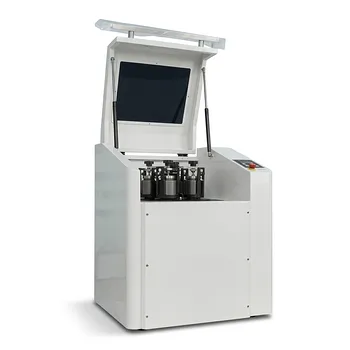
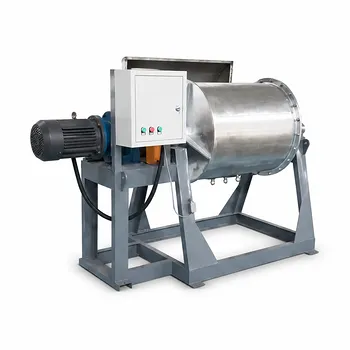
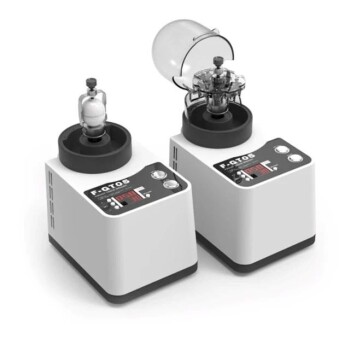
The decisive advantage of using a mechanical ball mill with airtight jars for preparing Na3FePO4CO3 is the absolute prevention of oxidation. By sealing the milling jars under an argon atmosphere, this method creates a reaction environment completely isolated from oxygen. This protects the Iron (II) (Fe2+) from oxidizing into Iron (III) (Fe3+), a degradation issue that frequently occurs during the washing and drying stages of the hydrothermal method.
Core Takeaway: The structural integrity of Na3FePO4CO3 relies on maintaining the Fe2+ oxidation state. While hydrothermal synthesis exposes the product to air during post-processing, airtight mechanical milling maintains a continuous inert environment, ensuring high retention of Fe2+ and superior material quality.
The Iron Oxidation Challenge
The Vulnerability of Hydrothermal Synthesis
In standard hydrothermal methods, the synthesis itself may occur in a controlled vessel, but the process does not end there. The resulting product requires washing and drying to remove solvents and impurities.
During these post-processing steps, the material is exposed to ambient air. This exposure triggers the unwanted oxidation of Fe2+ to Fe3+, effectively degrading the purity and electrochemical performance of the final compound.
The Mechanical Milling Solution
The mechanical ball mill approach utilizes airtight jars sealed specifically under an argon atmosphere. This isolates the reactants from the very beginning of the process.
Because the synthesis occurs entirely within this sealed, inert environment, there is no "washing and drying" phase that exposes the material to oxygen. The Fe2+ is preserved throughout the entire reaction, ensuring the final Na3FePO4CO3 material retains the correct chemical composition.
Secondary Operational Advantages
Precise Particle Size Reduction
Beyond chemical preservation, mechanical ball milling offers superior physical control over the material. It is capable of producing extremely fine powders with particle sizes of 10 microns or less.
This fine particle size is often critical for maximizing the surface area and reactivity of battery materials like Na3FePO4CO3.
Containment of Hazardous Materials
The enclosed nature of the ball mill system provides a safety benefit when handling toxic or reactive precursors.
Just as the closed system keeps oxygen out, it keeps hazardous dust and particulates in. This makes it an ideal method for processing toxic materials that require strict containment to ensure operator safety and sterility.
Understanding the Trade-offs
Equipment Wear and Contamination
While the supplementary data notes that ball mills are effective for abrasive materials, this interaction can be a double-edged sword. High-energy milling of abrasive compounds causes wear on the grinding media (balls) and the jar lining.
Over time, this wear can introduce microscopic impurities from the jar or balls into your synthesized powder. For high-purity applications, the material of the milling jar (e.g., agate, zirconia) must be carefully selected to minimize contamination.
Batch Processing vs. Continuous Flow
The specific requirement for airtight sealing under argon generally implies a batch processing approach.
While general ball mills can run continuously, maintaining a strict inert atmosphere for Na3FePO4CO3 synthesis typically requires a closed, batch-based setup. This ensures the atmosphere remains uncompromised but may limit throughput compared to open, continuous systems.
Making the Right Choice for Your Goal
- If your primary focus is Chemical Purity (Fe2+ Retention): Choose the airtight mechanical ball mill sealed under argon to strictly prevent oxidation during synthesis.
- If your primary focus is Particle Size Control: Utilize the ball mill to achieve consistent particle sizes under 10 microns, optimizing the material's surface area.
- If your primary focus is Safety with Toxic Precursors: Rely on the enclosed form of the ball mill to prevent exposure to hazardous dust during the grinding process.
By prioritizing the atmospheric control of the milling process, you ensure the chemical stability that the hydrothermal method compromises.
Summary Table:
| Feature | Mechanical Ball Milling (Airtight) | Hydrothermal Method |
|---|---|---|
| Oxidation Protection | Absolute (Argon-sealed environment) | Poor (Exposure during washing/drying) |
| Fe2+ Preservation | High (Maintains Iron II state) | Low (Risk of degradation to Fe3+) |
| Particle Size | Precise control (< 10 microns) | Variable depending on crystallization |
| Safety/Containment | High (Closed system for toxic dust) | Moderate (Open post-processing) |
| Impurity Risk | Potential wear from grinding media | Residual solvent or precursor salts |
Elevate Your Material Synthesis with KINTEK
Don't let oxidation compromise your research. KINTEK specializes in advanced laboratory solutions, providing high-performance crushing and milling systems alongside airtight jars designed for sensitive battery materials like Na3FePO4CO3.
Our extensive portfolio includes everything from high-temperature furnaces and hydraulic presses to battery research tools and high-pressure reactors. Whether you need to achieve sub-10-micron particle sizes or maintain a strict inert atmosphere, KINTEK has the expertise to support your laboratory's success.
Contact us today to find the perfect milling solution for your application!
Related Products
- Laboratory Ball Mill Jar Mill with Metal Alloy Grinding Jar and Balls
- Laboratory Jar Ball Mill with Alumina Zirconia Grinding Jar and Balls
- Laboratory Jar Mill with Agate Grinding Jar and Balls
- Laboratory Four-Body Horizontal Jar Mill
- Laboratory Single Horizontal Jar Mill
People Also Ask
- What is the function of a laboratory ball mill in the preparation of AMMCs? Optimize Dispersion & Grain Refinement
- What is the primary function of a laboratory ball mill in the modification of sulfide-based solid electrolytes with LiPO2F2?
- What is the function of a laboratory ball mill in the pretreatment of waste tire char (WTC)? Optimize Material Reactivity
- What is the primary function of a laboratory ball mill in Rice Husk Ash (RHA) modification? Achieve Peak Densification
- How do laboratory ball mills facilitate the mechanochemical synthesis of ZIF-8? Solvent-Free Synthesis Explained