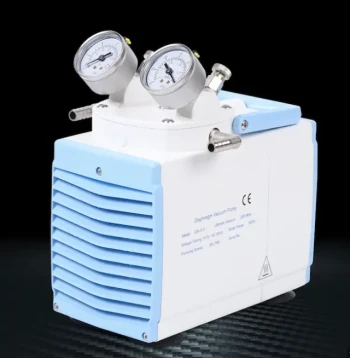
The specific roles of a vacuum dryer and an agate mortar in Nanoscale Zero-Valent Iron (NZVI) post-treatment are to preserve chemical reactivity and ensure physical uniformity, respectively. The vacuum dryer dehydrates the particles at room temperature in an oxygen-free environment to prevent oxidation, while the agate mortar grinds the resulting solid into a fine powder to guarantee full dispersion in subsequent applications.
The efficacy of NZVI relies entirely on maintaining its zero-valent core. The vacuum dryer preserves this chemical integrity by preventing oxidative passivation, while the agate mortar ensures the physical consistency required for maximum surface area contact.
The Critical Role of the Vacuum Dryer
Preventing Oxidative Passivation
Nanoscale Zero-Valent Iron is extremely sensitive to oxygen. If exposed to air during the drying process, the iron particles will rapidly oxidize. The vacuum dryer mitigates this by creating an oxygen-deprived environment, strictly preventing the passivation of the metal.
Controlled Dehydration
The primary function of this step is to remove moisture and residual solvents from the separated metal particles. The vacuum environment allows for rapid evaporation under negative pressure. This is typically conducted at room temperature for a duration of up to 24 hours.
Preserving the Reactive Core
By drying without heat or oxygen, the process prevents the thickening of the oxide film on the particle surface. This maintains the integrity of the zero-valent iron ($Fe^0$) core. A preserved core is essential for the material's high efficiency in removing contaminants, such as tetracycline.
The Function of the Agate Mortar
Ensuring Particle Uniformity
After the drying process, NZVI particles may agglomerate or cake together. An agate mortar is used to mechanically grind the dried product. This step breaks down clumps to produce a consistent, uniform powder.
Facilitating Full Dispersion
Physical consistency is a prerequisite for chemical performance. A fine powder ensures the material can be fully dispersed when added to an absorption solution. Without this step, clumps would reduce the available surface area, limiting the iron's reactivity.
Common Pitfalls to Avoid
Over-reliance on Heat
While drying requires moisture removal, adding excessive heat can be detrimental. It is crucial to rely on negative pressure (vacuum) rather than high temperatures to drive off solvents. Processing should generally remain at room temperature to protect the material's structure.
Exposure Between Steps
A common error occurs during the transfer of material from the dryer to the mortar. Because the material is highly reactive, prolonged exposure to air during this transition can negate the benefits of vacuum drying. Transfers should be efficient to minimize oxidation before grinding.
Making the Right Choice for Your Goal
To maximize the performance of your NZVI synthesis, prioritize the following based on your specific objectives:
- If your primary focus is Chemical Reactivity: Prioritize a strict vacuum seal and room-temperature drying to prevent oxide film thickening on the iron core.
- If your primary focus is Absorption Efficiency: Ensure thorough grinding in the agate mortar to maximize particle dispersion and surface area contact.
Mastering these two post-treatment steps ensures you transition from a raw synthesis to a highly functional nanomaterial.
Summary Table:
| Equipment | Primary Role | Key Benefit |
|---|---|---|
| Vacuum Dryer | Dehydration in oxygen-free environment | Prevents oxidative passivation and preserves $Fe^0$ core |
| Agate Mortar | Mechanical grinding of dried solids | Breaks down agglomerates to ensure full dispersion and surface area |
Maximize Your Material Performance with KINTEK
Precision is critical when handling sensitive nanomaterials like NZVI. KINTEK specializes in high-performance laboratory equipment designed to protect your samples' integrity. From advanced vacuum drying solutions that prevent oxidation to high-quality crushing and milling systems like agate mortars and planetary ball mills, we provide the tools necessary for superior material synthesis.
Whether you are focusing on battery research, contaminant removal, or advanced chemical synthesis, KINTEK offers a comprehensive range of high-temperature furnaces, hydraulic presses, and specialized consumables (PTFE, ceramics, and crucibles) to support your lab's success.
Ready to elevate your research efficiency? Contact KINTEK today for expert guidance and tailored equipment solutions!
References
- Wei Jiang, Xionghui Wei. The regeneration of Fe-EDTA denitration solutions by nanoscale zero-valent iron. DOI: 10.1039/c8ra08992b
This article is also based on technical information from Kintek Solution Knowledge Base .
Related Products
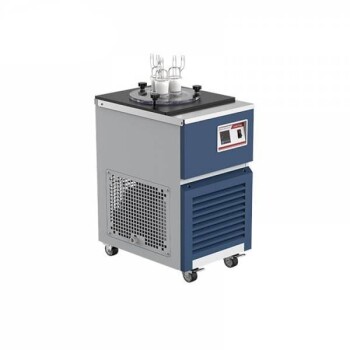
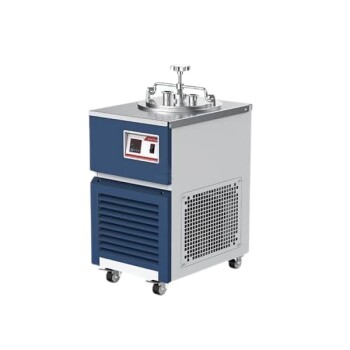
- 56L Vertical Laboratory Vacuum Drying Oven
- 23L Laboratory Vacuum Drying Oven
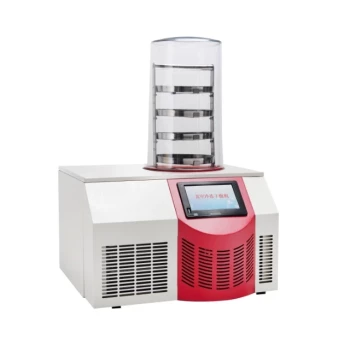
- Benchtop Laboratory Vacuum Freeze Dryer
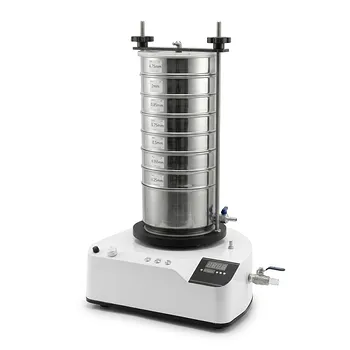
- Three-dimensional electromagnetic sieving instrument
- Vacuum Cold Mounting Machine for Sample Preparation
People Also Ask
- Why is a laboratory vacuum drying oven recommended for rice straw residues? Protect Your Biomass Integrity
- What role does a laboratory vacuum drying oven play in the preparation of modified multi-walled carbon nanotubes?
- What is the importance of using a laboratory vacuum drying oven? Preserving Slow-Release Microcapsule Integrity
- Why is a Laboratory Vacuum Drying Oven recommended for PBAT microspheres? Protect Sensitive Polymer Integrity
- What role does a laboratory vacuum drying oven play in processing nanoparticle powder samples? Protect Sample Integrity