Knowledge universal laboratory press What are the specifications of press machine? Find the Right Tonnage, Stroke & Bed Size for Your Needs
Author avatar

Tech Team · Kintek Solution

Updated 2 months ago

What are the specifications of press machine? Find the Right Tonnage, Stroke & Bed Size for Your Needs


Understanding the specifications of a press machine requires looking beyond a simple list of numbers. Because presses vary from small benchtop units to massive industrial machines, their specifications differ dramatically based on their type and intended use. The key is to understand what each specification means for the work you intend to do.

The most critical specifications of a press are not its physical dimensions, but its force capacity (tonnage), working area (daylight and bed size), and stroke length. These three factors directly determine the size of the parts you can work on and the operations you can perform.
What are the specifications of press machine? Find the Right Tonnage, Stroke & Bed Size for Your Needs

Core Performance Specifications: What the Press Can Do

The primary function of any press is to apply force. Its performance specifications define how much force it can apply and how it delivers that action.

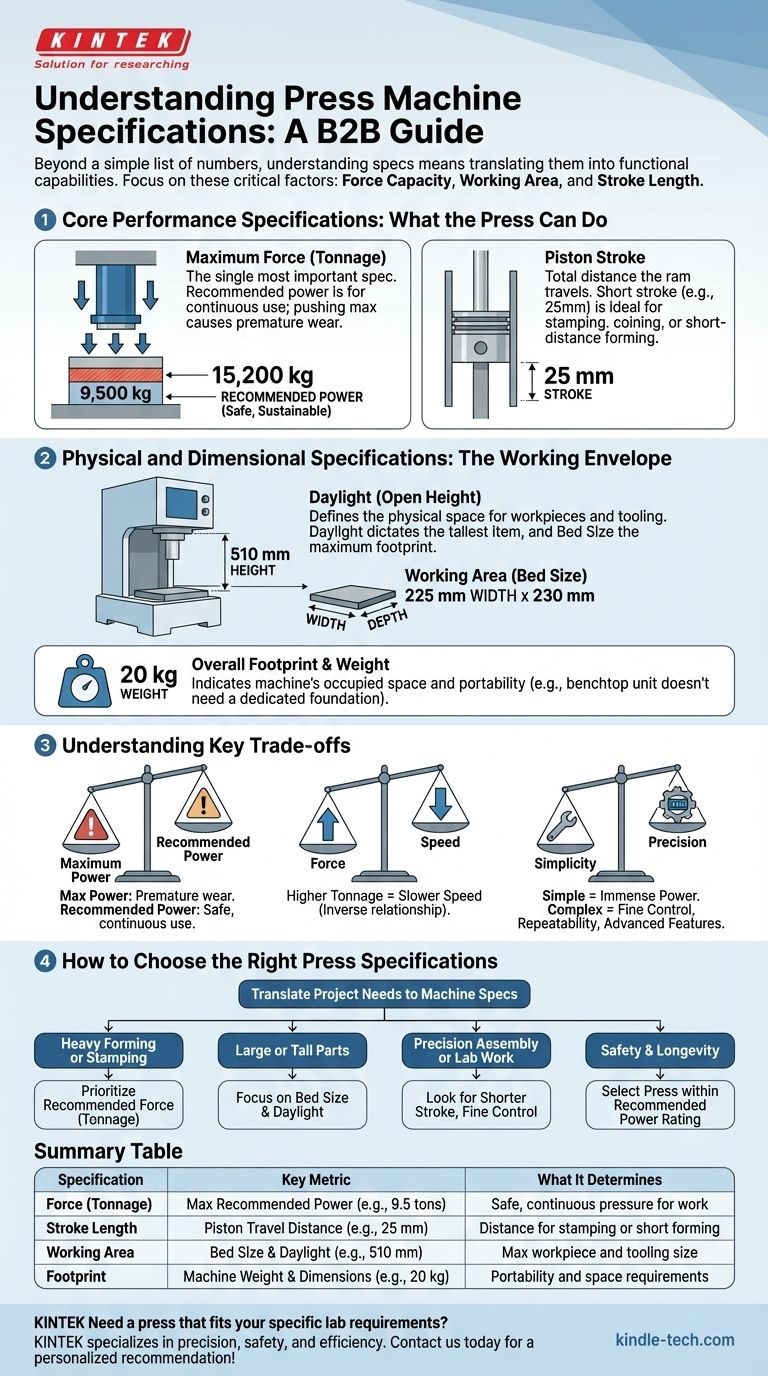
Maximum Force (Tonnage)

This is the single most important specification. It measures the maximum pressure the press can exert and is often expressed in kilograms, pounds, or tons.

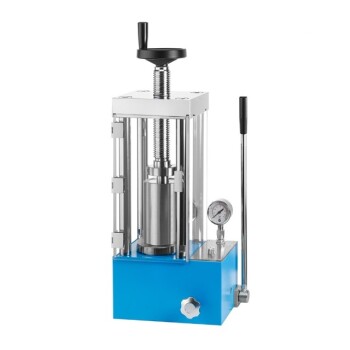
The example specifications list a maximum allowed power of 15,200 kg (approximately 15.2 metric tons) and a maximum recommended power of 9,500 kg (9.5 metric tons). This distinction is critical for safety and machine longevity.

Piston Stroke

The stroke is the total distance the moving ram or piston can travel from its fully retracted to its fully extended position.

A short stroke, like the 25 mm listed in the example, is common for operations like stamping, coining, or short-distance forming where high force is needed over a minimal distance.

Physical and Dimensional Specifications: The Working Envelope

These specifications define the physical space you have to work with, determining the maximum size of the workpiece and tooling (dies) that the press can accommodate.

Daylight (or Open Height)

Daylight refers to the maximum vertical distance between the ram and the press bed when the stroke is fully up. It dictates the tallest item that can fit inside the press.

The example's listed height of 510 mm (with a low spindle) likely represents its maximum daylight, providing the total vertical working room.

Working Area (Bed Size)

The bed is the flat, stationary surface upon which the workpiece and lower die are mounted. Its width and depth determine the maximum footprint of your project.

While not explicitly listed as "bed size," the example's width of 225 mm and depth of 230 mm indicate the machine's overall footprint, which constrains the size of the material you can place within it.

Overall Footprint and Weight

These dimensions tell you how much physical space the machine will occupy in your workshop and whether it requires special mounting.

A machine with a weight of 20 kg, like the one specified, is a small, portable benchtop unit that does not require a dedicated foundation.

Understanding the Key Trade-offs

Choosing a press involves balancing competing factors. Understanding these trade-offs is essential for selecting the right tool for the job.

Maximum vs. Recommended Power

Consistently operating a press at its absolute maximum allowed force will cause premature wear on its frame, seals, and hydraulic system.

The recommended power is the safe, sustainable limit for continuous, everyday use. Pushing beyond this should only be done intermittently, if at all.

Force vs. Speed

In most hydraulic systems, there is an inverse relationship between force and speed. A press designed to deliver extremely high tonnage will often move more slowly than a lower-tonnage press with a comparable power source.

Simplicity vs. Precision

A simple, manually operated press provides immense power but may lack the fine control, repeatability, and advanced features (like pressure holding or programmable cycles) of more complex, automated systems.

How to Choose the Right Press Specifications

Translate your project's needs into machine specifications to make an informed decision.

  • If your primary focus is heavy forming or stamping: Prioritize the maximum recommended force (tonnage) to ensure the press can perform the work without strain.
  • If your primary focus is working with large or tall parts: Focus on the bed size and daylight, ensuring your workpiece and tooling will fit comfortably within the working envelope.
  • If your primary focus is precision assembly or lab work: Look for a press with a shorter stroke and features that allow for fine control over force and ram position.
  • If your primary focus is safety and longevity: Always select a press where your typical working force falls comfortably within the manufacturer's recommended power rating.

By translating these numbers into functional capabilities, you can confidently select a machine that serves as a tool, not a limitation.

Summary Table:

Specification Key Metric What It Determines
Force (Tonnage) Maximum Recommended Power (e.g., 9.5 tons) Maximum pressure the press can safely exert for continuous work
Stroke Length Piston Travel Distance (e.g., 25 mm) Distance the ram can move; ideal for stamping or short-distance forming
Working Area Bed Size & Daylight (e.g., 510 mm height) Maximum size of workpiece and tooling that can fit in the press
Footprint Machine Weight & Dimensions (e.g., 20 kg) Portability and space requirements for your lab or workshop

Need a press that fits your specific lab requirements? KINTEK specializes in lab equipment and consumables, offering a range of press machines tailored for precision, safety, and efficiency. Whether you need high tonnage for heavy forming or a compact benchtop unit for assembly, our experts can help you select the right specifications for your workflow. Contact us today to discuss your project and get a personalized recommendation!

Visual Guide
What are the specifications of press machine? Find the Right Tonnage, Stroke & Bed Size for Your Needs Visual Guide

Related Products

People Also Ask

Related Products

Automatic High Temperature Heated Hydraulic Press Machine with Heated Plates for Lab

Automatic High Temperature Heated Hydraulic Press Machine with Heated Plates for Lab

The High Temperature Hot Press is a machine specifically designed for pressing, sintering and processing materials in a high temperature environment. It is capable of operating in the range of hundreds of degrees Celsius to thousands of degrees Celsius for a variety of high temperature process requirements.

Heated Hydraulic Press Machine with Heated Plates for Vacuum Box Laboratory Hot Press

Heated Hydraulic Press Machine with Heated Plates for Vacuum Box Laboratory Hot Press

Enhance your lab's precision with our lab press for vacuum box. Press pills and powders with ease and precision in a vacuum environment, reducing oxidation and improving consistency. Compact and easy to use with a digital pressure gauge.

Single Punch Tablet Press Machine and Mass Production Rotary Tablet Punching Machine for TDP

Single Punch Tablet Press Machine and Mass Production Rotary Tablet Punching Machine for TDP

Rotary tablet punching machine is an automatic rotating and continuous tableting machine. It is mainly used for tablet manufacturing in the pharmaceutical industry, and is also suitable for industrial sectors such as food, chemicals, batteries, electronics, ceramics, etc. to compress granular raw materials into tablets.

30T 40T Split Automatic Heated Hydraulic Press Machine with Heated Plates for Laboratory Hot Press

30T 40T Split Automatic Heated Hydraulic Press Machine with Heated Plates for Laboratory Hot Press

Discover our split automatic heated lab press 30T/40T for precise sample preparation in material research, pharmacy, ceramics, and electronics industries. With a small footprint and heating up to 300°C, it's perfect for processing under vacuum environment.

Automatic Heated Hydraulic Press Machine with Heated Plates for Laboratory Hot Press

Automatic Heated Hydraulic Press Machine with Heated Plates for Laboratory Hot Press

The Automatic High Temperature Heat Press is a sophisticated hydraulic hot press designed for efficient temperature control and product quality processing.

Heated Hydraulic Press Machine with Heated Plates for Vacuum Box Laboratory Hot Press

Heated Hydraulic Press Machine with Heated Plates for Vacuum Box Laboratory Hot Press

The lab press for vacuum box is a specialized piece of equipment designed for laboratory use. Its main purpose is to press pills and powders according to specific requirements.

Automatic Laboratory Heat Press Machine

Automatic Laboratory Heat Press Machine

Precision automatic heat press machines for labs—ideal for material testing, composites, and R&D. Customizable, safe, and efficient. Contact KINTEK today!

Cold Isostatic Pressing Machine CIP for Small Workpiece Production 400Mpa

Cold Isostatic Pressing Machine CIP for Small Workpiece Production 400Mpa

Produce uniformly high-density materials with our Cold Isostatic Press. Ideal for compacting small workpieces in production settings. Widely used in powder metallurgy, ceramics, and biopharmaceutical fields for high-pressure sterilization and protein activation.

Lab Scale Rotary Single Punch Tablet Press Machine TDP Tablet Punching Machine

Lab Scale Rotary Single Punch Tablet Press Machine TDP Tablet Punching Machine

This machine is a single-pressure automatic rotating, continuous tableting machine that compresses granular raw materials into various tablets. It is mainly used for tablet production in the pharmaceutical industry, and is also suitable for chemical, food, electronics and other industrial sectors.

Laboratory Hydraulic Press Lab Pellet Press Machine for Glove Box

Laboratory Hydraulic Press Lab Pellet Press Machine for Glove Box

Controlled environment lab press machine for glove box. Specialized equipment for material pressing and shaping with high precision digital pressure gauge.

Single Punch Electric Tablet Press Machine Laboratory Powder Tablet Punching TDP Tablet Press

Single Punch Electric Tablet Press Machine Laboratory Powder Tablet Punching TDP Tablet Press

The single-punch electric tablet press is a laboratory-scale tablet press suitable for corporate laboratories in pharmaceutical, chemical, food, metallurgical and other industries.

Single Punch Electric Tablet Press Machine TDP Tablet Punching Machine

Single Punch Electric Tablet Press Machine TDP Tablet Punching Machine

The electric tablet punching machine is a laboratory equipment designed for pressing various granular and powdery raw materials into discs and other geometric shapes. It is commonly used in pharmaceutical, healthcare products, food, and other industries for small batch production and processing. The machine is compact, lightweight, and easy to operate, making it suitable for use in clinics, schools, laboratories, and research units.

Single Punch Manual Tablet Press Machine TDP Tablet Punching Machine

Single Punch Manual Tablet Press Machine TDP Tablet Punching Machine

Single punch manual tablet punching machine can press various granular, crystal or powdery raw materials with good fluidity into disc-shaped, cylindrical, spherical, convex, concave and other various geometric shapes (such as square, triangle, ellipse, capsule shape, etc.), and can also press products with text and patterns.

Automatic Laboratory Hydraulic Pellet Press Machine for Lab Use

Automatic Laboratory Hydraulic Pellet Press Machine for Lab Use

Experience efficient sample preparation with our Automatic Lab Press Machine. Ideal for material research, pharmacy, ceramics, and more. Features a compact size and hydraulic press functionality with heating plates. Available in various sizes.

Manual Heated Hydraulic Press Machine with Heated Plates for Laboratory Hot Press

Manual Heated Hydraulic Press Machine with Heated Plates for Laboratory Hot Press

The Manual Heat Press is a versatile piece of equipment suitable for a variety of applications, operated by a manual hydraulic system that applies controlled pressure and heat to the material placed on the piston.

Manual Cold Isostatic Pressing Machine CIP Pellet Press

Manual Cold Isostatic Pressing Machine CIP Pellet Press

Lab Manual Isostatic Press is a high-efficient equipment for sample preparation widely used in material research, pharmacy, ceramics, and electronic industries. It allows for precision control of the pressing process and can work in a vacuum environment.

Automatic Lab Cold Isostatic Press CIP Machine Cold Isostatic Pressing

Automatic Lab Cold Isostatic Press CIP Machine Cold Isostatic Pressing

Efficiently prepare samples with our Automatic Lab Cold Isostatic Press. Widely used in material research, pharmacy, and electronic industries. Provides greater flexibility and control compared to electric CIPs.

Electric Split Lab Cold Isostatic Press CIP Machine for Cold Isostatic Pressing

Electric Split Lab Cold Isostatic Press CIP Machine for Cold Isostatic Pressing

Split cold isostatic presses are capable of providing higher pressures, making them suitable for testing applications that require high pressure levels.

Electric Lab Cold Isostatic Press CIP Machine for Cold Isostatic Pressing

Electric Lab Cold Isostatic Press CIP Machine for Cold Isostatic Pressing

Produce dense, uniform parts with improved mechanical properties with our Electric Lab Cold Isostatic Press. Widely used in material research, pharmacy, and electronic industries. Efficient, compact, and vacuum-compatible.

Automatic Laboratory Hydraulic Press for XRF & KBR Pellet Press

Automatic Laboratory Hydraulic Press for XRF & KBR Pellet Press

Fast and easy xrf sample pellet preparation with KinTek Automatic Lab Pellet Press. Versatile and accurate results for X-ray fluorescence analysis.


Leave Your Message