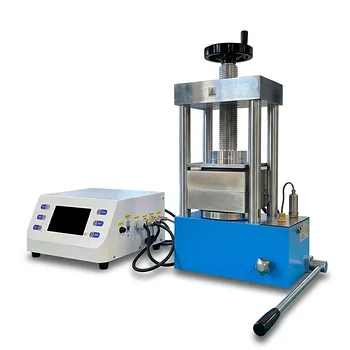
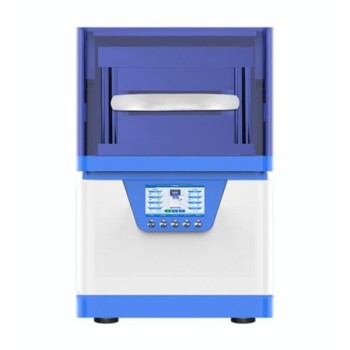
The heated hydraulic press functions as the critical activation chamber for the Cold Sintering Process (CSP) of LATP-halide composites. It creates a controlled environment where high uniaxial pressure (typically 500 MPa) and moderate heat (around 150°C) are applied simultaneously. This dual application of energy is essential to drive the chemical and mechanical processes that densify the material without the extreme temperatures required in traditional sintering.
The press drives a unique dissolution-precipitation-creep mechanism by maintaining precise pressure and temperature conditions in the presence of a transient liquid phase. This synergy allows for high densification and structural integrity at significantly lower processing temperatures.
The Synergistic Mechanism
Simultaneous Pressure and Thermal Fields
The primary role of the press is to move beyond simple compaction. While standard hydraulic presses operate at room temperature to create "green" pellets, the heated press introduces a thermal field of approximately 150°C. This moderate heat is strictly controlled to work in tandem with the mechanical force.
Activating the Dissolution-Precipitation-Creep Cycle
Under the influence of the press, a transient liquid phase—specifically DMF (Dimethylformamide) for LATP systems—becomes active. The 500 MPa pressure forces particles into intimate contact, while the heat facilitates the dissolution of surface material into the liquid. This material then precipitates to fill voids, effectively cementing the ceramic grains together.
Facilitating Mass Transport
The press ensures that the liquid phase is distributed evenly and held under confinement. This allows for rapid mass transfer between particles. The mechanical pressure contributes to a "creep" mechanism, where solid material slowly deforms to close remaining pores, ensuring a highly dense final structure.
Densification vs. Traditional Compaction
Beyond Standard Cold Pressing
A standard laboratory press is typically used to compress calcined powder into green pellets at room temperature. This increases packing density and reduces inter-particle distance, but it does not achieve final densification. The heated press in CSP bridges the gap between forming and sintering, achieving high density in a single step.
Promoting Particle Rearrangement
Similar to processes observed in other ceramics (such as BZY20), the high-pressure environment forces moistened powder particles to rearrange. By maintaining constant pressure, the press prevents the re-opening of pores as the solvent evaporates or reacts. This leads to density levels that would normally require significantly higher thermal energy.
Operational Considerations and Trade-offs
Equipment Precision and Stability
The success of CSP relies heavily on the stability of the hydraulic press. Fluctuations in pressure or uneven heating can disrupt the dissolution-precipitation balance. If the pressure drops, the "creep" mechanism fails; if the temperature spikes, the transient solvent may evaporate before densification is complete.
Uniaxial Limitations
Most heated hydraulic presses apply force uniaxially (from one direction). While effective for flat pellets or layered composites, this can result in density gradients in complex shapes. Operators must carefully control the dwell time and pressure ramp rates to ensure the core of the composite reaches the same density as the edges.
Making the Right Choice for Your Goal
To optimize the Cold Sintering Process for LATP-halide electrolytes, align your equipment usage with your specific objectives:
- If your primary focus is achieving maximum density: Ensure your press can sustain at least 500 MPa continuously at 150°C to fully activate the creep mechanism and minimize porosity.
- If your primary focus is preventing dendrite growth: Utilize the press's capability for stepwise processing to bond layers of varying chemical stability into a single, cohesive pellet.
Ultimately, the heated hydraulic press is not just a forming tool, but a chemical reactor that enables high-performance ceramics at low-energy inputs.
Summary Table:
| Feature | Role in Cold Sintering Process (CSP) | Key Specification/Mechanism |
|---|---|---|
| Uniaxial Pressure | Drives particle rearrangement and creep mechanism | Typically ~500 MPa |
| Thermal Field | Facilitates dissolution & activates transient liquid phase | Moderate heat (~150°C) |
| Liquid Phase | Enables mass transport & material precipitation | Often DMF (Dimethylformamide) |
| Equipment Stability | Ensures consistent density & prevents pore re-opening | High-precision pressure & heat control |
Revolutionize Your Electrolyte Research with KINTEK
Achieving the perfect densification in Cold Sintering requires more than just force; it demands precision. KINTEK specializes in advanced laboratory equipment, providing high-performance heated hydraulic presses (pellet, hot, and isostatic) designed specifically for the rigorous 500 MPa/150°C requirements of CSP.
Beyond pressing, our portfolio includes everything from high-temperature furnaces and crushing systems to battery research tools and high-pressure reactors. Partner with KINTEK to ensure your LATP-halide composites achieve superior structural integrity and conductivity.
Contact our experts today to find the ideal pressing solution for your lab!
Related Products
- 24T 30T 60T Heated Hydraulic Press Machine with Heated Plates for Laboratory Hot Press
- Heated Hydraulic Press Machine with Integrated Manual Heated Plates for Lab Use
- Automatic Heated Hydraulic Press Machine with Heated Plates for Laboratory Hot Press 25T 30T 50T
- Heated Hydraulic Press Machine with Heated Plates for Vacuum Box Laboratory Hot Press
- Automatic High Temperature Heated Hydraulic Press Machine with Heated Plates for Lab
People Also Ask
- Why is the heating function of a laboratory hydraulic press essential for MEA assembly in DEFC? Optimize Cell Bonding
- What technical conditions does a heated hydraulic press provide for PEO batteries? Optimize Solid-State Interfaces
- How is a heated hydraulic press used for Li-LLZO batteries? Optimize Interfacial Bonding with Thermal-Pressure
- What is the core function of a laboratory heated hydraulic press in CSP? Revolutionize Low-Temp Ceramic Sintering
- What are heated hydraulic presses used for? Molding Composites, Vulcanizing Rubber, and More