At its core, a mold is not a single entity but a vast, interconnected network of microscopic, thread-like filaments called hyphae. These individual hyphae branch and weave together to form the visible mass we recognize as a mold colony, which is technically known as a mycelium.
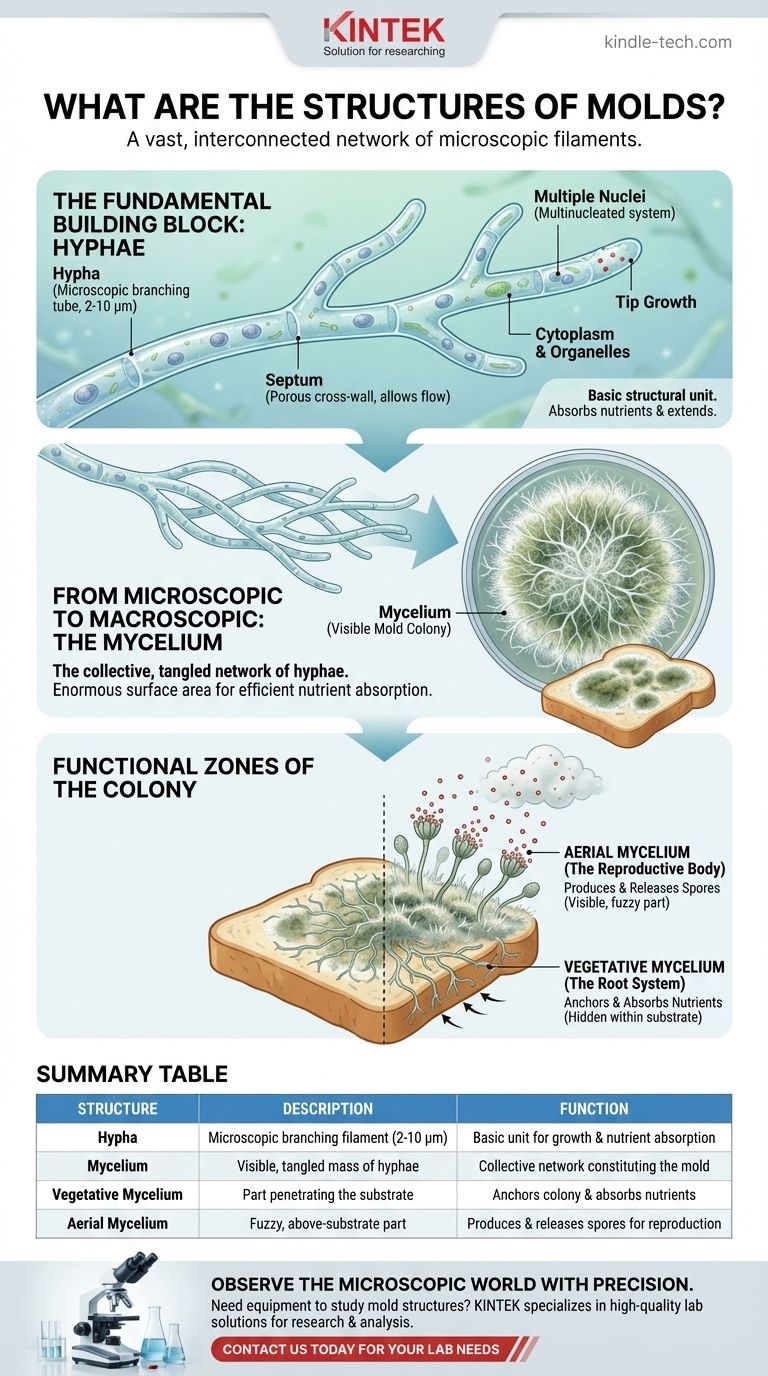
The fundamental structure of a mold is the hypha, a microscopic branching tube. The visible mold colony you see is the mycelium, which is simply a massive, tangled network of these individual hyphae.
The Fundamental Building Block: Hyphae
To understand a mold, you must first understand its individual components. The entire organism is built from repeating, simple units.
What is a Hypha?
A hypha (plural: hyphae) is the basic structural unit of a mold. It is a branching, tubular filament, similar to a single strand of thread.
These structures are microscopic, typically measuring only 2-10 micrometers in diameter. Their primary purpose is to grow, extend, and absorb nutrients from the environment.
Internal Divisions: Septa
Most hyphae are divided into cell-like compartments by internal cross-walls called septa.
These septa are not solid walls. They are perforated, allowing cytoplasm, organelles, and nutrients to flow freely between compartments, which facilitates rapid, coordinated growth across the entire network.
A Multinucleated System
Molds are multinucleated, meaning multiple nuclei can exist within a single compartment or share a common cytoplasm. This structure allows the organism to coordinate its functions and grow efficiently without having to form complete new cells for every extension.
From Microscopic to Macroscopic: The Mycelium
While a single hypha is invisible to the naked eye, their collective growth forms the structure we can easily see.
Defining the Mycelium
The mycelium is the term for the entire mass of intertwined hyphae that constitutes the mold colony.
When you see a fuzzy patch of mold on bread or a damp wall, you are looking at the mycelium—a vast, three-dimensional network of filaments.
Why This Structure is So Effective
The filamentous network of the mycelium is incredibly efficient at its job: absorbing nutrients.
This structure creates an enormous surface area, allowing the mold to make maximum contact with its food source and secrete digestive enzymes externally. This is why molds are such effective decomposers.
The Functional Parts of a Mold Colony
Not all parts of the mycelium perform the same function. The colony is typically organized into two distinct operational zones.
Vegetative Mycelium: The Root System
The portion of the mycelium that penetrates the food source (the substrate) is called the vegetative mycelium.
Its function is analogous to the roots of a plant. It anchors the colony and is primarily responsible for absorbing water and nutrients. This part is often hidden from view within the material the mold is growing on.
Aerial Mycelium: The Reproductive Body
The aerial mycelium grows upward, away from the substrate, and rises into the air. This is the fuzzy, often colorful part of the mold we are most familiar with.
Its primary function is reproduction. This part of the mycelium develops specialized structures that produce and release microscopic spores, which can then travel through the air to establish new colonies.
Key Structural Concepts at a Glance
Understanding these structural layers is key to understanding how molds function and grow.
- If your primary focus is the microscopic level: The key structure is the hypha, the individual, branching filament that absorbs nutrients.
- If your primary focus is the visible colony: You are observing the mycelium, which is the collective, tangled mass of countless hyphae.
- If your primary focus is the mold's lifecycle: Distinguish between the vegetative mycelium for feeding and the aerial mycelium for reproduction via spores.
This simple, repeating filamentous structure is what allows a microscopic spore to develop into a large, complex, and highly effective organism.
Summary Table:
| Structure | Description | Function |
|---|---|---|
| Hypha | A microscopic, branching, tubular filament (2-10 μm in diameter) | The basic unit for growth and nutrient absorption |
| Mycelium | The visible, tangled mass of hyphae forming the colony | The collective network that constitutes the mold |
| Vegetative Mycelium | The part that penetrates the substrate (food source) | Anchors the colony and absorbs nutrients |
| Aerial Mycelium | The fuzzy, above-substrate part of the mycelium | Produces and releases spores for reproduction |
Need precise equipment to study microscopic structures like mold hyphae? KINTEK specializes in high-quality lab equipment and consumables for all your laboratory needs. Whether you're in research, education, or quality control, our tools help you observe, analyze, and understand complex biological systems with accuracy and ease. Contact us today to find the perfect solution for your lab!
Visual Guide
Related Products
- Double Plate Heating Press Mold for Lab
- XRF Boric Acid Lab Powder Pellet Pressing Mold for Laboratory Use
- XRF & KBR steel ring lab Powder Pellet Pressing Mold for FTIR
- Cylindrical Press Mold with Scale for Lab
- Anti-Cracking Press Mold for Lab Use
People Also Ask
- What is the process of mold press? A Step-by-Step Guide to Compression Molding
- How to use a press mold? Master the Art of Creating Consistent Ceramic Forms
- What is the difference between heat press and sublimation? A Tool vs. a Process Explained
- What is the purpose of specialized pressure devices in sulfide solid-state batteries? Ensure Chemo-Mechanical Stability
- Why are pressure molds with non-conductive resin inner walls required for battery testing? Ensure Data Accuracy