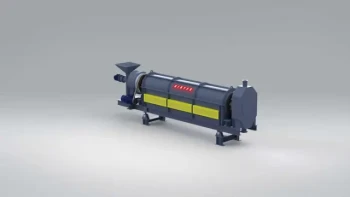
The material movement within a rotating cylinder is defined by two fundamental components: axial movement and transverse movement. Axial movement drives the material along the length of the cylinder to determine residence time, while transverse movement circulates material across the cross-section to facilitate mixing and heat transfer.
While axial flow controls the throughput and timing of the process, it is the transverse motion within the cylinder bed that primarily governs process quality, specifically the efficiency of heat transfer and the homogeneity of the mixture.
Understanding the Two Directions of Flow
To optimize the performance of a rotating cylinder—whether it is a kiln, dryer, or mixer—you must treat these two components as distinct but interactive forces.
Axial Movement: The Longitudinal Component
Axial movement refers to the travel of the charge (material) along the length of the cylinder.
This is the directional force that moves material from the feed end to the discharge end. It is the primary factor in calculating residence time.
Transverse Movement: The Cross-Sectional Component
Transverse movement occurs in the plane perpendicular to the cylinder's axis.
This component dictates how the material tumbles, rolls, or slides within the bed itself. It is responsible for the internal mechanics of the charge, specifically influencing primary bed processes.
The Impact on Process Efficiency
The interaction between these two movements determines the overall success of the operation.
Controlling Residence Time
The axial component is the "clock" of your process.
By adjusting the factors that influence axial speed, you control how long the material remains under processing conditions. This ensures the material is exposed to the environment for the exact duration required for the desired chemical or physical changes.
Driving Heat Transfer and Mixing
The transverse component is the "engine" of your process quality.
Effective transverse movement ensures that the material is constantly turning over. This continuous exposure of new surface areas is critical for achieving uniform material mixing and efficient heat transfer throughout the bed.
Understanding the Trade-offs
Focusing too heavily on one component often compromises the other, leading to process inefficiencies.
Throughput vs. Process Quality
If you increase axial movement to boost throughput, you inevitably reduce residence time.
Without sufficient time in the cylinder, the transverse movement may not have enough cycles to thoroughly mix the bed or transfer heat to the core of the charge.
The Risk of Poor Transverse Motion
Conversely, having the correct residence time (axial) is useless if the transverse movement is poor.
If the material slides rather than rolls (poor transverse motion), it may spend the correct amount of time in the cylinder but fail to heat evenly or mix properly.
Optimizing Cylinder Performance
To achieve the best results, you must prioritize the component that aligns with your specific operational constraints.
- If your primary focus is Production Volume: Prioritize the axial component to maximize material flow rate, but ensure the residence time remains above the minimum threshold for reaction completion.
- If your primary focus is Product Uniformity: Prioritize the transverse component to maximize bed turnover, ensuring thorough mixing and heat transfer even if it requires a slower axial progression.
Mastering the relationship between these two vectors allows you to predict process outcomes with precision.
Summary Table:
| Movement Component | Direction | Primary Process Function | Key Outcome |
|---|---|---|---|
| Axial Movement | Longitudinal (Lengthwise) | Controls flow rate and throughput | Determines Residence Time |
| Transverse Movement | Cross-sectional (Perpendicular) | Drives tumbling, rolling, and sliding | Ensures Heat Transfer & Mixing |
Elevate Your Processing Precision with KINTEK
Achieving the perfect balance between axial throughput and transverse mixing quality requires high-performance equipment. KINTEK specializes in advanced laboratory and industrial solutions, including rotary furnaces, crushing systems, and high-temperature reactors designed to provide uniform heat distribution and precise material control.
Whether you are scaling up battery research or optimizing material synthesis, our expert team is ready to help you select the ideal furnace or processing system for your specific needs. Contact us today to enhance your lab's efficiency and product uniformity!
Related Products
- Rotating Platinum Disk Electrode for Electrochemical Applications
- RRDE rotating disk (ring disk) electrode / compatible with PINE, Japanese ALS, Swiss Metrohm glassy carbon platinum
- Electric Rotary Kiln Pyrolysis Furnace Plant Machine Calciner Small Rotary Kiln Rotating Furnace
- Laboratory Vacuum Tilt Rotary Tube Furnace Rotating Tube Furnace
- Custom PTFE Teflon Parts Manufacturer for PTFE Measuring Cylinder 10/50/100ml
People Also Ask
- What is the working principle of a platinum disk electrode? A Guide to Precise Electrochemical Analysis
- What are the temperature limitations for a platinum disk electrode? The Critical Factor is the Insulating Body
- What can cause poisoning of a platinum disk electrode and how can it be prevented? Ensure Reliable Electrochemical Data
- How should a platinum disk electrode be polished? Master the Technique for Reliable Electrochemical Data
- How should a platinum disk electrode be used during an experiment? A Guide to Accurate Electrochemical Measurements