Knowledge muffle furnace What are the uses of muffle furnace in pharmaceutical industry? Essential for Drug Purity & Safety
Author avatar

Tech Team · Kintek Solution

Updated 2 months ago

What are the uses of muffle furnace in pharmaceutical industry? Essential for Drug Purity & Safety


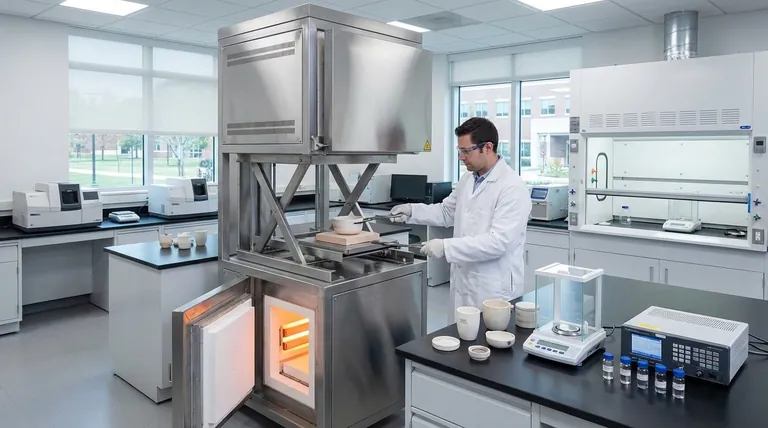
In the pharmaceutical industry, a muffle furnace is primarily used for the high-temperature preparation and analysis of samples, which is a critical step in drug inspection and quality control. These furnaces provide the precise, controlled heat needed to burn away organic compounds, allowing technicians to isolate and quantify the inorganic residue left behind.

A muffle furnace's role extends beyond simple heating; it is an essential analytical tool for ensuring drug purity and safety. Its primary function is to perform ashing and loss-on-ignition tests, which are fundamental for quantifying inorganic impurities and meeting stringent pharmacopoeial standards.
What are the uses of muffle furnace in pharmaceutical industry? Essential for Drug Purity & Safety

The Core Function: High-Temperature Analysis

A muffle furnace is essentially a high-temperature oven, insulated to reach temperatures up to 1200°C or higher. Its key feature is that the sample is heated without coming into direct contact with the heating element, preventing contamination and ensuring uniform temperature.

Ashing for Impurity Analysis

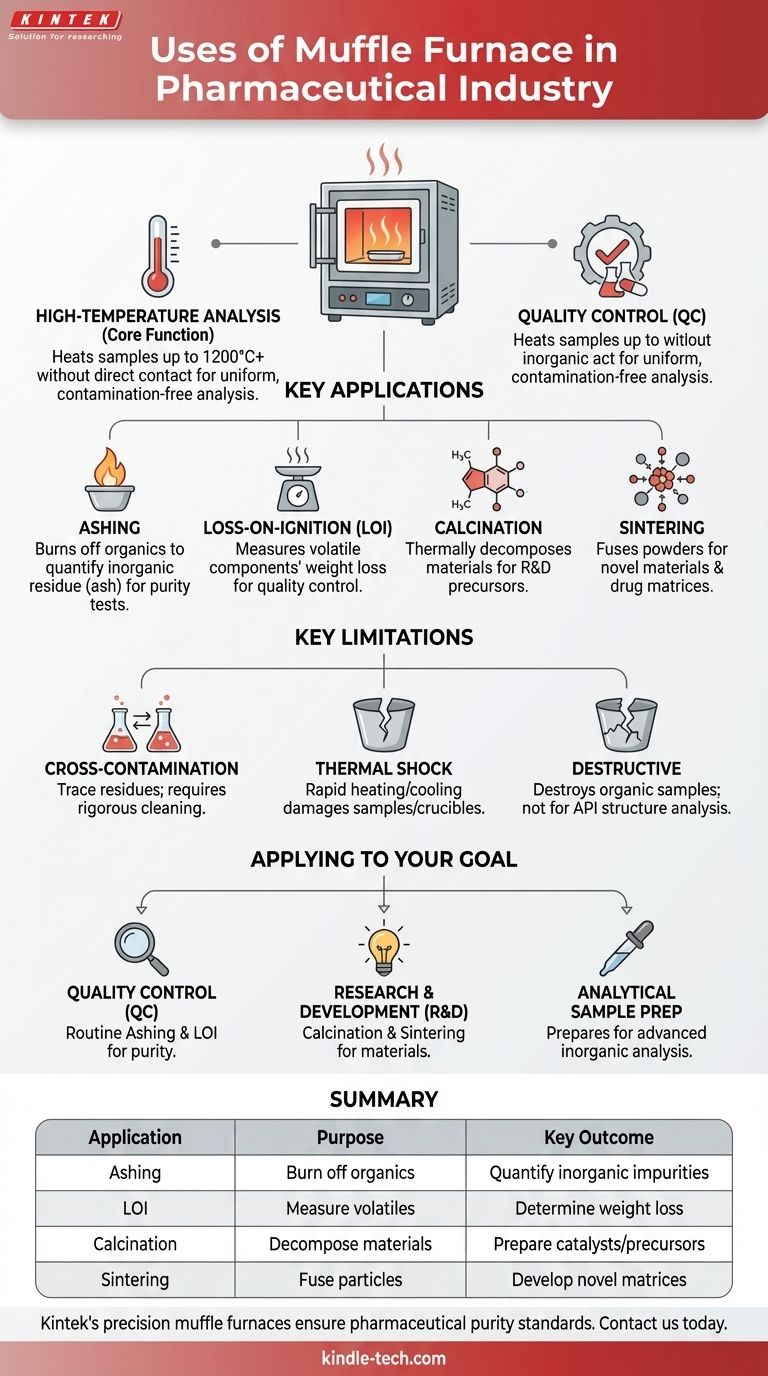
Ashing is the most common pharmaceutical application. The process involves heating a sample at a very high temperature to completely burn off all organic substances, including the active pharmaceutical ingredient (API) and excipients.

What remains is the inorganic residue or "ash." Weighing this residue is a direct measure of the total amount of inorganic impurities in the original sample. This procedure is the basis for standard pharmacopoeial tests like "Residue on Ignition" or "Sulphated Ash."

Loss-on-Ignition (LOI) Testing

Loss-on-ignition is a specific analytical method that uses a muffle furnace to determine the weight percentage of volatile components in a sample.

The sample is weighed before and after the heating process. The weight lost during ignition corresponds to components like water, carbonates, or other volatile materials, providing critical data for quality control.

Calcination for Material Preparation

Calcination involves heating a solid material to a high temperature to cause thermal decomposition or drive off volatile substances, but without melting it.

In pharmaceutical R&D, this can be used to synthesize stable inorganic materials or catalysts. For example, it can convert metal carbonates into their more reactive oxide forms for use in subsequent chemical processes.

Sintering in Materials Science

Sintering uses heat to fuse particles of a powder together, creating a solid or porous solid mass. This is done below the material's melting point.

While less common, this application is relevant in pharmaceutical materials science for creating specific ceramic components or developing novel drug delivery matrices.

Understanding the Key Limitations

While essential, operating a muffle furnace requires a clear understanding of its limitations to ensure accurate and safe results.

Risk of Cross-Contamination

The interior chamber can retain trace residues from previous runs. Without rigorous cleaning protocols between different sample types, cross-contamination can occur, leading to inaccurate impurity measurements.

Thermal Shock to Samples and Crucibles

Rapid heating or cooling can cause thermal shock, which can damage or even shatter the ceramic crucibles used to hold samples. It may also cause certain samples to spatter, resulting in material loss and inaccurate final weights. Controlled, gradual temperature ramps are essential.

Destructive to Organic Components

By its very nature, the ashing process destroys the organic sample. It is a tool for analyzing what is not the drug. It cannot be used to analyze the chemical structure or properties of the active pharmaceutical ingredient itself.

Applying This to Your Pharmaceutical Goal

The specific use of a muffle furnace depends entirely on your team's objective within the drug lifecycle.

  • If your primary focus is Quality Control (QC): Your main use will be performing routine ashing and loss-on-ignition tests to quantify inorganic impurities and ensure batches comply with pharmacopoeial standards.
  • If your primary focus is Research & Development (R&D): You will use it for materials science applications, such as calcination to create precursor materials or sintering to develop novel formulations.
  • If your primary focus is Analytical Sample Prep: The furnace is essential for preparing samples for more advanced inorganic analysis (e.g., Atomic Absorption Spectroscopy) by cleanly removing the organic matrix.

Ultimately, the muffle furnace is a foundational instrument for verifying the purity and quality that underpins pharmaceutical safety.

Summary Table:

Application Purpose Key Outcome
Ashing Burn off organic material Quantify inorganic impurities (ash)
Loss-on-Ignition (LOI) Measure volatile components Determine weight loss for quality control
Calcination Thermally decompose materials Prepare inorganic catalysts or precursors
Sintering Fuse powder particles Develop novel drug delivery matrices

Ensure your pharmaceutical products meet the highest purity standards with KINTEK's precision muffle furnaces. Our lab equipment is designed for accurate ashing, loss-on-ignition, and calcination processes, providing the reliable performance your quality control and R&D teams demand. Contact us today to find the perfect furnace for your laboratory's needs and enhance your drug safety protocols.

Visual Guide
What are the uses of muffle furnace in pharmaceutical industry? Essential for Drug Purity & Safety Visual Guide

Related Products

People Also Ask

Related Products

1200℃ Muffle Furnace Oven for Laboratory

1200℃ Muffle Furnace Oven for Laboratory

Upgrade your lab with our 1200℃ Muffle Furnace. Achieve fast, precise heating with Japan alumina fibers and Molybdenum coils. Features TFT touch screen controller for easy programming and data analysis. Order now!

1800℃ Muffle Oven Furnace for Laboratory

1800℃ Muffle Oven Furnace for Laboratory

KT-18 muffle furnace with Japan Al2O3 polycrystalline fibe and Silicon Molybdenum heating element, up to 1900℃, PID temperature control and 7" smart touch screen. Compact design, low heat loss, and high energy efficiency. Safety interlock system and versatile functions.

1400℃ Muffle Oven Furnace for Laboratory

1400℃ Muffle Oven Furnace for Laboratory

Get precise high-temperature control up to 1500℃ with KT-14M Muffle furnace. Equipped with a smart touch screen controller and advanced insulation materials.

1700℃ Muffle Oven Furnace for Laboratory

1700℃ Muffle Oven Furnace for Laboratory

Get superior heat control with our 1700℃ Muffle Furnace. Equipped with intelligent temperature microprocessor, TFT touch screen controller & advanced insulation materials for precise heating up to 1700C. Order now!

High Temperature Muffle Oven Furnace for Laboratory Debinding and Pre Sintering

High Temperature Muffle Oven Furnace for Laboratory Debinding and Pre Sintering

KT-MD High temperature debinding and pre-sintering furnace for ceramic materials with various molding processes. Ideal for electronic components such as MLCC and NFC.

Laboratory Muffle Oven Furnace Bottom Lifting Muffle Furnace

Laboratory Muffle Oven Furnace Bottom Lifting Muffle Furnace

Efficiently produce batches with excellent temperature uniformity using our Bottom Lifting Furnace. Features two electric lifting stages and advanced temperature control up to 1600℃.

Molybdenum Vacuum Heat Treat Furnace

Molybdenum Vacuum Heat Treat Furnace

Discover the benefits of a high-configuration molybdenum vacuum furnace with heat shield insulation. Ideal for high-purity, vacuum environments like sapphire crystal growth and heat treatment.

Multi-zone Laboratory Tube Furnace

Multi-zone Laboratory Tube Furnace

Experience precise, efficient thermal testing with our Multi Zone Tube Furnace. Independent heating zones and temperature sensors allow for controlled high-temperature gradient heating fields. Order now for advanced thermal analysis!

Vacuum Heat Treat and Molybdenum Wire Sintering Furnace for Vacuum Sintering

Vacuum Heat Treat and Molybdenum Wire Sintering Furnace for Vacuum Sintering

A vacuum molybdenum wire sintering furnace is a vertical or bedroom structure, which is suitable for withdrawal, brazing, sintering and degassing of metal materials under high vacuum and high temperature conditions. It is also suitable for dehydroxylation treatment of quartz materials.

Horizontal High Temperature Graphite Vacuum Graphitization Furnace

Horizontal High Temperature Graphite Vacuum Graphitization Furnace

Horizontal Graphitization Furnace: This type of furnace is designed with the heating elements placed horizontally, allowing for uniform heating of the sample. It's well-suited for graphitizing large or bulky samples that require precise temperature control and uniformity.

Vacuum Hot Press Furnace Machine Heated Vacuum Press

Vacuum Hot Press Furnace Machine Heated Vacuum Press

Discover the advantages of Vacuum Hot Press Furnace! Manufacture dense refractory metals & compounds, ceramics, and composites under high temp and pressure.

Controlled Nitrogen Inert Hydrogen Atmosphere Furnace

Controlled Nitrogen Inert Hydrogen Atmosphere Furnace

KT-AH Hydrogen atmosphere furnace - induction gas furnace for sintering/annealing with built-in safety features, dual housing design, and energy-saving efficiency. Ideal for lab and industrial use.

1200℃ Controlled Atmosphere Furnace Nitrogen Inert Atmosphere Furnace

1200℃ Controlled Atmosphere Furnace Nitrogen Inert Atmosphere Furnace

Discover our KT-12A Pro Controlled atmosphere furnace - high precision, heavy duty vacuum chamber, versatile smart touch screen controller, and excellent temperature uniformity up to 1200C. Ideal for both laboratory and industrial application.

1700℃ Controlled Atmosphere Furnace Nitrogen Inert Atmosphere Furnace

1700℃ Controlled Atmosphere Furnace Nitrogen Inert Atmosphere Furnace

KT-17A Controlled atmosphere furnace: 1700℃ heating, vacuum sealing technology, PID temperature control, and versatile TFT smart touch screen controller for laboratory and industrial use.

Non Consumable Vacuum Arc Induction Melting Furnace

Non Consumable Vacuum Arc Induction Melting Furnace

Explore the benefits of Non-Consumable Vacuum Arc Furnace with high melting point electrodes. Small, easy to operate & eco-friendly. Ideal for laboratory research on refractory metals & carbides.

Rotary Tube Furnace Split Multi Heating Zone Rotating Tube Furnace

Rotary Tube Furnace Split Multi Heating Zone Rotating Tube Furnace

Multi zone rotary furnace for high-precision temperature control with 2-8 independent heating zones. Ideal for lithium ion battery electrode materials and high-temperature reactions. Can work under vacuum and controlled atmosphere.

600T Vacuum Induction Hot Press Furnace for Heat Treat and Sintering

600T Vacuum Induction Hot Press Furnace for Heat Treat and Sintering

Discover the 600T Vacuum Induction Hot Press Furnace, designed for high-temperature sintering experiments in vacuum or protected atmospheres. Its precise temperature and pressure control, adjustable working pressure, and advanced safety features make it ideal for nonmetal materials, carbon composites, ceramics, and metal powders.

Multi Heating Zones CVD Tube Furnace Machine Chemical Vapor Deposition Chamber System Equipment

Multi Heating Zones CVD Tube Furnace Machine Chemical Vapor Deposition Chamber System Equipment

KT-CTF14 Multi Heating Zones CVD Furnace - Precise Temperature Control and Gas Flow for Advanced Applications. Max temp up to 1200℃, 4 channels MFC mass flow meter, and 7" TFT touch screen controller.

Vacuum Heat Treat Furnace with Ceramic Fiber Liner

Vacuum Heat Treat Furnace with Ceramic Fiber Liner

Vacuum furnace with polycrystalline ceramic fiber insulation liner for excellent heat insulation and uniform temperature field. Choose from 1200℃ or 1700℃ max. working temperature with high vacuum performance and precise temperature control.

Vacuum Heat Treat and Pressure Sintering Furnace for High Temperature Applications

Vacuum Heat Treat and Pressure Sintering Furnace for High Temperature Applications

Vacuum pressure sintering furnaces are designed for high temperature hot pressing applications in metal and ceramic sintering. Its advanced features ensure precise temperature control, reliable pressure maintenance, and a robust design for seamless operation.


Leave Your Message



















