Knowledge cvd machine What conditions are needed to make artificial diamonds? A Guide to HPHT and CVD Methods
Author avatar

Tech Team · Kintek Solution

Updated 3 months ago

What conditions are needed to make artificial diamonds? A Guide to HPHT and CVD Methods


To create an artificial diamond, you must use one of two primary methods, each involving drastically different conditions. The first, High Pressure/High Temperature (HPHT), replicates the brutal force of the Earth's mantle. The second, Chemical Vapor Deposition (CVD), "grows" a diamond atom-by-atom from a superheated gas. Both methods produce a final product that is chemically, physically, and optically identical to a mined diamond.

The core challenge in creating a diamond is forcing carbon atoms into a highly stable, rigid crystal lattice. You can either achieve this with immense physical force (HPHT) or by meticulously engineering the atomic environment (CVD).
What conditions are needed to make artificial diamonds? A Guide to HPHT and CVD Methods

The Brute Force Approach: High Pressure/High Temperature (HPHT)

The HPHT method is the original technique for creating diamonds and directly mimics the conditions deep within the Earth where natural diamonds form.

Replicating the Earth's Mantle

The goal of HPHT is to create an environment where carbon's most stable form is diamond, not graphite (the form found in pencils). This requires simulating the conditions of the Earth's upper mantle.

The Key Ingredients

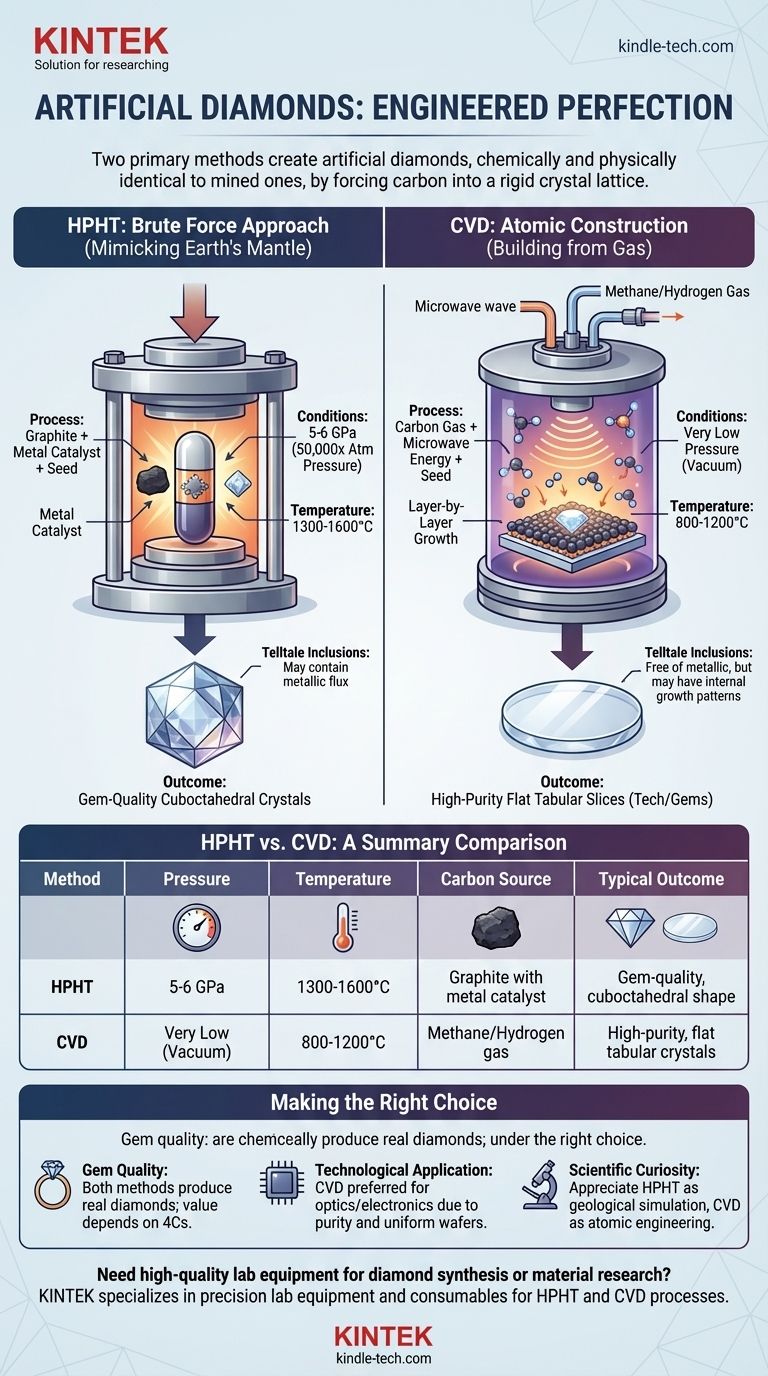
A process starts with a source of pure carbon, like graphite. This carbon is placed in a capsule with a metal catalyst (such as iron, nickel, or cobalt) and a tiny diamond "seed" crystal.

The Required Conditions

The capsule is subjected to immense pressure of 5 to 6 gigapascals (GPa), which is over 50,000 times the atmospheric pressure at sea level. Simultaneously, it is heated to temperatures between 1300–1600°C (2372–2912°F).

The Outcome: Gem-Quality Crystals

Under this extreme heat and pressure, the metal catalyst dissolves the carbon source. The carbon atoms then migrate through the molten metal and precipitate onto the cooler diamond seed, crystallizing into a new, larger diamond. The process can take several days to weeks.

The Atomic Construction Approach: Chemical Vapor Deposition (CVD)

CVD is a newer technique that builds a diamond from the ground up, more akin to 3D printing on an atomic scale. It does not rely on high pressure.

Building from the Atom Up

Instead of forcing a solid carbon source into a diamond, CVD starts with a carbon-containing gas. The method deposits carbon atoms one by one onto a substrate to grow a diamond crystal in layers.

The Key Ingredients

This process begins with a thin slice of a diamond seed crystal placed inside a vacuum chamber. The chamber is then filled with a carbon-rich gas, typically methane, along with other gases like hydrogen.

The Required Conditions

The chamber is heated to high temperatures of 800–1200°C (1472–2192°F), but at very low pressure—essentially a vacuum. Energy, usually from microwaves, is introduced into the chamber to break the gas molecules apart, liberating the carbon atoms.

The Outcome: High-Purity Slices

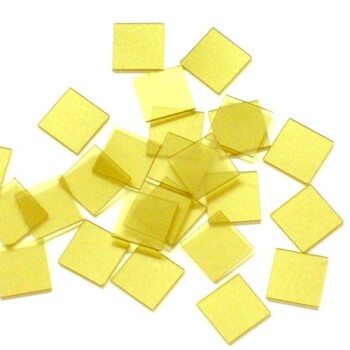
These freed carbon atoms then settle onto the diamond seed plate, growing the crystal layer by layer. The result is often a flat, tabular diamond crystal of very high purity. This process is highly controlled and can produce large diamonds suitable for both gems and advanced technology.

Understanding the Trade-offs and Differences

While both methods produce real diamonds, the conditions under which they are made leave subtle clues that a gemologist can identify.

HPHT vs. CVD: A Matter of Growth

HPHT diamonds grow in a cuboctahedral shape, mirroring their natural counterparts. In contrast, CVD diamonds grow in flat layers, resulting in a tabular crystal structure before cutting.

Telltale Inclusions

The creation process can leave behind microscopic identifying marks. HPHT diamonds may contain tiny inclusions of the metallic flux used during their growth. CVD diamonds, on the other hand, are free of metallic inclusions but may exhibit unique internal growth patterns or dark pinpoint carbon spots.

Color and Treatment

Initially, HPHT diamonds were often yellowish or brownish due to nitrogen in the growth environment, while CVD diamonds could have a brownish hue from other factors. However, post-growth treatment processes (often involving heat or irradiation) can permanently remove this coloration, making the final gems colorless.

Making the Right Choice for Your Goal

Understanding the creation conditions helps you appreciate the final product, whether it's for jewelry, science, or industry.

  • If your primary focus is gem quality: Know that both methods produce real diamonds. The final quality and value are determined by the 4Cs (cut, color, clarity, and carat), not the growth method.
  • If your primary focus is technological application: CVD is often preferred for optics and electronics, as it allows for the creation of large, uniform, high-purity diamond wafers with specific properties.
  • If your primary focus is scientific curiosity: Appreciate HPHT as a triumph of geological simulation and CVD as a masterpiece of atomic-scale engineering.

Ultimately, both methods demonstrate that the extreme conditions of nature can be successfully replicated and even refined through human ingenuity.

Summary Table:

Method Pressure Temperature Carbon Source Typical Outcome
HPHT 5-6 GPa (50,000x atmospheric) 1300–1600°C Graphite with metal catalyst Gem-quality crystals, cuboctahedral shape
CVD Very low (vacuum) 800–1200°C Methane/Hydrogen gas High-purity, flat tabular crystals for tech/gems

Need high-quality lab equipment for diamond synthesis or material research? KINTEK specializes in precision lab equipment and consumables for advanced processes like HPHT and CVD. Whether you're growing diamonds for gemological, scientific, or industrial applications, our solutions ensure reliable performance and exacting standards. Contact us today to discuss how we can support your laboratory's unique needs!

Visual Guide
What conditions are needed to make artificial diamonds? A Guide to HPHT and CVD Methods Visual Guide

Related Products

People Also Ask

Related Products

Customizable Laboratory High Temperature High Pressure Reactors for Diverse Scientific Applications

Customizable Laboratory High Temperature High Pressure Reactors for Diverse Scientific Applications

High-pressure lab reactor for precise hydrothermal synthesis. Durable SU304L/316L, PTFE liner, PID control. Customizable volume & materials. Contact us!

High Pressure Laboratory Autoclave Reactor for Hydrothermal Synthesis

High Pressure Laboratory Autoclave Reactor for Hydrothermal Synthesis

Discover the applications of Hydrothermal Synthesis Reactor - a small, corrosion-resistant reactor for chemical labs. Achieve rapid digestion of insoluble substances in a safe and reliable way. Learn more now.

Customizable High Pressure Reactors for Advanced Scientific and Industrial Applications

Customizable High Pressure Reactors for Advanced Scientific and Industrial Applications

This laboratory-scale high-pressure reactor is a high-performance autoclave engineered for precision and safety in demanding research and development environments.

Stainless High Pressure Autoclave Reactor Laboratory Pressure Reactor

Stainless High Pressure Autoclave Reactor Laboratory Pressure Reactor

Discover the versatility of Stainless High Pressure Reactor - a safe and reliable solution for direct and indirect heating. Built with stainless steel, it can withstand high temperatures and pressures. Learn more now.

Mini SS High Pressure Autoclave Reactor for Laboratory Use

Mini SS High Pressure Autoclave Reactor for Laboratory Use

Mini SS High Pressure Reactor - Ideal for medicine, chemical, and scientific research industries. Programmed heating temp and stirring speed, up to 22Mpa pressure.

Laboratory High Pressure Vacuum Tube Furnace

Laboratory High Pressure Vacuum Tube Furnace

KT-PTF High Pressure Tube Furnace: Compact split tube furnace with strong positive pressure resistance. Working temp up to 1100°C and pressure up to 15Mpa. Also works under controller atmosphere or high vacuum.

Automatic High Temperature Heated Hydraulic Press Machine with Heated Plates for Lab

Automatic High Temperature Heated Hydraulic Press Machine with Heated Plates for Lab

The High Temperature Hot Press is a machine specifically designed for pressing, sintering and processing materials in a high temperature environment. It is capable of operating in the range of hundreds of degrees Celsius to thousands of degrees Celsius for a variety of high temperature process requirements.

Microwave Plasma Chemical Vapor Deposition MPCVD Machine System Reactor for Lab and Diamond Growth

Microwave Plasma Chemical Vapor Deposition MPCVD Machine System Reactor for Lab and Diamond Growth

Get high-quality diamond films with our Bell-jar Resonator MPCVD machine designed for lab and diamond growth. Discover how Microwave Plasma Chemical Vapor Deposition works for growing diamonds using carbon gas and plasma.

Manual High Temperature Heated Hydraulic Press Machine with Heated Plates for Lab

Manual High Temperature Heated Hydraulic Press Machine with Heated Plates for Lab

The High Temperature Hot Press is a machine specifically designed for pressing, sintering and processing materials in a high temperature environment. It is capable of operating in the range of hundreds of degrees Celsius to thousands of degrees Celsius for a variety of high temperature process requirements.

Visual High-Pressure Reactor for In-Situ Observation

Visual High-Pressure Reactor for In-Situ Observation

The visual high-pressure reactor uses transparent sapphire or quartz glass, maintaining high strength and optical clarity under extreme conditions for real-time reaction observation.

Cylindrical Resonator MPCVD Machine System Reactor for Microwave Plasma Chemical Vapor Deposition and Lab Diamond Growth

Cylindrical Resonator MPCVD Machine System Reactor for Microwave Plasma Chemical Vapor Deposition and Lab Diamond Growth

Learn about Cylindrical Resonator MPCVD Machine, the microwave plasma chemical vapor deposition method used for growing diamond gemstones and films in the jewelry and semi-conductor industries. Discover its cost-effective advantages over traditional HPHT methods.

Automatic Heated Hydraulic Press Machine with Heated Plates for Laboratory Hot Press

Automatic Heated Hydraulic Press Machine with Heated Plates for Laboratory Hot Press

The Automatic High Temperature Heat Press is a sophisticated hydraulic hot press designed for efficient temperature control and product quality processing.

CVD Diamond for Thermal Management Applications

CVD Diamond for Thermal Management Applications

CVD diamond for thermal management: High-quality diamond with thermal conductivity up to 2000 W/mK, ideal for heat spreaders, laser diodes, and GaN on Diamond (GOD) applications.

High Purity Pure Graphite Crucible for Evaporation

High Purity Pure Graphite Crucible for Evaporation

Vessels for high temperature applications, where materials are kept at extremely high temperatures to evaporate, allowing thin films to be deposited on substrates.

High Temperature Constant Temperature Heating Circulator Water Bath Chiller Circulator for Reaction Bath

High Temperature Constant Temperature Heating Circulator Water Bath Chiller Circulator for Reaction Bath

Efficient and reliable, KinTek KHB Heating Circulator is perfect for your lab needs. With a max. heating temperature of up to 300℃, it features accurate temperature control and fast heating.

Vacuum Hot Press Furnace Machine Heated Vacuum Press

Vacuum Hot Press Furnace Machine Heated Vacuum Press

Discover the advantages of Vacuum Hot Press Furnace! Manufacture dense refractory metals & compounds, ceramics, and composites under high temp and pressure.

600T Vacuum Induction Hot Press Furnace for Heat Treat and Sintering

600T Vacuum Induction Hot Press Furnace for Heat Treat and Sintering

Discover the 600T Vacuum Induction Hot Press Furnace, designed for high-temperature sintering experiments in vacuum or protected atmospheres. Its precise temperature and pressure control, adjustable working pressure, and advanced safety features make it ideal for nonmetal materials, carbon composites, ceramics, and metal powders.

Automatic Heated Hydraulic Press Machine with Heated Plates for Laboratory Hot Press 25T 30T 50T

Automatic Heated Hydraulic Press Machine with Heated Plates for Laboratory Hot Press 25T 30T 50T

Efficiently prepare your samples with our Automatic Heated Lab Press. With a pressure range up to 50T and precise control, it's perfect for various industries.

Desktop Fast High Pressure Laboratory Autoclave Sterilizer 16L 24L for Lab Use

Desktop Fast High Pressure Laboratory Autoclave Sterilizer 16L 24L for Lab Use

The desktop fast steam sterilizer is a compact and reliable device used for rapid sterilization of medical, pharmaceutical, and research items.

24T 30T 60T Heated Hydraulic Press Machine with Heated Plates for Laboratory Hot Press

24T 30T 60T Heated Hydraulic Press Machine with Heated Plates for Laboratory Hot Press

Looking for a reliable Hydraulic Heated Lab Press? Our 24T / 40T model is perfect for material research labs, pharmacy, ceramics, and more. With a small footprint and the ability to work inside a vacuum glove box, it's the efficient and versatile solution for your sample preparation needs.


Leave Your Message