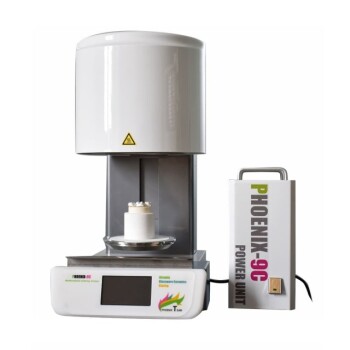
Knowledge What conditions does a high-temperature box resistance furnace provide for slate ceramsite? Optimize Your Sintering Process
Author avatar

Tech Team · Kintek Solution

Updated 15 hours ago

What conditions does a high-temperature box resistance furnace provide for slate ceramsite? Optimize Your Sintering Process


A high-temperature box resistance furnace creates a precise, two-stage thermal environment for slate ceramsite production: a preheating phase at 300°C followed by high-temperature sintering at 1230°C. These specific conditions are engineered to first stabilize the physical integrity of the "green" (unfired) pellets and then induce the chemical reactions necessary to create an ultra-lightweight, porous structure.

Core Takeaway The furnace acts as a dual-function reactor that first gently removes structural water to prevent fracture, and subsequently creates a synchronized state where the material becomes thermoplastic just as internal gases are released, trapping bubbles to form a lightweight aggregate.

The Critical Stages of Thermal Processing

The production of high-quality ceramsite is not merely about applying heat; it is about applying specific temperatures at specific times to trigger distinct physical changes.

Preheating Conditions (300°C)

The first critical condition the furnace provides is a steady soak at 300°C.

This stage is strictly focused on moisture management. The goal is to remove structural water trapped within the raw slate material.

By maintaining this moderate temperature, the furnace ensures the water evaporates at a controlled rate rather than flashing into steam, which would cause the green pellets to crack or explode.

Sintering Conditions (1230°C)

Once stabilized, the furnace ramps up to a high-heat environment of 1230°C.

At this temperature, the furnace supplies sufficient thermal energy to fundamentally alter the state of the material. The slate transitions from a solid to a thermoplastic state, becoming viscous and pliable.

Mechanisms of Pore Formation

The high-temperature box resistance furnace facilitates the "bloating" process by synchronizing two chemical and physical behaviors.

Gas Generation via Decomposition

The 1230°C environment triggers the chemical decomposition of iron oxides present in the slate.

As these oxides break down, they release gas. This gas generation is the internal force required to expand the pellet.

Trapping the Gas

For the material to become lightweight, the gas must not escape.

Because the furnace has simultaneously heated the material to a thermoplastic state, the pellet becomes sticky and viscous. This viscous shell traps the generated gas, preventing its release and forcing the pellet to expand into a porous structure.

Understanding the Trade-offs

While the furnace provides precise control, the relationship between these two stages involves critical dependencies.

The Risk of Thermal Shock

Skipping or shortening the 300°C preheating phase is a common point of failure.

Without this stabilization, the rapid transition to sintering temperatures leads to thermal shock. This compromises the structural integrity of the pellet before the pore-forming chemistry can even begin.

Balancing Viscosity and Gas Release

The sintering temperature of 1230°C represents a narrow operating window.

If the temperature is too low, the material remains too solid to stretch, and the gas forces its way out through cracks, resulting in a heavy, dense pellet.

If the temperature is uncontrolled or too high, the material may become too fluid, causing the structure to collapse rather than hold the porous shape.

Making the Right Choice for Your Goal

When configuring your thermal profile for slate ceramsite, consider your specific production targets.

  • If your primary focus is structural integrity: Prioritize a stable, sufficient duration at the 300°C preheating stage to ensure total removal of structural water and eliminate cracking.
  • If your primary focus is lightweight expansion: Ensure the furnace can maintain a uniform 1230°C during sintering to perfectly synchronize iron oxide decomposition with the thermoplastic phase.

Success in ceramsite production relies on the furnace's ability to decouple drying from sintering, allowing each physical mechanism to occur without interference.

Summary Table:

Process Stage Target Temp Primary Function Physical/Chemical Change
Preheating 300°C Moisture Removal Structural water evaporation; prevents cracking/thermal shock
Sintering 1230°C Pore Formation Material becomes thermoplastic; iron oxide decomposes to release gas
Bloating 1230°C Expansion Viscous material traps gas, creating an ultra-lightweight structure

Elevate Your Materials Research with KINTEK Precision

Achieving the perfect balance of viscosity and gas release in slate ceramsite production requires uncompromising thermal accuracy. KINTEK specializes in advanced laboratory equipment, providing the high-performance high-temperature muffle and box furnaces necessary for precise two-stage sintering profiles.

From crushing and milling systems for raw material preparation to high-pressure reactors and specialized ceramics, our comprehensive portfolio supports every stage of your mineral and battery research. Partner with KINTEK to ensure uniform heating, prevent thermal shock, and maximize your production yield.

Ready to optimize your thermal processing?
Contact our laboratory experts today to find the ideal equipment solution for your specific application.

References

  1. Zhen Li, Xiao-Wei Duan. Manufacturing of Ultra-light Ceramsite from Slate Wastes in Shangri-la, China. DOI: 10.4191/kcers.2018.55.1.02

This article is also based on technical information from Kintek Solution Knowledge Base .

Related Products

People Also Ask

Related Products

1200℃ Split Tube Furnace with Quartz Tube Laboratory Tubular Furnace

1200℃ Split Tube Furnace with Quartz Tube Laboratory Tubular Furnace

KT-TF12 split tube furnace: high-purity insulation, embedded heating wire coils, and max. 1200C. Widely used for new materials and chemical vapour deposition.

Ultra-High Temperature Graphite Vacuum Graphitization Furnace

Ultra-High Temperature Graphite Vacuum Graphitization Furnace

The ultra-high temperature graphitization furnace utilizes medium frequency induction heating in a vacuum or inert gas environment. The induction coil generates an alternating magnetic field, inducing eddy currents in the graphite crucible, which heats up and radiates heat to the workpiece, bringing it to the desired temperature. This furnace is primarily used for graphitization and sintering of carbon materials, carbon fiber materials, and other composite materials.

Manual High Temperature Heated Hydraulic Press Machine with Heated Plates for Lab

Manual High Temperature Heated Hydraulic Press Machine with Heated Plates for Lab

The High Temperature Hot Press is a machine specifically designed for pressing, sintering and processing materials in a high temperature environment. It is capable of operating in the range of hundreds of degrees Celsius to thousands of degrees Celsius for a variety of high temperature process requirements.

Automatic High Temperature Heated Hydraulic Press Machine with Heated Plates for Lab

Automatic High Temperature Heated Hydraulic Press Machine with Heated Plates for Lab

The High Temperature Hot Press is a machine specifically designed for pressing, sintering and processing materials in a high temperature environment. It is capable of operating in the range of hundreds of degrees Celsius to thousands of degrees Celsius for a variety of high temperature process requirements.

Graphite Vacuum Continuous Graphitization Furnace

Graphite Vacuum Continuous Graphitization Furnace

High-temperature graphitization furnace is a professional equipment for graphitization treatment of carbon materials. It is a key equipment for the production of high-quality graphite products. It has high temperature, high efficiency and uniform heating. It is suitable for various high-temperature treatments and graphitization treatments. It is widely used in metallurgy, electronics, aerospace, etc. industry.

Spark Plasma Sintering Furnace SPS Furnace

Spark Plasma Sintering Furnace SPS Furnace

Discover the benefits of Spark Plasma Sintering Furnaces for rapid, low-temperature material preparation. Uniform heating, low cost & eco-friendly.

Graphite Vacuum Furnace Negative Material Graphitization Furnace

Graphite Vacuum Furnace Negative Material Graphitization Furnace

Graphitization furnace for battery production has uniform temperature and low energy consumption. Graphitization furnace for negative electrode materials: an efficient graphitization solution for battery production and advanced functions to enhance battery performance.

Vacuum Sealed Continuous Working Rotary Tube Furnace Rotating Tube Furnace

Vacuum Sealed Continuous Working Rotary Tube Furnace Rotating Tube Furnace

Experience efficient material processing with our vacuum-sealed rotary tube furnace. Perfect for experiments or industrial production, equipped with optional features for controlled feeding and optimized results. Order now.

Custom PTFE Teflon Parts Manufacturer Laboratory High Temperature Mixing Paddle Mixer

Custom PTFE Teflon Parts Manufacturer Laboratory High Temperature Mixing Paddle Mixer

The PTFE mixing paddle mixer is a versatile and robust tool designed for laboratory use, particularly in environments requiring high resistance to chemicals and extreme temperatures. Crafted from high-quality PTFE, this mixer boasts several key features that enhance its functionality and durability.

Laboratory Single Horizontal Jar Mill

Laboratory Single Horizontal Jar Mill

KT-JM3000 is a mixing and grinding instrument for placing a ball milling tank with a volume of 3000ml or less. It adopts frequency conversion control to realize timing, constant speed, direction change, overload protection and other functions.

Vacuum Hot Press Furnace Machine for Lamination and Heating

Vacuum Hot Press Furnace Machine for Lamination and Heating

Experience clean and precise lamination with Vacuum Lamination Press. Perfect for wafer bonding, thin-film transformations, and LCP lamination. Order now!

Laboratory Vortex Mixer Orbital Shaker Multifunctional Rotation Oscillation Mixer

Laboratory Vortex Mixer Orbital Shaker Multifunctional Rotation Oscillation Mixer

The inching mixer is small in size, mixes quickly and thoroughly, and the liquid is in a vortex shape, which can mix all the test solutions attached to the tube wall.

Custom PTFE Teflon Parts Manufacturer for PTFE Measuring Cylinder 10/50/100ml

Custom PTFE Teflon Parts Manufacturer for PTFE Measuring Cylinder 10/50/100ml

PTFE measuring cylinder are a rugged alternative to traditional glass cylinders. They are chemically inert over a wide temperature range (up to 260º C), have excellent corrosion resistance and maintain a low coefficient of friction, ensuring ease of use and cleaning.

Laboratory Oscillating Orbital Shaker

Laboratory Oscillating Orbital Shaker

Mixer-OT orbital shaker uses brushless motor, which can run for a long time. It is suitable for vibration tasks of culture dishes, flasks and beakers.

5L Heating Chilling Circulator Cooling Water Bath Circulator for High and Low Temperature Constant Temperature Reaction

5L Heating Chilling Circulator Cooling Water Bath Circulator for High and Low Temperature Constant Temperature Reaction

KinTek KCBH 5L Heating Chilling Circulator - Ideal for labs and industrial conditions with multi-functional design and reliable performance.

Warm Isostatic Press WIP Workstation 300Mpa for High Pressure Applications

Warm Isostatic Press WIP Workstation 300Mpa for High Pressure Applications

Discover Warm Isostatic Pressing (WIP) - A cutting-edge technology that enables uniform pressure to shape and press powdered products at a precise temperature. Ideal for complex parts and components in manufacturing.

Multifunctional Electrolytic Electrochemical Cell Water Bath Single Layer Double Layer

Multifunctional Electrolytic Electrochemical Cell Water Bath Single Layer Double Layer

Discover our high-quality Multifunctional Electrolytic Cell Water Baths. Choose from single or double-layer options with superior corrosion resistance. Available in 30ml to 1000ml sizes.

Laboratory Disc Rotary Mixer for Efficient Sample Mixing and Homogenization

Laboratory Disc Rotary Mixer for Efficient Sample Mixing and Homogenization

Efficient Laboratory Disc Rotary Mixer for Precise Sample Mixing, Versatile for Various Applications, DC Motor and Microcomputer Control, Adjustable Speed and Angle.

Twin Screw Extruder Plastic Granulation Machine

Twin Screw Extruder Plastic Granulation Machine

Twin screw extruder plastic granulation machine is designed for the mixing and processing experiments of engineering plastics, modified plastics, waste plastics and masterbatches.


Leave Your Message