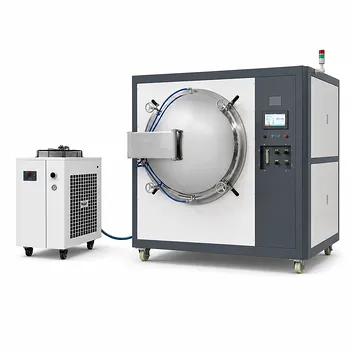
A vacuum hot press furnace acts as the central engine for transforming loose powder into a solid, high-performance composite. It provides a controlled environment where high temperature (980°C) and mechanical pressure (40 MPa) are applied simultaneously under vacuum protection. This specific combination drives the copper matrix to physically flow into gaps while enabling the thermodynamic reactions necessary to chemically bond the graphite and copper.
The core value of this furnace lies in its ability to synchronize extreme heat and pressure, transitioning the material from a weak mechanical mixture to a robust metallurgically bonded composite through the formation of a Zirconium Carbide (ZrC) interface.
The Mechanics of Densification
Promoting Plastic Flow
The primary physical function of the furnace is to force the metal matrix to deform. Under the application of 40 MPa of pressure, the copper matrix undergoes plastic flow.
Filling Microscopic Voids
This flow is essential for structural integrity. The softened copper is pressed into the interstitial spaces between graphite flakes, effectively eliminating porosity and creating a dense, continuous structure.
Overcoming Rigid Obstacles
Without simultaneous pressure, the copper would simply coat the graphite without filling the deep gaps. The mechanical force overcomes the resistance offered by the rigid graphite flakes, ensuring near-full densification.
Achieving Metallurgical Bonding
Inducing Zirconium Diffusion
Beyond simple squeezing, the furnace creates a specific thermodynamic environment. The sustained heat at 980°C provides the necessary energy for zirconium to diffuse effectively through the composite mixture.
Creating the Interface Layer
This diffusion is not passive; it is reactive. The zirconium reacts with the graphite flakes to form a Zirconium Carbide (ZrC) interface layer.
Transitioning Bonding Types
This reaction is the defining moment of the process. It shifts the material from relying on weak mechanical interlocking to establishing strong metallurgical bonding, significantly enhancing the composite's performance.
The Critical Role of the Vacuum
Preventing Oxidation
At 980°C, both copper and graphite are highly susceptible to degradation. The vacuum environment strips away oxygen, preventing the copper matrix from oxidizing and the graphite from burning off.
Protecting the Reaction
The vacuum ensures that the chemical environment remains pure. By eliminating atmospheric contaminants, it ensures that the zirconium reacts only with the graphite to form the desired ZrC layer, rather than forming oxides or other impurities.
Understanding the Trade-offs
Process Sensitivity
While effective, this process requires rigorous control. A slight deviation in temperature or pressure can lead to incomplete bonding (if too low) or material degradation (if too high), making the process less forgiving than standard sintering.
Equipment Complexity
The need to maintain a vacuum while simultaneously applying high mechanical loads adds significant complexity. This requires specialized molds, often high-strength graphite, which must withstand thermal stress and pressure without reacting with the copper matrix.
Making the Right Choice for Your Goal
To maximize the utility of a vacuum hot press furnace for graphite/copper composites, align your process parameters with your specific performance targets:
- If your primary focus is Structural Density: Prioritize the application of mechanical pressure (40 MPa) to ensure the plastic flow of copper fully eliminates internal voids.
- If your primary focus is Interface Strength: Prioritize precise temperature control (980°C) to guarantee the thermodynamic conditions required for zirconium diffusion and ZrC formation.
The vacuum hot press furnace is not just a heating element; it is a reactor that synthesizes pressure, temperature, and atmosphere to engineer the fundamental microstructure of the composite.
Summary Table:
| Feature | Parameter | Primary Function in Densification |
|---|---|---|
| Operating Temperature | 980°C | Facilitates Zr diffusion and formation of ZrC interface layer |
| Mechanical Pressure | 40 MPa | Drives plastic flow of copper to eliminate microscopic voids |
| Atmosphere | Vacuum | Prevents oxidation of copper and degradation of graphite |
| Bonding Mechanism | Metallurgical | Transitions from mechanical interlocking to strong chemical bonds |
| Matrix Material | Copper (Cu) | Acts as the ductile phase that fills interstitial gaps |
Elevate Your Materials Research with KINTEK Precision
Unlock the full potential of your composite engineering with KINTEK’s advanced vacuum hot press furnaces. Whether you are developing high-performance graphite/copper composites or exploring new metal matrix interfaces, our equipment provides the precise synchronization of temperature, vacuum, and mechanical pressure required for near-full densification and robust metallurgical bonding.
Why partner with KINTEK?
- Comprehensive Thermal Solutions: From muffle and tube furnaces to specialized vacuum hot presses and CVD systems.
- Processing Excellence: Achieve superior structural integrity with our high-pressure reactors, crushing and milling systems, and hydraulic presses.
- Total Lab Support: We provide the essential consumables—including high-strength graphite molds, ceramics, and crucibles—needed for rigorous thermal processing.
Ready to achieve superior heat treatment and material density? Contact our technical experts today to find the perfect solution for your laboratory or production needs.
Related Products
- Vacuum Hot Press Furnace Heated Vacuum Press Machine Tube Furnace
- 600T Vacuum Induction Hot Press Furnace for Heat Treat and Sintering
- Vacuum Hot Press Furnace Machine Heated Vacuum Press
- Vacuum Hot Press Furnace Machine for Lamination and Heating
- Vacuum Heat Treat and Pressure Sintering Furnace for High Temperature Applications
People Also Ask
- What advantages does a vacuum hot press furnace provide for LSLBO ceramic electrolytes? Achieve 94% Relative Density
- What role does a Vacuum Hot Press (VHP) furnace play in the densification of austenitic stainless steel 316 composites?
- What are the advantages of using a vacuum hot pressing furnace? Superior Densification for 2024Al/Gr/SiC Composites
- What are the advantages of a vacuum hot press furnace for LTPO solid electrolytes? Boost Density and Conductivity
- What core processing conditions does a vacuum hot press furnace provide? Achieve High-Density Cu-SiC/Diamond Composites