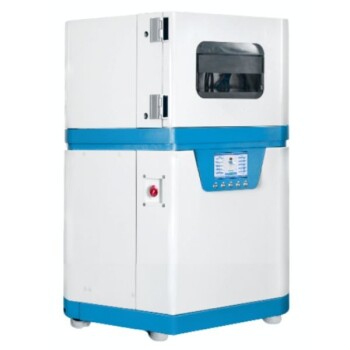
A vacuum hot press furnace establishes three critical processing conditions: a high-vacuum environment (typically $1 \times 10^{-4}$ mbar), elevated temperatures (around $1000^\circ\text{C}$), and significant axial mechanical pressure (e.g., $32\text{ MPa}$).
This combination allows for the fabrication of Cu-SiC and Cu-diamond composites by effectively preventing the oxidation of the copper matrix while utilizing pressure to force material densification at temperatures below the melting point of copper.
Core Insight: The effectiveness of a vacuum hot press furnace lies in its ability to decouple densification from melting. By applying mechanical pressure alongside thermal energy in a contaminant-free vacuum, the system forces plastic flow and atomic diffusion, achieving near-theoretical density without subjecting sensitive reinforcements like diamond to damaging oxidation or graphitization.
The Role of the High-Vacuum Environment
Preventing Matrix and Reinforcement Degradation
The primary function of the vacuum (typically around $1 \times 10^{-4}$ mbar) is to minimize the oxygen partial pressure within the chamber. This is critical for copper-based composites, as it prevents the oxidation of the copper powder which would otherwise weaken the final material.
Protecting Diamond Stability
For Cu-diamond composites specifically, the vacuum serves a dual purpose. Beyond protecting the copper, it prevents the diamond particles from oxidizing or graphitizing, a degradation process that occurs rapidly at high temperatures in the presence of oxygen.
Surface Purification for Bonding
The vacuum environment actively removes adsorbed gases, moisture, and volatile impurities from the surface of the powder particles. Creating these clean particle surfaces is a prerequisite for effective atomic diffusion and the formation of strong physical bonds at the interface between the metal matrix and the reinforcement (SiC or Diamond).
The Synergy of Heat and Mechanical Pressure
Driving Plastic Flow
While thermal energy softens the material, the application of external axial pressure (often between $3\text{--}32\text{ MPa}$) physically forces the particles to rearrange. This pressure induces plastic sliding and flow, effectively closing large pores that thermal diffusion alone cannot eliminate.
Accelerating Atomic Diffusion
The simultaneous application of heat (e.g., $950^\circ\text{C}$ to $1000^\circ\text{C}$) provides the kinetic energy required for atoms to move. When combined with pressure, the contact area between particles increases, significantly shortening the diffusion path and accelerating the formation of sintering necks.
Achieving Low-Temperature Densification
This method allows the composite to achieve high relative density (up to 94% or higher) at temperatures significantly lower than would be required for pressureless sintering. Keeping the process temperature below the melting point of copper preserves the fine-grained microstructure and prevents adverse reactions between the copper and the carbon-based reinforcements.
Understanding the Trade-offs
The Risk of Microstructural Damage
While high pressure promotes density, excessive pressure combined with the wrong temperature can damage brittle reinforcements like SiC or Diamond. The process requires a precise balance to ensure matrix flow without crushing the reinforcement phase.
Vacuum Integrity and Purity
The success of the process is entirely dependent on maintaining the vacuum level. Even a minor loss in vacuum integrity can lead to the formation of oxide layers at the interface. These oxides act as barriers to diffusion, resulting in weak interfacial bonding and reduced mechanical performance of the final composite.
Making the Right Choice for Your Goal
To maximize the performance of your Cu-SiC or Cu-Diamond composites, tailor your processing parameters to your specific performance targets:
- If your primary focus is Maximum Density: Prioritize the application of higher axial pressure (near $30\text{ MPa}$) to mechanically force plastic flow into voids and eliminate porosity.
- If your primary focus is Interface Strength: Focus on maintaining the highest possible vacuum ($1 \times 10^{-4}$ mbar) to ensure pristine surfaces for optimal atomic diffusion and bonding between the copper and the reinforcement.
Success in vacuum hot pressing relies on the simultaneous "clean, heat, and squeeze" approach to achieve defect-free, high-performance composites.
Summary Table:
| Processing Condition | Parameter Target | Core Function in Composite Fabrication |
|---|---|---|
| Vacuum Level | $1 \times 10^{-4}$ mbar | Prevents oxidation; protects diamond from graphitization; cleans particle surfaces. |
| Temperature | $950^\circ\text{C} - 1000^\circ\text{C}$ | Provides kinetic energy for atomic diffusion; softens the copper matrix. |
| Axial Pressure | $3 - 32\text{ MPa}$ | Drives plastic flow and particle rearrangement; closes pores to reach near-theoretical density. |
| Atmosphere Control | Contaminant-free | Ensures strong interfacial bonding by removing moisture and adsorbed gases. |
Elevate Your Material Research with KINTEK Precision
Unlock the full potential of your high-performance composites with KINTEK’s advanced laboratory solutions. Whether you are fabricating Cu-SiC or Cu-diamond materials, our state-of-the-art vacuum hot press furnaces and high-temperature furnaces provide the precise control over atmosphere, temperature, and pressure necessary for superior densification.
From crushing and milling systems for powder preparation to isostatic hydraulic presses and high-pressure reactors, KINTEK specializes in the equipment that drives innovation in battery research, dental ceramics, and advanced metallurgy. Our comprehensive portfolio ensures that your lab is equipped with durable, high-purity consumables like PTFE products, ceramics, and crucibles to maintain the integrity of every experiment.
Ready to optimize your sintering process? Contact our technical experts today to find the perfect equipment solution for your specific research goals!
Related Products
- Vacuum Hot Press Furnace Heated Vacuum Press Machine Tube Furnace
- 600T Vacuum Induction Hot Press Furnace for Heat Treat and Sintering
- Vacuum Hot Press Furnace Machine Heated Vacuum Press
- Vacuum Hot Press Furnace Machine for Lamination and Heating
- Vacuum Heat Treat and Pressure Sintering Furnace for High Temperature Applications
People Also Ask
- What advantages does a vacuum hot press furnace provide for LSLBO ceramic electrolytes? Achieve 94% Relative Density
- What role does a Vacuum Hot Press (VHP) furnace play in the densification of austenitic stainless steel 316 composites?
- What are the advantages of using a vacuum hot pressing furnace? Superior Densification for 2024Al/Gr/SiC Composites
- What are the advantages of a vacuum hot press furnace for LTPO solid electrolytes? Boost Density and Conductivity
- How does a vacuum hot press furnace achieve the densification of ZrB2–SiC–TaC? Unlock Ultra-High Ceramic Density