Knowledge What do you mean by brazing? A Complete Guide to High-Strength Metal Joining
Author avatar

Tech Team · Kintek Solution

Updated 6 days ago

What do you mean by brazing? A Complete Guide to High-Strength Metal Joining


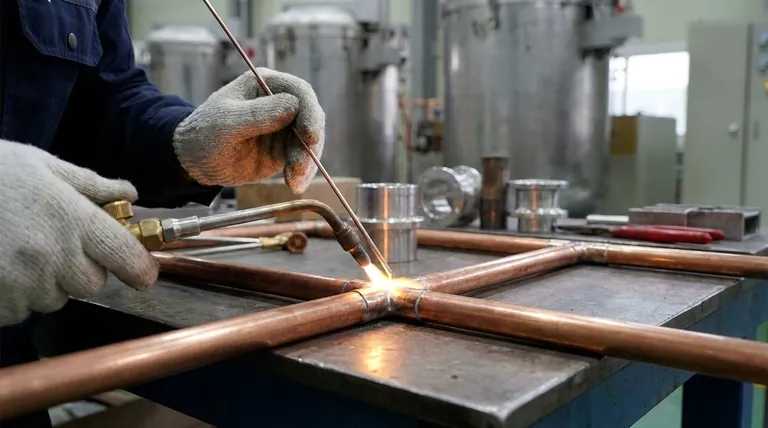
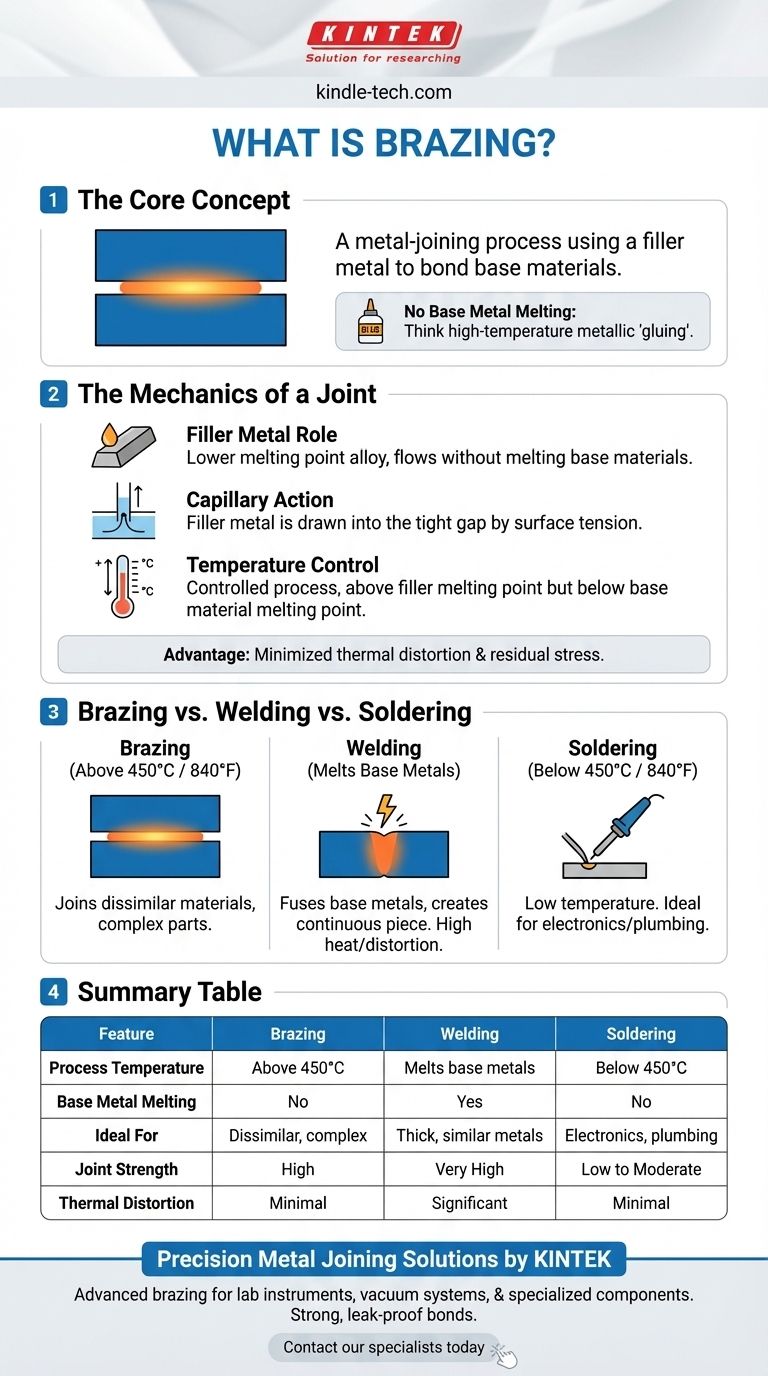
At its core, brazing is a metal-joining process that uses a filler metal to form a bond between two or more base materials. The key principle is that the filler metal has a lower melting point than the base materials, allowing it to be melted and flow into the joint without melting the components themselves. This creates a strong, permanent metallurgical bond upon cooling.

The fundamental difference between brazing and welding is that brazing joins materials without melting them. Think of it as high-temperature metallic "gluing," where the integrity and properties of the base materials are preserved.
What do you mean by brazing? A Complete Guide to High-Strength Metal Joining

The Mechanics of a Brazed Joint

To truly understand brazing, you must look beyond the simple definition and see how the process works on a physical level. The strength of a brazed joint comes from a combination of temperature control, material science, and a natural phenomenon.

The Role of the Filler Metal

The entire process hinges on the filler metal, an alloy specifically designed to melt at a temperature lower than the base materials being joined. This allows the process to operate at a much lower temperature than welding.

The filler metal is chosen based on its compatibility with the base materials and the intended application of the final component.

The Importance of Capillary Action

Once the filler metal is melted, it is drawn into the tight gap between the base materials through a process called capillary action. This is the same force that pulls water up a narrow straw.

For capillary action to work effectively, the parts must be designed with a very specific, small clearance. This ensures the molten filler completely fills the joint, creating a solid, void-free bond.

Why the Base Metal Doesn't Melt

The process temperature is carefully controlled to be above the melting point of the filler metal but safely below the melting point of the base materials.

This is the single most important advantage of brazing. By not melting the base materials, the process minimizes thermal distortion, reduces residual stress, and preserves their original metallurgical properties.

Understanding the Trade-offs: Brazing vs. Other Methods

Brazing is not a universal solution. Its value becomes clear when compared to other common joining methods like welding and soldering.

Brazing vs. Welding

Welding fuses materials by melting the base metals along with a filler. This creates a single, continuous piece. Welding typically produces a stronger joint but introduces significant heat and stress, which can distort or weaken the base materials.

Brazing, in contrast, leaves the base metals intact. This makes it ideal for delicate parts, complex assemblies, and joining dissimilar materials (e.g., copper to steel) that cannot be easily welded.

Brazing vs. Soldering

Brazing and soldering are mechanically similar, but they are distinguished by one critical factor: temperature.

By formal definition, a process is considered brazing if the filler metal melts above 450°C (840°F). If the filler melts below this temperature, the process is called soldering. This higher temperature gives brazed joints significantly greater strength and temperature resistance than soldered joints.

When to Choose Brazing

Brazing excels in specific scenarios where welding is impractical or soldering is too weak. It is the preferred method for joining dissimilar materials, including metals to ceramics, and for creating leak-proof joints in complex assemblies like HVAC and refrigeration systems.

Making the Right Choice for Your Goal

Selecting the correct joining process requires understanding the demands of your specific application, from strength requirements to the types of materials involved.

  • If your primary focus is maximum joint strength for thick, similar metals: Welding is often the superior choice as it fuses the base metals directly.
  • If your primary focus is joining dissimilar materials or minimizing thermal distortion: Brazing is the ideal solution due to its lower process temperature and ability to bond different material types.
  • If your primary focus is low-temperature electronics or basic plumbing: Soldering is the correct and most cost-effective process, operating below the 450°C threshold.

Understanding these fundamental differences empowers you to select the precise joining method your project demands.

Summary Table:

Feature Brazing Welding Soldering
Process Temperature Above 450°C (840°F) Melts base metals Below 450°C (840°F)
Base Metal Melting No Yes No
Ideal For Dissimilar materials, complex assemblies Thick, similar metals Electronics, plumbing
Joint Strength High Very High Low to Moderate
Thermal Distortion Minimal Significant Minimal

Need precision metal joining for your laboratory equipment? At KINTEK, we specialize in advanced brazing solutions for laboratory instruments, vacuum systems, and specialized components. Our expertise ensures strong, leak-proof bonds for your most demanding applications.

Contact our brazing specialists today to discuss how we can enhance your product's performance and reliability!

Visual Guide
What do you mean by brazing? A Complete Guide to High-Strength Metal Joining Visual Guide

Related Products

People Also Ask

Related Products

Graphite Vacuum Furnace Negative Material Graphitization Furnace

Graphite Vacuum Furnace Negative Material Graphitization Furnace

Graphitization furnace for battery production has uniform temperature and low energy consumption. Graphitization furnace for negative electrode materials: an efficient graphitization solution for battery production and advanced functions to enhance battery performance.

Vacuum Heat Treat and Pressure Sintering Furnace for High Temperature Applications

Vacuum Heat Treat and Pressure Sintering Furnace for High Temperature Applications

Vacuum pressure sintering furnaces are designed for high temperature hot pressing applications in metal and ceramic sintering. Its advanced features ensure precise temperature control, reliable pressure maintenance, and a robust design for seamless operation.

Horizontal High Temperature Graphite Vacuum Graphitization Furnace

Horizontal High Temperature Graphite Vacuum Graphitization Furnace

Horizontal Graphitization Furnace: This type of furnace is designed with the heating elements placed horizontally, allowing for uniform heating of the sample. It's well-suited for graphitizing large or bulky samples that require precise temperature control and uniformity.

Graphite Vacuum Furnace Bottom Discharge Graphitization Furnace for Carbon Materials

Graphite Vacuum Furnace Bottom Discharge Graphitization Furnace for Carbon Materials

Bottom-out graphitization furnace for carbon materials, ultra-high temperature furnace up to 3100°C, suitable for graphitization and sintering of carbon rods and carbon blocks. Vertical design, bottom discharging, convenient feeding and discharging, high temperature uniformity, low energy consumption, good stability, hydraulic lifting system, convenient loading and unloading.

Large Vertical Graphite Vacuum Graphitization Furnace

Large Vertical Graphite Vacuum Graphitization Furnace

A large vertical high-temperature graphitization furnace is a type of industrial furnace used for the graphitization of carbon materials, such as carbon fiber and carbon black. It is a high-temperature furnace that can reach temperatures of up to 3100°C.

1200℃ Muffle Furnace Oven for Laboratory

1200℃ Muffle Furnace Oven for Laboratory

Upgrade your lab with our 1200℃ Muffle Furnace. Achieve fast, precise heating with Japan alumina fibers and Molybdenum coils. Features TFT touch screen controller for easy programming and data analysis. Order now!

1700℃ Laboratory Quartz Tube Furnace with Alumina Tube Tubular Furnace

1700℃ Laboratory Quartz Tube Furnace with Alumina Tube Tubular Furnace

Looking for a high-temperature tube furnace? Check out our 1700℃ Tube Furnace with Alumina Tube. Perfect for research and industrial applications up to 1700C.

Vacuum Hot Press Furnace Machine for Lamination and Heating

Vacuum Hot Press Furnace Machine for Lamination and Heating

Experience clean and precise lamination with Vacuum Lamination Press. Perfect for wafer bonding, thin-film transformations, and LCP lamination. Order now!

Laboratory Sterilizer Lab Autoclave Vertical Pressure Steam Sterilizer for Liquid Crystal Display Automatic Type

Laboratory Sterilizer Lab Autoclave Vertical Pressure Steam Sterilizer for Liquid Crystal Display Automatic Type

Liquid crystal display automatic vertical sterilizer is a safe, reliable and automatic control sterilization equipment, which is composed of heating system, microcomputer control system and overheating and overvoltage protection system.

Laboratory Scientific Electric Heating Blast Drying Oven

Laboratory Scientific Electric Heating Blast Drying Oven

The desktop fast autoclave sterilizer is a compact and reliable device used for rapid sterilization of medical, pharmaceutical, and research items.

Ultra-Vacuum Electrode Feedthrough Connector Flange Power Electrode Lead for High-Precision Applications

Ultra-Vacuum Electrode Feedthrough Connector Flange Power Electrode Lead for High-Precision Applications

Discover the Ultra-Vacuum Electrode Feedthrough Connector Flange, perfect for high-precision applications. Ensure reliable connections in ultra-vacuum environments with advanced sealing and conductive technology.

Inclined Rotary Plasma Enhanced Chemical Vapor Deposition PECVD Equipment Tube Furnace Machine

Inclined Rotary Plasma Enhanced Chemical Vapor Deposition PECVD Equipment Tube Furnace Machine

Upgrade your coating process with PECVD coating equipment. Ideal for LED, power semiconductors, MEMS and more. Deposits high-quality solid films at low temps.

Laboratory Vibratory Sieve Shaker Machine Slap Vibrating Sieve

Laboratory Vibratory Sieve Shaker Machine Slap Vibrating Sieve

KT-T200TAP is a slapping and oscillating sieving instrument for laboratory desktop use, with 300 rpm horizontal circular motion and 300 vertical slapping motions to simulate manual sieving to help sample particles pass through better.

Laboratory Vortex Mixer Orbital Shaker Multifunctional Rotation Oscillation Mixer

Laboratory Vortex Mixer Orbital Shaker Multifunctional Rotation Oscillation Mixer

The inching mixer is small in size, mixes quickly and thoroughly, and the liquid is in a vortex shape, which can mix all the test solutions attached to the tube wall.

Lab Internal Rubber Mixer Rubber Kneader Machine for Mixing and Kneading

Lab Internal Rubber Mixer Rubber Kneader Machine for Mixing and Kneading

Lab internal rubber mixer is suitable for mixing, kneading and dispersing various chemical raw materials such as plastics, rubber, synthetic rubber, hot melt adhesive and various low-viscosity materials.

Electron Beam Evaporation Coating Tungsten Crucible and Molybdenum Crucible for High Temperature Applications

Electron Beam Evaporation Coating Tungsten Crucible and Molybdenum Crucible for High Temperature Applications

Tungsten and molybdenum crucibles are commonly used in electron beam evaporation processes due to their excellent thermal and mechanical properties.

E Beam Crucibles Electron Gun Beam Crucible for Evaporation

E Beam Crucibles Electron Gun Beam Crucible for Evaporation

In the context of electron gun beam evaporation, a crucible is a container or source holder used to contain and evaporate the material to be deposited onto a substrate.

Laboratory Hybrid Tissue Grinding Mill

Laboratory Hybrid Tissue Grinding Mill

KT-MT20 is a versatile laboratory device used for rapid grinding or mixing of small samples, whether dry, wet, or frozen. It comes with two 50ml ball mill jars and various cell wall breaking adapters for biological applications such as DNA/RNA and protein extraction.

Engineering Advanced Fine Ceramics Alumina Crucibles (Al2O3) for Thermal Analysis TGA DTA

Engineering Advanced Fine Ceramics Alumina Crucibles (Al2O3) for Thermal Analysis TGA DTA

TGA/DTA thermal analysis vessels are made of aluminum oxide (corundum or aluminum oxide). It can withstand high temperature and is suitable for analyzing materials that require high temperature testing.

Vibratory Sieve Shaker Machine Dry Three-Dimensional Vibrating Sieve

Vibratory Sieve Shaker Machine Dry Three-Dimensional Vibrating Sieve

The KT-V200 product focuses on solving common sieving tasks in the laboratory. It is suitable for sieving 20g-3kg dry samples.


Leave Your Message