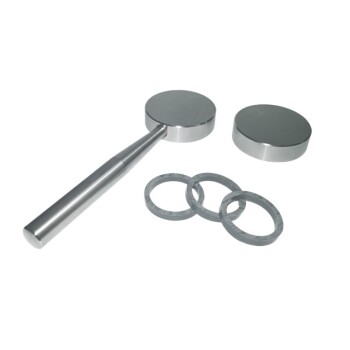
The graphite mold acts simultaneously as a geometric containment vessel and a mechanical pressure transmission medium. In the context of W-Si alloy targets, the mold confines the high-purity alloy powder to define the final shape while acting as a rigid interface to transfer hydraulic force—typically between 20 and 30 MPa—directly to the material.
Core Takeaway The effectiveness of the sintering process relies entirely on the graphite mold's ability to maintain structural rigidity at high heat. It must withstand extreme thermal conditions without deforming to ensure that external hydraulic pressure is converted into the internal densification of the alloy powder.
Role 1: Geometric Containment and Shaping
Defining the Macroscopic Form
The primary function of the graphite mold is to serve as a high-precision container. Before sintering, the W-Si alloy exists as a loose high-purity powder that lacks structural integrity.
The mold confines this powder, establishing the specific diameter and geometry of the final target. This containment must be absolute, preventing powder leakage while accommodating the initial volume of the loose material.
Structural Stability at Sintering Temperatures
To function as an effective container, the mold must possess exceptional high-temperature stability. Sintering environments can reach extreme temperatures (often exceeding 900°C and up to 1600°C depending on the specific alloy mix).
Under these conditions, standard materials would soften or warp. High-purity graphite retains its shape, ensuring the final W-Si target maintains high dimensional accuracy rather than deforming under the combined load of heat and containment stress.
Role 2: Mechanical Pressure Transmission
Acting as a Force Conduit
The second critical role is acting as a transmission medium for the hydraulic system. The machine generates mechanical pressure, but it cannot apply this force directly to loose powder without a stable interface.
The graphite mold acts as this bridge. It accepts the axial pressure (typically 20 to 30 MPa for W-Si targets) from the hydraulic rams and transmits it evenly to the confined powder.
Driving Material Densification
The ultimate goal of this pressure transmission is densification. By effectively transferring the load, the mold forces the W-Si powder particles closer together.
This mechanical compression, combined with heat, eliminates voids within the microstructure. If the mold fails to transmit this pressure efficiently—due to fracture or elasticity—the target will remain porous and mechanically weak.
Understanding the Trade-offs
The Risk of Deformation
While graphite is chosen for its strength, it is not invincible. A critical trade-off exists between the applied pressure and the mold's wall thickness and grade.
If the pressure exceeds the graphite's mechanical limit at high temperatures, the mold may undergo plastic deformation. This results in a target with incorrect dimensions and potentially uneven density gradients.
Thermal Field Homogenization
Supplementary data indicates that while pressure is the primary "active" role, the mold also influences thermal distribution. High-purity graphite has excellent thermal conductivity.
However, if the mold design is flawed or the graphite quality is poor, it can lead to uneven heating. This uneven thermal stress can cause the Indium Zinc Oxide (IZO) or W-Si target to crack during the cooling phase.
Making the Right Choice for Your Goal
To ensure the successful sintering of W-Si alloy targets, you must select graphite molds based on your specific processing parameters.
- If your primary focus is Dimensional Accuracy: Prioritize graphite grades with the highest available thermal stability to prevent creep or warping at maximum sintering temperatures.
- If your primary focus is Maximum Density: Ensure the mold wall thickness is calculated to withstand pressures exceeding 30 MPa to allow for aggressive compaction without failure.
Select a mold that balances thermal conductivity with sufficient mechanical hardness to translate hydraulic power into metallurgical solidity.
Summary Table:
| Role | Primary Function | Impact on W-Si Alloy Target |
|---|---|---|
| Geometric Containment | Defines macroscopic form and prevents powder leakage. | Ensures high dimensional accuracy and specific target geometry. |
| Pressure Transmission | Transmits 20-30 MPa of axial force to loose powder. | Eliminates voids and drives material densification for maximum density. |
| Thermal Regulation | Provides uniform heat distribution via high conductivity. | Prevents cracking and ensures a consistent microstructure during cooling. |
Elevate Your Material Sintering with KINTEK Precision Solutions
Achieving the perfect balance of density and dimensional accuracy in W-Si alloy targets requires high-performance graphite molds and robust pressing systems. KINTEK specializes in advanced laboratory equipment, including high-temperature muffle and vacuum furnaces, hot presses, and high-precision graphite consumables designed to withstand extreme sintering environments.
Whether you are refining battery research, developing semiconductors, or processing ceramics, our experts are here to provide the tools you need for metallurgical excellence.
Ready to optimize your sintering process? Contact KINTEK today to discuss our custom solutions and how we can support your lab's specific requirements.
Related Products
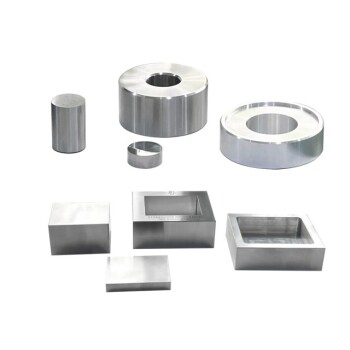
- Special Heat Press Mold for Lab Use
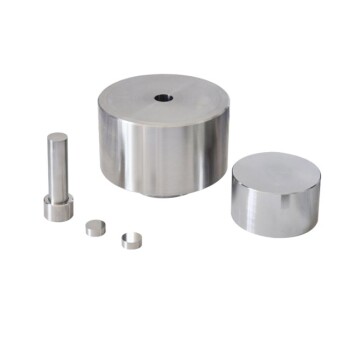
- Ball Press Mold for Lab
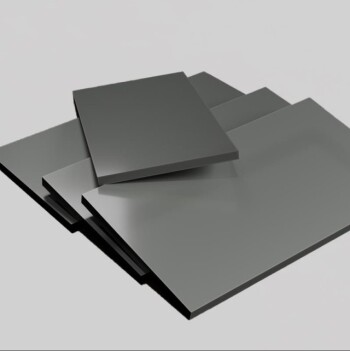
- Carbon Graphite Plate Manufactured by Isostatic Pressing Method
- Anti-Cracking Press Mold for Lab Use
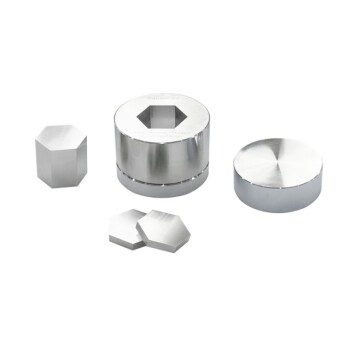
- Polygon Press Mold for Lab
People Also Ask
- How to use a press mold? Master the Art of Creating Consistent Ceramic Forms
- What is the press mould method? A Guide to Consistent, Detailed Ceramic Forms
- What is a press mold used for? Achieve Repeatable Precision and Efficiency
- What is the function of press molds during the preparation of SiCf/Ti-43Al-9V composites? Achieve Structural Precision
- What is the purpose of specialized pressure devices in sulfide solid-state batteries? Ensure Chemo-Mechanical Stability