
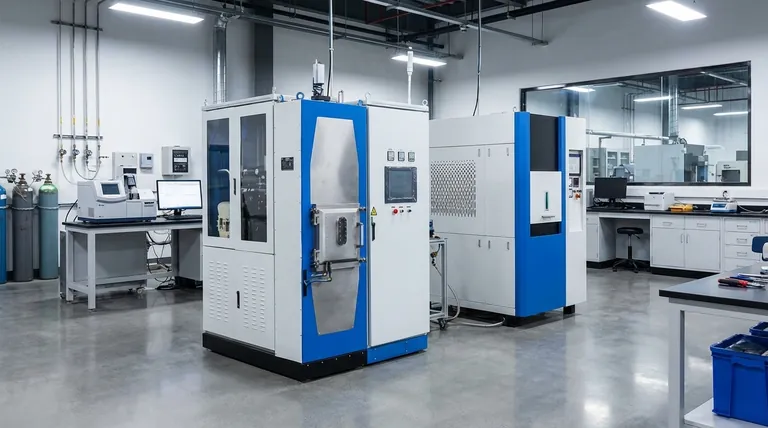
At its core, the equipment used for sintering is a specialized furnace designed to apply high heat to a compacted powder, fusing it into a solid mass without melting it. However, the specific machinery varies significantly based on the material and the desired outcome, ranging from conventional high-temperature furnaces to advanced systems that use electric currents or high pressure to achieve superior results.
The central concept is that "sintering equipment" is not a single device, but a category of tools. The choice of equipment—from a simple furnace to a complex Hot Isostatic Press—is a strategic decision that directly dictates the final density, strength, and performance of the sintered part.
The Core Function: Applying Controlled Energy
The fundamental goal of all sintering equipment is to facilitate atomic diffusion between powder particles. This is achieved by applying energy, most commonly in the form of heat, and sometimes in combination with external pressure.
The Foundation: The Sintering Furnace
The most common piece of equipment is a sintering furnace. This is a high-temperature chamber that heats the compacted powder (known as a "green part") according to a precise thermal profile.
This process, often called conventional or solid-state sintering, is the workhorse of the powder metallurgy and ceramics industries. It is analogous to how a kiln fires pottery, transforming soft clay into a hard, durable object.
The Preliminary Step: Powder Compaction Presses
Before entering the furnace, the raw powder is typically formed into its near-net shape using a press. This step compacts the powder, creating the "green part" with enough mechanical integrity to be handled and transported to the furnace.
Advanced Sintering Equipment for Specialized Needs
For advanced materials or applications demanding superior properties, specialized equipment has been developed that goes beyond simple heating.
Microwave Sintering Systems
This equipment uses microwaves as the energy source instead of conventional radiant heating elements. This allows for very rapid and sometimes more uniform heating from within the material itself, significantly reducing processing time.
Spark Plasma Sintering (SPS) Machines
SPS, also known as Field Assisted Sintering Technology (FAST), is a revolutionary technique. The equipment simultaneously applies a pulsed direct electric current and uniaxial pressure to the powder.
The electric current generates intense, localized heat at the particle contact points, promoting extremely fast diffusion and densification. This makes it ideal for novel alloys, composites, and other advanced materials.
Hot Isostatic Pressing (HIP) Units
A HIP unit is a high-tech pressure vessel. It applies both high temperature and high-pressure inert gas (like argon) uniformly from all directions to the part.
The primary goal of HIP is to collapse any remaining internal voids or porosity. It is often used as a secondary step after conventional sintering to create components with nearly 100% theoretical density, which is critical for high-performance applications like jet engine turbines or medical implants.
Understanding the Trade-offs
Choosing the right equipment involves balancing cost, speed, and the desired final properties of the component. There is no single "best" method.
Conventional Furnaces: Cost vs. Speed
Conventional furnaces are the most established and cost-effective solution for high-volume production. However, their heating and cooling cycles can be long, making them less suitable for rapid prototyping or materials sensitive to prolonged heat exposure.
Advanced Systems (SPS, HIP): Performance vs. Complexity
SPS and HIP machines offer unparalleled control over microstructure and can produce parts with superior mechanical properties. This performance comes at a significant cost in terms of equipment investment, operational complexity, and often, smaller batch sizes.
Supporting and Post-Processing Equipment
A complete sintering operation also requires supporting equipment. This includes powder mixers and blenders for creating a homogenous starting material and analytical tools like dilatometers to study and optimize the sintering cycle.
Furthermore, many sintered parts require final machining (turning, milling, drilling) to meet tight dimensional tolerances, adding another layer of equipment and process considerations.
Making the Right Choice for Your Goal
Your selection of sintering equipment should be directly driven by the application's demands for performance, cost, and speed.
- If your primary focus is large-scale production of standard metal or ceramic parts: Conventional furnaces combined with pre-forming presses offer the most established and cost-effective solution.
- If your primary focus is rapid development of advanced materials or unique microstructures: Spark Plasma Sintering (SPS) or Microwave Sintering provides unmatched speed, making it ideal for R&D and high-value components.
- If your primary focus is achieving maximum density and mechanical strength for critical applications: Hot Isostatic Pressing (HIP) is the definitive choice for eliminating all porosity in mission-critical parts.
Understanding these equipment classes empowers you to move beyond simply making a part to strategically engineering its final properties from the powder up.
Summary Table:
| Equipment Type | Primary Function | Key Feature | Ideal Use Case |
|---|---|---|---|
| Conventional Furnace | Applies high heat | Cost-effective, high-volume | Standard metal/ceramic parts |
| Spark Plasma Sintering (SPS) | Applies pulsed current & pressure | Rapid densification, unique microstructures | R&D, advanced materials |
| Hot Isostatic Pressing (HIP) | Applies heat & high-pressure gas | Eliminates porosity, near 100% density | Critical components (e.g., aerospace, medical) |
| Microwave Sintering | Uses microwave energy | Rapid, uniform internal heating | Specialized ceramics, rapid processing |
Ready to Engineer Superior Sintered Parts?
Choosing the right sintering equipment is a strategic decision that directly impacts the density, strength, and performance of your final component. The experts at KINTEK are here to guide you.
We provide the advanced lab equipment and consumables you need to succeed. Whether you are scaling up production with conventional furnaces or pioneering new materials with SPS technology, we have the solutions to meet your laboratory's specific challenges.
Let's discuss your project goals. Contact our team today to find the perfect sintering solution for your application.
Visual Guide

Related Products
- Vacuum Heat Treat and Sintering Furnace with 9MPa Air Pressure
- Spark Plasma Sintering Furnace SPS Furnace
- Vacuum Heat Treat and Molybdenum Wire Sintering Furnace for Vacuum Sintering
- Small Vacuum Heat Treat and Tungsten Wire Sintering Furnace
- Dental Porcelain Zirconia Sintering Ceramic Vacuum Press Furnace
People Also Ask
- What is the process of pressure sintering? Achieve Superior Density and Strength for High-Performance Parts
- What is the effect of sintering temperature on grain size? A Guide to Microstructural Control
- What is the point of sintering? Create Strong, Complex Parts Without Melting
- How does the vacuum environment impact sintering of diamond-copper composites? Protect Against Thermal Damage
- What are some alternative atmospheres to pure hydrogen for powder metallurgy sintering processes? Top Sintering Solutions



















