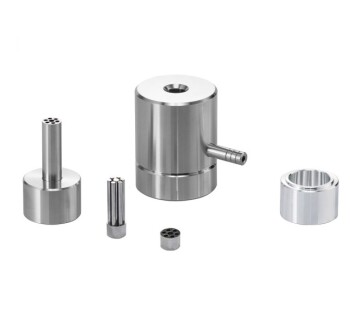
High-strength graphite molds serve as the critical interface between the machinery and the material during the vacuum hot press sintering of CuW30 (Copper-Tungsten) composites. They function primarily as a structural vessel to define the billet's geometry and as an active transmission medium, transferring mechanical pressures of approximately 30 MPa from the hydraulic system directly to the powder to force densification.
Core Insight While most molds simply hold a shape, high-strength graphite molds in this process are active tools for densification. Their ability to maintain structural rigidity under extreme pressure and heat allows them to squeeze porosity out of the CuW30 mixture without chemically contaminating the composite.
The Mechanics of Densification
Transmitting Uniaxial Pressure
The primary engineering function of the mold is pressure transmission. In vacuum hot pressing, the hydraulic system applies force to the mold plungers, not directly to the loose powder.
The graphite mold must withstand significant mechanical loads—specifically around 30 MPa for CuW30 applications—without cracking or deforming. It transfers this uniaxial force to the powder bed, promoting particle rearrangement and plastic deformation. This mechanism is essential for achieving near-theoretical density in the final composite.
Defining Geometric Precision
The mold acts as the containment vessel that dictates the final net shape of the CuW30 billet.
Because the powder behaves like a fluid under high pressure and temperature, the mold walls must remain rigid. Any deformation in the mold walls would result in dimensional inaccuracies in the sintered part. High-strength graphite ensures the billet retains precise tolerances throughout the thermal cycle.
Material Compatibility and Stability
Chemical Inertness
A critical requirement for processing Copper-Tungsten (CuW30) is purity. The mold material must not react adversely with the composite components.
High-strength graphite provides a stable environment that avoids harmful chemical reactions with the CuW30 mixture. It acts as a barrier, preventing the diffusion of impurities from the furnace environment into the billet, ensuring the metallurgical integrity of the copper and tungsten phases.
High-Temperature Structural Integrity
Vacuum hot pressing exposes materials to temperatures where most metals would soften or melt.
Graphite is unique because its strength actually increases with temperature up to approximately 2500°C. This allows the mold to maintain its mechanical properties and containment capabilities at the specific sintering temperatures required for CuW30, ensuring safety and reliability during the process.
Thermal Performance Roles
Facilitating Uniform Heating
While the primary reference focuses on pressure, the supplementary context highlights graphite's role in thermal management.
Graphite possesses excellent thermal conductivity. This property allows the mold to transfer heat rapidly and uniformly from the heating elements to the CuW30 powder. Uniform heating is vital for preventing thermal gradients, which could lead to uneven densification or warping of the composite material.
Understanding the Trade-offs
The Risk of Oxidation
While graphite is excellent in a vacuum, it is highly susceptible to oxidation.
If the vacuum integrity is compromised or if oxygen is introduced at high temperatures (typically above 400°C), the graphite mold will degrade rapidly, turning into carbon dioxide. This requires strict atmosphere control to prevent mold failure.
Mechanical Wear and Lifespan
Despite being "high-strength," graphite is brittle and susceptible to abrasive wear.
Repeated loading and unloading of abrasive tungsten powders, combined with the high pressures (30 MPa), creates friction that eventually erodes the mold walls. This limits the lifecycle of a single mold compared to metal dies used in lower-temperature processes, necessitating regular replacement to maintain dimensional tolerance.
Making the Right Choice for Your Goal
To maximize the quality of your CuW30 composites, align your mold selection with your specific sintering objectives:
- If your primary focus is Maximum Density: Ensure the graphite grade chosen has a compressive strength significantly higher than the 30 MPa processing pressure to prevent wall deflection.
- If your primary focus is Dimensional Accuracy: Prioritize graphite with high density and fine grain structure to minimize erosion and maintain precise shape definition over multiple cycles.
- If your primary focus is Material Purity: Verify the ash content of the graphite allows for chemical inertness to prevent carbon contamination at the billet surface.
The success of your sintering run depends not just on the powder, but on the structural and thermal reliability of the graphite containment system.
Summary Table:
| Function | Key Role in CuW30 Sintering | Performance Metric |
|---|---|---|
| Pressure Transmission | Directs force to powder to eliminate porosity | ~30 MPa Capacity |
| Geometric Precision | Defines net shape and maintains tolerances | High Structural Rigidity |
| Chemical Stability | Prevents contamination and metallurgical reactions | Inert Environment |
| Thermal Management | Ensures uniform heat distribution across the billet | High Conductivity |
| Heat Resistance | Maintains integrity at extreme sintering temperatures | Stable up to 2500°C |
Elevate Your Material Synthesis with KINTEK Precision
Achieving near-theoretical density in CuW30 composites requires the perfect balance of pressure, temperature, and containment. KINTEK specializes in advanced laboratory equipment designed to meet these rigorous engineering standards.
Our extensive portfolio includes:
- High-Temperature Furnaces: Vacuum, muffle, tube, CVD/PECVD/MPCVD, and induction melting systems.
- Advanced Pressing Solutions: Vacuum hot presses, hydraulic pellet presses, and isostatic presses for superior densification.
- Specialized Lab Tools: High-pressure reactors, autoclaves, electrolytic cells, and cooling solutions (ULT freezers, freeze dryers).
- Essential Consumables: High-purity graphite molds, ceramic crucibles, and PTFE products.
Don't let equipment limitations compromise your material integrity. Let our experts help you select the right high-strength systems for your research and production needs.
Ready to optimize your sintering process? Contact us today to request a quote or technical consultation!
Related Products
- 2200 ℃ Graphite Vacuum Heat Treat Furnace
- Ultra-High Temperature Graphite Vacuum Graphitization Furnace
- Vacuum Heat Treat and Molybdenum Wire Sintering Furnace for Vacuum Sintering
- Vacuum Heat Treat and Pressure Sintering Furnace for High Temperature Applications
- 600T Vacuum Induction Hot Press Furnace for Heat Treat and Sintering
People Also Ask
- How does heat transmit in a vacuum? Mastering Thermal Radiation for Purity & Precision
- What is the process of vacuum heat treating? Achieve Superior Hardening with a Clean, Bright Finish
- Why do you heat treat in a vacuum? Achieve Perfect Surface Finish and Material Integrity
- How does a vacuum heat treat furnace work? Achieve Pristine, Oxide-Free Metal Parts
- What is graphite heating? A Guide to Durable, High-Temp Industrial Furnace Solutions