Knowledge What function does a laboratory hydraulic press perform for sulfide electrolytes? Achieve 90%+ Densification Today
Author avatar

Tech Team · Kintek Solution

Updated 2 days ago

What function does a laboratory hydraulic press perform for sulfide electrolytes? Achieve 90%+ Densification Today


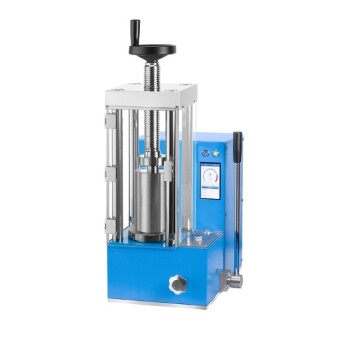
A laboratory hydraulic press serves as the primary engine for room-temperature pressure sintering in sulfide electrolytes. By applying high uniaxial pressure (often around 360 MPa), the press forces sulfide glass particles to undergo plastic deformation. Because these particles possess high ductility and low binding energy, the mechanical force fuses them together, effectively eliminating inter-particle voids and creating dense, conductive pellets without the application of heat.

Core Takeaway: The hydraulic press acts as a substitute for thermal kilns in sulfide processing. It leverages the unique ductility of sulfide materials to achieve high densification (>90%) and conductivity through mechanical force alone, avoiding the chemical degradation often caused by high-temperature sintering.

The Mechanics of Cold Densification

Plastic Deformation

The fundamental mechanism at work is plastic deformation. Unlike brittle ceramics that require heat to fuse, sulfide glass particles are soft and ductile.

When the hydraulic press applies uniaxial pressure, the particles physically deform and change shape.

Void Elimination

As the particles deform, they fill the empty spaces (voids) between them.

This process eliminates porosity, which is the primary barrier to ionic conductivity.

Achieving High Density

The result of this pressure-driven fusion is a pellet with a relative density exceeding 90%.

This high density is critical for creating a continuous pathway for ions to travel, resulting in a high-conductivity solid-state electrolyte.

Advanced Application: Multi-Layer Fabrication

Stepwise Pressing for Composites

For advanced battery designs, the hydraulic press is used to create tri-layer composite electrolytes.

This involves a stepwise pressing process. Individual layers are pre-pressed at low pressure, followed by a final co-pressing of the entire assembly at high pressure.

Functional Integration

This technique allows researchers to integrate different materials into a single pellet.

For example, an inner layer can be optimized for high ionic conductivity, while outer layers are chosen for chemical stability against the anode or cathode.

Interfacial Bonding

The immense pressure ensures tight physical contact between these distinct layers.

Strong interfacial bonding is essential to inhibit the growth of metal dendrites, which are a common cause of failure in solid-state batteries.

Operational Nuances and Requirements

The Necessity of Massive Pressure

While this process avoids high heat, it demands significant mechanical force.

The press must be capable of delivering hundreds of megapascals (MPa). This massive pressure is non-negotiable for promoting the dense particle packing required for efficient ion transport.

Material Specificity

It is important to note that this "cold" densification is highly specific to the material properties of sulfides.

The process relies entirely on the low binding energy and ductility of sulfide glass. Harder ceramic materials would require the introduction of heat or solvents (such as in the Cold Sintering Process at ~150°C) to achieve similar results via pressure solution creep.

Making the Right Choice for Your Goal

The way you utilize the hydraulic press depends on the specific performance metrics you are targeting for your solid-state battery project.

  • If your primary focus is maximizing ionic conductivity: Prioritize applying the highest safe uniaxial pressure (e.g., 360 MPa) to a single layer of sulfide glass to maximize density and eliminate voids.
  • If your primary focus is battery longevity and safety: Implement a stepwise pressing protocol to fabricate multi-layer composites, ensuring stable interfaces that resist dendrite penetration.

By mastering the pressure parameters of the hydraulic press, you unlock the ability to process high-performance sulfide electrolytes at room temperature.

Summary Table:

Process Feature Mechanical Impact on Sulfide Electrolytes Benefit to Battery Performance
Plastic Deformation Particles fuse via ductility and low binding energy Eliminates inter-particle voids without heat
High Uniaxial Pressure Typically applied at ~360 MPa Achievement of >90% relative density
Stepwise Pressing Sequential layering of composite materials Enhanced interfacial bonding & dendrite inhibition
Cold Sintering Room-temperature mechanical densification Prevents chemical degradation from high-temp kilns

Maximize Your Battery Research Precision with KINTEK

Unlock the full potential of your solid-state electrolyte research with KINTEK’s high-performance laboratory hydraulic presses. Whether you are targeting maximum ionic conductivity through extreme densification or engineering complex multi-layer composites, our robust pellet, hot, and isostatic presses provide the exact mechanical force needed for superior results.

From high-temperature furnaces and CVD systems to specialized battery research tools, electrolytic cells, and high-pressure reactors, KINTEK is your partner in laboratory excellence. Our precision-engineered equipment ensures your sulfide glass electrolytes achieve the density and stability required for next-generation energy storage.

Ready to elevate your material synthesis? Contact KINTEK today to find the perfect pressing solution for your lab!

Related Products

People Also Ask

Related Products

Laboratory Hydraulic Press Lab Pellet Press Machine for Glove Box

Laboratory Hydraulic Press Lab Pellet Press Machine for Glove Box

Controlled environment lab press machine for glove box. Specialized equipment for material pressing and shaping with high precision digital pressure gauge.

Automatic Laboratory Hydraulic Pellet Press Machine for Lab Use

Automatic Laboratory Hydraulic Pellet Press Machine for Lab Use

Experience efficient sample preparation with our Automatic Lab Press Machine. Ideal for material research, pharmacy, ceramics, and more. Features a compact size and hydraulic press functionality with heating plates. Available in various sizes.

Automatic Lab Cold Isostatic Press CIP Machine Cold Isostatic Pressing

Automatic Lab Cold Isostatic Press CIP Machine Cold Isostatic Pressing

Efficiently prepare samples with our Automatic Lab Cold Isostatic Press. Widely used in material research, pharmacy, and electronic industries. Provides greater flexibility and control compared to electric CIPs.

Electric Split Lab Cold Isostatic Press CIP Machine for Cold Isostatic Pressing

Electric Split Lab Cold Isostatic Press CIP Machine for Cold Isostatic Pressing

Split cold isostatic presses are capable of providing higher pressures, making them suitable for testing applications that require high pressure levels.

Manual Heated Hydraulic Press Machine with Heated Plates for Laboratory Hot Press

Manual Heated Hydraulic Press Machine with Heated Plates for Laboratory Hot Press

The Manual Heat Press is a versatile piece of equipment suitable for a variety of applications, operated by a manual hydraulic system that applies controlled pressure and heat to the material placed on the piston.

Automatic Heated Hydraulic Press Machine with Heated Plates for Laboratory Hot Press 25T 30T 50T

Automatic Heated Hydraulic Press Machine with Heated Plates for Laboratory Hot Press 25T 30T 50T

Efficiently prepare your samples with our Automatic Heated Lab Press. With a pressure range up to 50T and precise control, it's perfect for various industries.

Heated Hydraulic Press Machine with Integrated Manual Heated Plates for Lab Use

Heated Hydraulic Press Machine with Integrated Manual Heated Plates for Lab Use

Efficiently process heat-pressing samples with our Integrated Manual Heated Lab Press. With a heating range up to 500°C, it's perfect for various industries.

Single Punch Electric Tablet Press Machine Laboratory Powder Tablet Punching TDP Tablet Press

Single Punch Electric Tablet Press Machine Laboratory Powder Tablet Punching TDP Tablet Press

The single-punch electric tablet press is a laboratory-scale tablet press suitable for corporate laboratories in pharmaceutical, chemical, food, metallurgical and other industries.

Manual High Temperature Heated Hydraulic Press Machine with Heated Plates for Lab

Manual High Temperature Heated Hydraulic Press Machine with Heated Plates for Lab

The High Temperature Hot Press is a machine specifically designed for pressing, sintering and processing materials in a high temperature environment. It is capable of operating in the range of hundreds of degrees Celsius to thousands of degrees Celsius for a variety of high temperature process requirements.

Single Punch Electric Tablet Press Machine TDP Tablet Punching Machine

Single Punch Electric Tablet Press Machine TDP Tablet Punching Machine

The electric tablet punching machine is a laboratory equipment designed for pressing various granular and powdery raw materials into discs and other geometric shapes. It is commonly used in pharmaceutical, healthcare products, food, and other industries for small batch production and processing. The machine is compact, lightweight, and easy to operate, making it suitable for use in clinics, schools, laboratories, and research units.

Rubber Vulcanizer Vulcanizing Machine Plate Vulcanizing Press for Lab

Rubber Vulcanizer Vulcanizing Machine Plate Vulcanizing Press for Lab

The Plate vulcanizing press is a kind of equipment used in the production of rubber products, mainly used for the vulcanization of rubber products. Vulcanization is a key step in rubber processing.

Single Punch Tablet Press Machine and Mass Production Rotary Tablet Punching Machine for TDP

Single Punch Tablet Press Machine and Mass Production Rotary Tablet Punching Machine for TDP

Rotary tablet punching machine is an automatic rotating and continuous tableting machine. It is mainly used for tablet manufacturing in the pharmaceutical industry, and is also suitable for industrial sectors such as food, chemicals, batteries, electronics, ceramics, etc. to compress granular raw materials into tablets.

Automatic High Temperature Heated Hydraulic Press Machine with Heated Plates for Lab

Automatic High Temperature Heated Hydraulic Press Machine with Heated Plates for Lab

The High Temperature Hot Press is a machine specifically designed for pressing, sintering and processing materials in a high temperature environment. It is capable of operating in the range of hundreds of degrees Celsius to thousands of degrees Celsius for a variety of high temperature process requirements.

Metallographic Specimen Mounting Machine for Laboratory Materials and Analysis

Metallographic Specimen Mounting Machine for Laboratory Materials and Analysis

Precision metallographic mounting machines for labs—automated, versatile, and efficient. Ideal for sample prep in research and quality control. Contact KINTEK today!

Laboratory Test Sieves and Vibratory Sieve Shaker Machine

Laboratory Test Sieves and Vibratory Sieve Shaker Machine

Efficiently process powders, granules, and small blocks with a high-frequency vibration sieve. Control vibration frequency, screen continuously or intermittently, and achieve accurate particle size determination, separation, and classification.

Vacuum Hot Press Furnace Machine for Lamination and Heating

Vacuum Hot Press Furnace Machine for Lamination and Heating

Experience clean and precise lamination with Vacuum Lamination Press. Perfect for wafer bonding, thin-film transformations, and LCP lamination. Order now!

Small Lab Rubber Calendering Machine

Small Lab Rubber Calendering Machine

Small lab rubber calendering machine is used for producing thin, continuous sheets of plastic or rubber materials. It is commonly employed in laboratories, small-scale production facilities, and prototyping environments to create films, coatings, and laminates with precise thickness and surface finish.

Laboratory Sterilizer Lab Autoclave Herbal Powder Sterilization Machine for Plant

Laboratory Sterilizer Lab Autoclave Herbal Powder Sterilization Machine for Plant

The herbal powder sterilization autoclave machine for Chinese medicine uses saturated steam for effective sterilization. It utilizes the heat and penetrative properties of steam, achieves sterilization after heat preservation, and maintains a good drying effect with a dedicated drying system.

Small Injection Molding Machine for Lab Use

Small Injection Molding Machine for Lab Use

The small injection molding machinehas fast and stable movements; good controllability and repeatability, super energy saving; the product can be automatically dropped and formed; the machine body is low, convenient for feeding, easy to maintain, and no height restrictions on the installation site.

Lab Internal Rubber Mixer Rubber Kneader Machine for Mixing and Kneading

Lab Internal Rubber Mixer Rubber Kneader Machine for Mixing and Kneading

Lab internal rubber mixer is suitable for mixing, kneading and dispersing various chemical raw materials such as plastics, rubber, synthetic rubber, hot melt adhesive and various low-viscosity materials.


Leave Your Message